

City Unveils Plan to Curb Grocery Store Closures
Grant program would help cover costs; proposed ordinance aims to attract new stores.
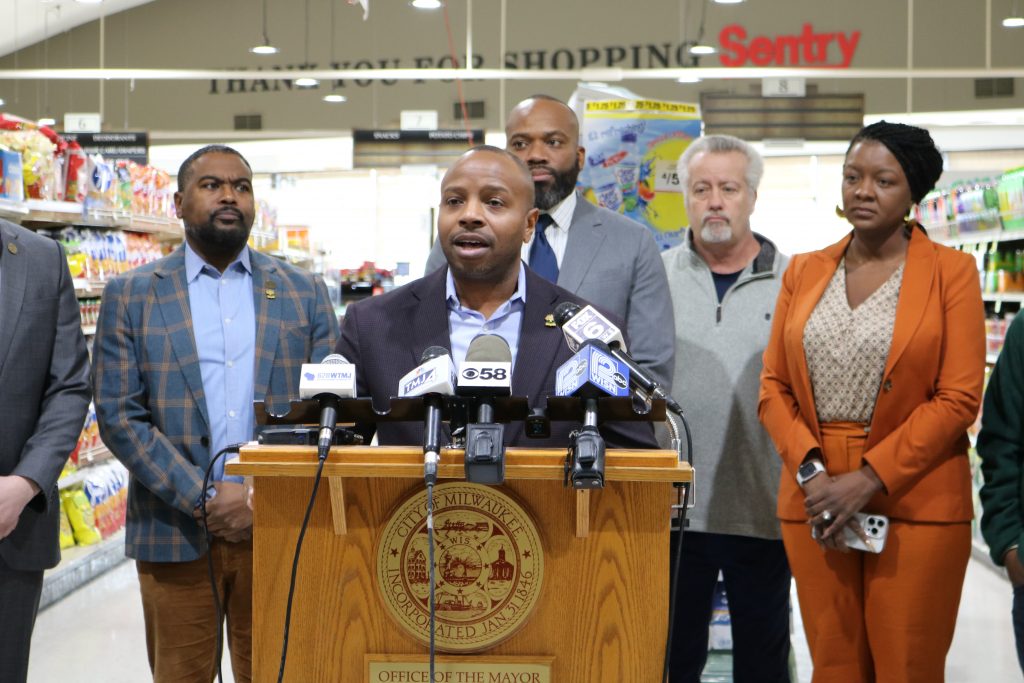
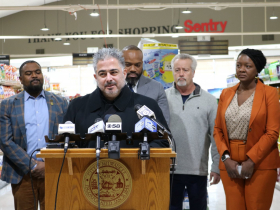
Mayor Cavalier Johnson speaks during a press conference on food accessibility in Milwaukee. Photo taken Feb. 9, 2026 by Sophie Bolich.
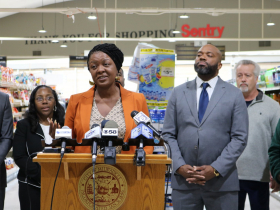
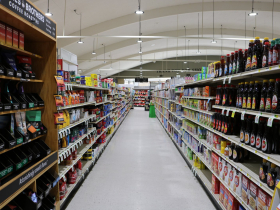
City officials gathered Monday morning in the central aisle of Sentry Foods to discuss a series of initiatives aimed at addressing food insecurity, supporting grocers and attracting new retailers to Milwaukee.
Fresh food accessibility has seen increased attention at City Hall amid a pattern of grocery store and pharmacy closures, many of which came with little advance notice.
In response, representatives from the Milwaukee Common Council, Department of City Development and Milwaukee Health Department are partnering with the mayor’s office to launch a grant program to help grocers cover capital expenses, invest in equipment, meet payroll and manage operating costs in hopes of preventing additional shutdowns.
The effort would reallocate about $1 million from the Large Impact Development Fund, or LID, with additional channels for contribution still in talks, said Mayor Cavalier Johnson.
“Grocery store closures continue to be a problem across the city, and we have been leveraging partnerships in order to stem the current wave of closures,” said Johnson, who hosted a roundtable with local operators earlier this month. He said costs associated with equipment upgrades emerged as a key concern during the conversation. “Those are big issues, especially for grocery stores that run on thin margins.”
Johnson spoke from a podium inside the northwest-side grocery store, at 9210 W. Lisbon Ave., as shoppers filled their carts nearby. Sentry will be among the first to receive a grant, with $25,000 earmarked for a new refrigeration system.
The city’s plan also includes legislation that would require store operators to provide two months’ notice before closing a store.
Alderpersons Andrea Pratt and Russell W. Stamper II are advancing legislation that declares “food apartheid” a public health and economic emergency and would require store owners to issue a 60-day closure notice to city officials, who would in turn implement a 30-day intervention period to attempt to keep the business open. If no solutions arise, the public would be notified 30 days before the closure.
“When large retailers leave without warning, neighborhoods pay the price,” Pratt said. “Access to fresh, affordable food is disappearing block by block. This is not the failure of individual families, it’s a systems issue and it demands a public response.”
The requirement applies to all food dealers, including pharmacies like Walgreens. It’s part of an attempt to prevent unexpected closures, such as Pick ‘n Save’s exit from five Milwaukee-area stores last summer, one of which was located in Stamper’s district.
“Corporate disinvestment continues to treat central-city neighborhoods as optional,” Stamper said, noting that the closure “sent a painful message” to residents. “I listened to elders who take two buses to get to the grocery store. I walked with families traveling miles for fresh food and prescriptions.”
The alders are also co-sponsors of a proposed ordinance authored by Milele A. Coggs directing the Department of City Development (DCD) and Milwaukee Health Department to develop strategies for attracting and retaining grocery stores and pharmacies in Milwaukee.
“This is not about blame, it’s about responsibility,” Stamper said. “We want those who are committed to serve our community, our neighbors, to stay right here. We want businesses like Sentry Foods to thrive and we want to see that the heart of Milwaukee, our central city, has quality groceries and pharmacies, not by chance, but by design.”
In the interim, city leaders aim to fill gaps by helping neighborhood food pantries expand their reach through refrigeration upgrades and more frequent distribution.
Donations from Palermo’s Pizza would support that effort. The Milwaukee-based company is working with local food pantries to identify areas of highest need and has agreed to donate pizzas for weekly giveaways, with specific locations to be announced shortly, said Giacomo Fallucca, chairman and CEO of Palermo’s.
DCD Commissioner Lafayette Crump, Alderwoman Larresa Taylor, Milwaukee Health Commissioner Michael Totoraitis, a representative from Alderman Lamont Westmoreland‘s office and Sherman Park Grocery owner Maurice “Moe” Wince were also in attendance at the press conference.
Johnson said the plan presented Monday isn’t a substitute for long-term solutions. In addition to immediate actions, the city will create an interdepartmental task force to explore innovative approaches to food access, with possible recommendations including community grocers, urban agriculture and mobile food markets.
Beyond simple cash flow, retailers such as Sherman Park Grocery have struggled with costly repairs, theft and last fall’s government shutdown, which temporarily interrupted FoodShare benefits. “Many of these stores took a significant hit during that time that they still haven’t caught up from,” Johnson said of the shutdown.
“There are trends that affect every grocer, but one that we can have a direct impact on right now in the short term is working to make sure that we … open up some money for them to make investments in their stores, keep their staff, keep the lights on and keep the doors open.”
“Closure is that what we’re trying to prevent from happening, and so this is going to take a lot of work.”
Photos
If you think stories like this are important, become a member of Urban Milwaukee and help support real, independent journalism. Plus you get some cool added benefits.
Political Contributions Tracker
Displaying political contributions between people mentioned in this story. Learn more.
- April 22, 2019 - Cavalier Johnson received $50 from Lafayette Crump
- February 16, 2016 - Milele A. Coggs received $50 from Lafayette Crump
- February 13, 2016 - Milele A. Coggs received $10 from Larresa Taylor
- July 20, 2015 - Russell W. Stamper, II received $50 from Lafayette Crump




















A critical need, but we can’t be subsidizing huge conglomerates who will take our money and still flee the affected neighborhoods. How bout working with locals like Outpost Natural Food CO-OP to make their healthier food affordable for everyone? El Rey is another local business that has been very successful in serving the food needs of the community.
Not liking the idea of subsidizing huge business.
Instead of subsidizing a business we should just have government run grocery stores in food deserts. The Chicago mayor promised this but backed down. Mamdani did too, so we’ll see what he does in NYC, and if it can be successfully copied here.
Robinson Patman Act of 1936 (from Wikipedia)
“The Robinson–Patman Act (RPA) of 1936 is a United States federal law that prohibits anticompetitive practices by producers, specifically price discrimination.
Co-sponsored by Senator Joseph T. Robinson (D-AR) and Representative Wright Patman (D-TX), it was designed to protect small retail shops against competition from chain stores by fixing a minimum price for retail products. Specifically, the law prevents suppliers, wholesalers, or manufacturers from supplying goods to “preferred customers” at a reduced price. It also prevents coercing suppliers into restrictions as to whom they can and can’t sell goods. This means that it is illegal for a supplier to sell one truckload of goods at a steep discount to a large business, such as Walmart or Amazon, and then charge a substantially higher price for a truckload of identical goods to a small business, such as a local grocery store.
Enforcement of the RPA’s provisions began to decline beginning in the 1980s”. (I guess you could say it “started to decline” but you could also say politicians aren’t enforcing the law anymore).
So I don’t know if it is a “cure all” but enforcing the CURRENT law at a federal level might help smaller grocers complete. I also read that New York state lawmakers are working on a state version of the “RPA”, maybe WI could? (ha-ha).
Could also get into the Sherman Anti Trust Act or raising the minimum wage as solutions to food deserts, but why bother when you can fight over transgender bathrooms or Super Bowl halftime entertainment?
I agree, we should not be using taxpayer money to bribe the Kroger’s, Walmart’s, Target’s and Albertson’s to keep stores in Milwaukee. The city could bring together local grocers’ and ethnic food markets along with consumers to create a solution that meetings everyone’s needs. There is an abundance of local resources and ideas. Milwaukee does not have to accept the mandates of corporate offices hundreds of miles away.
Perhaps if the entitled culture could be educated that not every business has the lax standards of MCTS which encourages fare evasion, this problem would not be as large as it is. I suggest these stores are closing because of the large amounts of theft. No business can stay afloat without making a profit, no matter how small. Why isn’t education of the community addressed? You don’t walk into a store unless you can afford to purchase your needs/wants.
It’s time this entitled culture be addressed and re-educated. You don’t walk into a store and take anything you want without paying. Children used to be taught that. It’s time it be taught again in school. If you are hungry and can’t afford food, go to a food pantry while folks are still donating to them. Or go to St. Ben’s for a warm, nourishing meal nightly.
I am dependent on MCTS and have never evaded a fare. My thanks? Raising the daily cap from $5 to $8 per day, The sad thing is, most of these fare evaders can afford to pay, but they know they can get away with it.
;