‘No Other Choice’ Is Comic, Gruesome Revenge Tale
Potent Korean film based on 1950s American story getting Oscar talk.
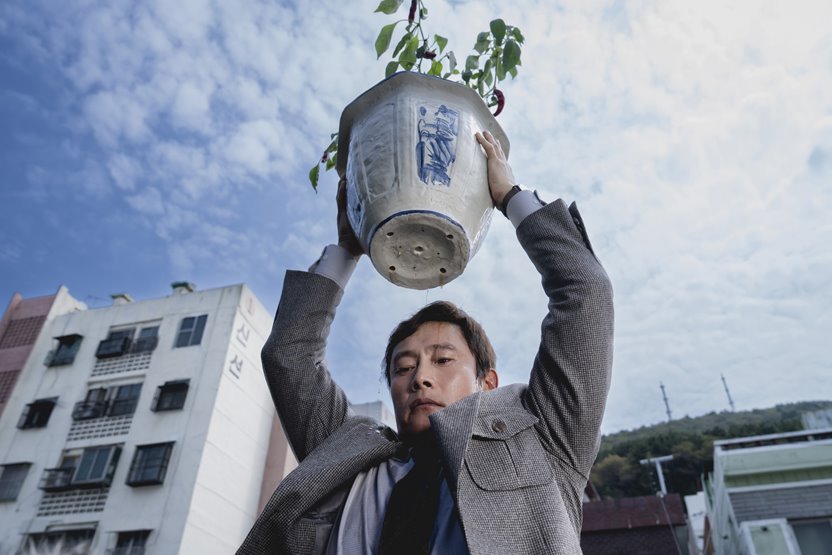
Lee Byung-hun in a pivotal moment from No Other Choice. Photo courtesy of Milwaukee Film.
The story has a universal resonance: a hard-working 25-year employee rising from blue-collar worker to manager, finally able to afford his own carefully cultivated home for his wife and two children, then suddenly thrown into the dust by the company he devoted his life to.
The worker handles it all well: therapy sessions, a secondary job, selling his family’s pet dogs, his wife handling his loss of house and income, and meanwhile his paper mill industry insulting him in small ways until his subdued anger snaps. His mantra of acceptance turns into a mantra of revenge that is the film’s title: No Other Choice.
What happens then is comic and gruesome, romantic feelings turning into murderous determination. Blow by blow, the pain mounts, to the point that we sympathize with the desire to take action. Hitchcock once advised filmmakers to force audiences to share the guilt with the violent guy, and this is what No Other Choice does.
This is a South Korean film likely to show up at the Oscars both as a nominee for best international film and for best picture, according to insiders.
Curiously, the same pulp paper industry and the same topic started with an American crime fiction writer I have admired since the 1950s, the late Donald Westlake, who wrote screenplays as well as novels under his own name and famous pseudonyms (Richard Stark). His story “The Ax” was previously filmed by Costa-Gavras and is now adapted for No Other Choice by director Park Chan-wook, who dedicated his film to Costa-Gavras.
There is an Asian affinity for American crime fiction exploring the plight of workers rising above their lower beginnings. On Substack, I recently explored how famed Japanese director Akira Kurosawa reached into an Ed McBain pulp crime thriller from the 1950s, only to see director Spike Lee mine the same material in 2025.
For this film, director Park Chan-wook takes the tale into far darker and more macabre territory than the previous outings, bathing the horrifying moments in pratfalls and misfired killings. Our hero worker, popular and masterful South Korean actor Lee Byung-hun, pretends to create a pulp mill consortium to gather résumés of his most likely opponents in the paper mill industry, then stalks them (sometimes clumsily) and embarks on a determined murder spree to enhance his chances of being hired to his previous supervisory position.
His loving and intelligent wife — actress Son Ye-jin, so alive as to almost steal the film — suspects his trauma but strives to protect him. He is a devoted gardener who knows how to entwine miniature bonsai trees — so keep an eye on his greenhouse and his use of wires. The story is located in what we call suburban quarters, but the use of woods and color is cinematically striking.
The sequences of the murders are comic and then traumatic, yet we never lose empathy with the worker, which says something about how many in the audience have gone through the same sense of being tossed in the trash by major corporations. A side benefit of the film is that patrons learn intriguing details about modern pulp paper uses, which become intrinsic to the plot.
The need for subtitles — and the way the excellent music by Cho Young-wuk varies modern sounds, background pop music and Mozart — may challenge some patrons to follow the finale, but the film captures us with the loving family at the start and the emotional escape from responsibility at the end.
Dominique Paul Noth served for decades as film and drama critic, later senior editor for features at the Milwaukee Journal. You’ll find his blog here and here. For his Dom’s Snippets, an unusual family history and memoir, go to domnoth.substack.com.
If you think stories like this are important, become a member of Urban Milwaukee and help support real, independent journalism. Plus you get some cool added benefits.


Movies
-
Oscar-Winning Russian Documentary Takes on Putin
 Mar 21st, 2026 by Dominique Paul Noth
-
Oscar Show Catches Hollywood in Transition
 Mar 16th, 2026 by Dominique Paul Noth
-
Can Film Incentives Turn Wisconsin Into A Movie Hub?
 Mar 10th, 2026 by Sophie Bolich
Review
-
Cosmos Café Is a Hidden Gem
 Mar 28th, 2026 by Cari Taylor-Carlson
-
‘Barefoot in the Park’ Is a Comic Time Capsule
 Mar 23rd, 2026 by Dominique Paul Noth
-
Oscar-Winning Russian Documentary Takes on Putin
Mar 21st, 2026 by Dominique Paul Noth