

Republican Attacks Misleading on State Stewardship Program?
Data shows just 1.13% of all state land conserved by Knowles-Nelson program.
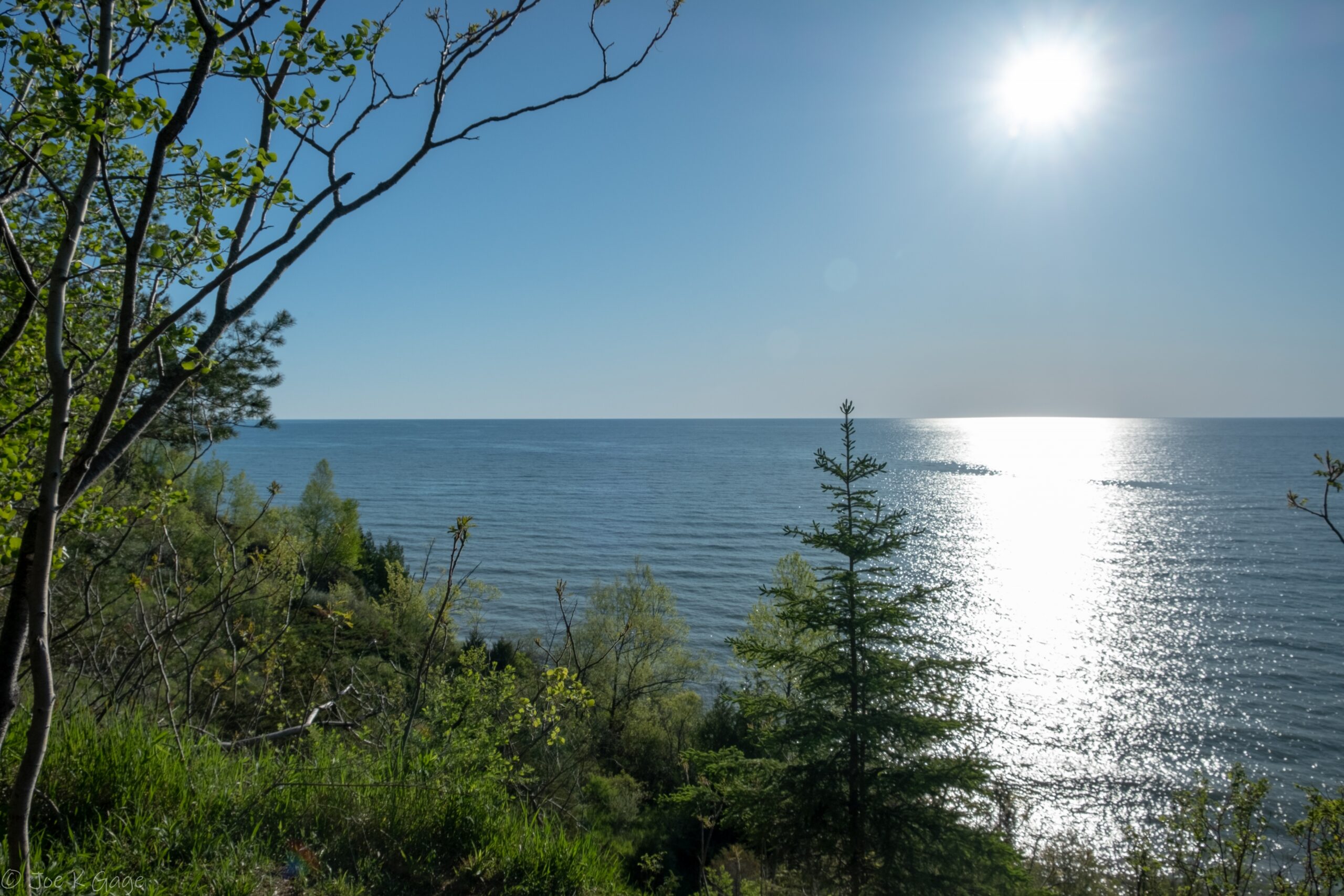
A view of Lake Michigan from Lion’s Den Gorge Nature Preserve near Grafton. The Ozaukee County Park was preserved with funding from the Knowles-Nelson Stewardship Program. Joseph Gage/ CC BY-SA 2.0
At a Wisconsin Assembly committee meeting in November to consider a proposal to extend the widely popular Knowles-Nelson Stewardship Grant program, Rep. Rob Swearingen (R-Rhinelander) complained that too much land in his district has been conserved through the program.
That sentiment has become increasingly common among a subset of Republicans in the Wisconsin Legislature, most of them representing the far northern reaches of the state. The complaint they often make is that Knowles-Nelson has taken too much land off local property tax rolls, depriving already struggling local governments of important revenue.These complaints also go hand-in-hand with laments that the Wisconsin Supreme Court undermined the Legislature’s authority to conduct oversight of the grant program by ruling the Republican-controlled Joint Committee on Finance was unconstitutionally blocking stewardship grant projects proposed by the Department of Natural Resources. These Republicans say that their districts have borne the burden of Wisconsin’s land conservation goals for too long and some of that work should shift to southern parts of the state.
Because of this group’s objections in the Republican legislative caucus, the stewardship program is facing its demise next year.
Popular program hits roadblocks
The Knowles-Nelson program was started in 1989 to fund land conservation in the state. Grants from the program to local governments and non-profits help cover some of the costs for purchasing and conserving land that can be used for recreation, preserving animal habitats and supporting local industries such as forestry. Polls have shown an overwhelming majority of Wisconsinites support the program.
Despite that support, it is set to expire next summer and, so far, legislative efforts to extend the program have failed.
In his initial 2025-27 state budget proposal, Gov. Tony Evers asked to extend the program for ten years with $100 million in annual funding. Republicans stripped that provision from the budget immediately.
Rep. Tony Kurtz (R-Wonewoc) and Sen. Patrick Testin (R-Stevens Point) have authored a bill that would extend the program for four years at $28 million per year. The bill also includes a provision that would require the full Legislature to approve any land purchases that cost more than $1 million — a proposal that critics say would be far too slow for the speed at which real estate transactions need to move.A separate proposal from Sen. Jodi Habush Sinykin (D-Whitefish Bay) would re-authorize the program for six years at $72 million per year and create an independent board made up of members appointed by the Legislature to approve large land purchases through the program.
Separately, Rep. Shae Sortwell (R-Two Rivers) has introduced a proposed constitutional amendment that would require the full Legislature to approve any state spending on land conservation.
Data contradicts lawmakers’ complaints
The complaints that Knowles-Nelson has conserved too much Northwoods land may prove fatal to the program in a Legislature that has been unable to find common ground on environmental issues.
But an analysis of public lands data shows that the Knowles-Nelson program plays a comparatively small role in Wisconsin’s conserved land portfolio. Despite the claims of critics, the program’s land purchases have been made in all corners of the state.
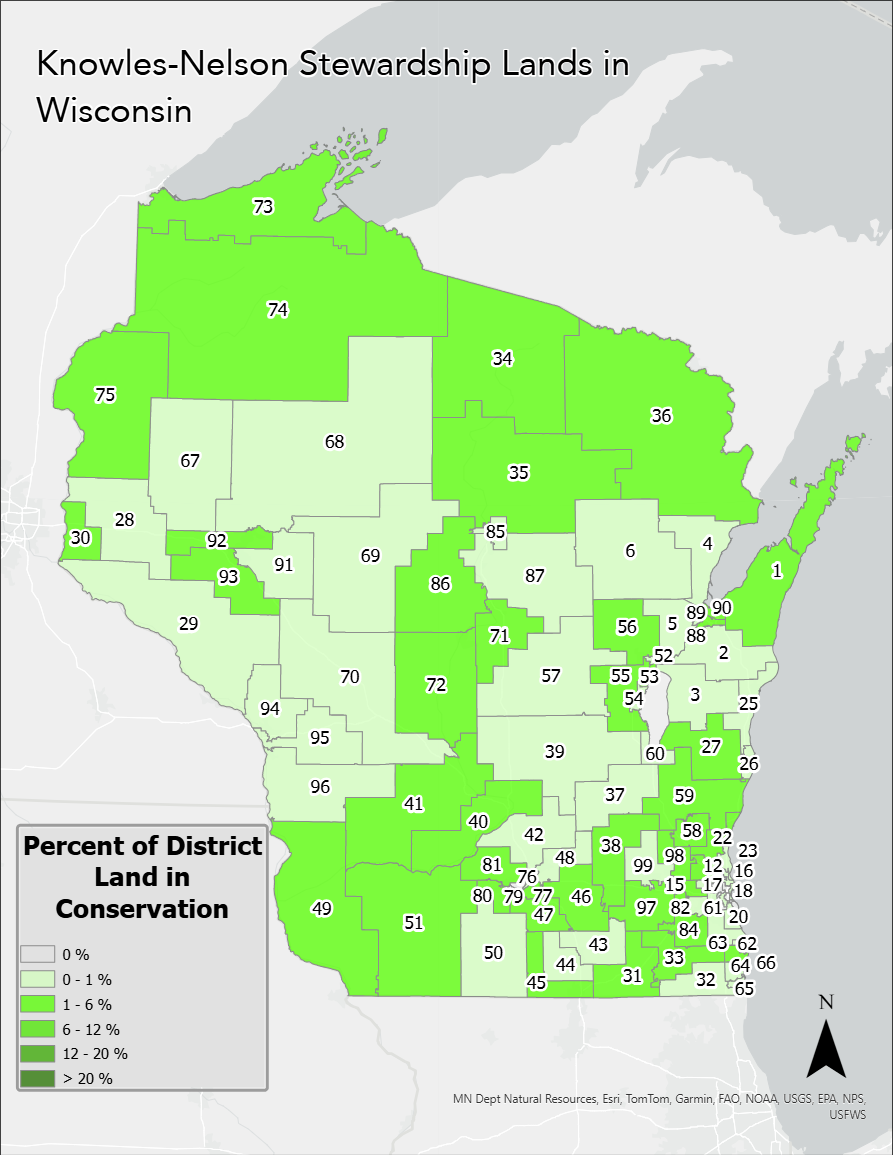
Image from MN Dept Natural Resources.
The program has widespread support, he says.
“Public lands are the prized heritage of Americans, right?” Carlin says. “It’s one of the only things that we just largely agree on as a country, is that we are really proud of our public lands. And this is part of our national identity, and I think it’s certainly part of our Wisconsin identity.”Swearingen’s 34th district, which covers north central Wisconsin from Rhinelander up to the Michigan border, has more land conserved by the DNR than any other district in the state — almost 335,000 acres, nearly 24% of the district. That includes land set aside for state parks, natural areas, forests and similar uses.
But only 4.7% of the district is conserved through Knowles-Nelson. Another 4.6% of his district is conserved by the federal government, and 8.6% is conserved county forest land.
Despite the claims that Knowles-Nelson has devoured valuable land across the state, no Assembly district has had more than 5.1% of its land conserved through the program, data shows. The average amount of Knowles-Nelson conserved land across all 99 Assembly districts is 1.13%.
Many small purchases
Ron Eckstein, a board member of Wisconsin Green Fire, says Knowles-Nelson is best equipped to help the state purchase smaller tracts to connect already conserved land across the southern part of the state.
“Many state fish and wildlife areas, state parks, and state natural areas across the southern two-thirds of Wisconsin have private land inholdings within their property boundaries,” he said in an email.
“It is very important to continue to purchase these inholdings so these state properties can meet their intended purpose: fish and wildlife habitat, rare species, game species, public access, recreation and recreational trails,” Eckstein said. “This means continuing the long-term, slow process of purchasing a 20-acre tract here and an 80-acre tract there to complete these state-owned areas and fulfill their public purpose.”
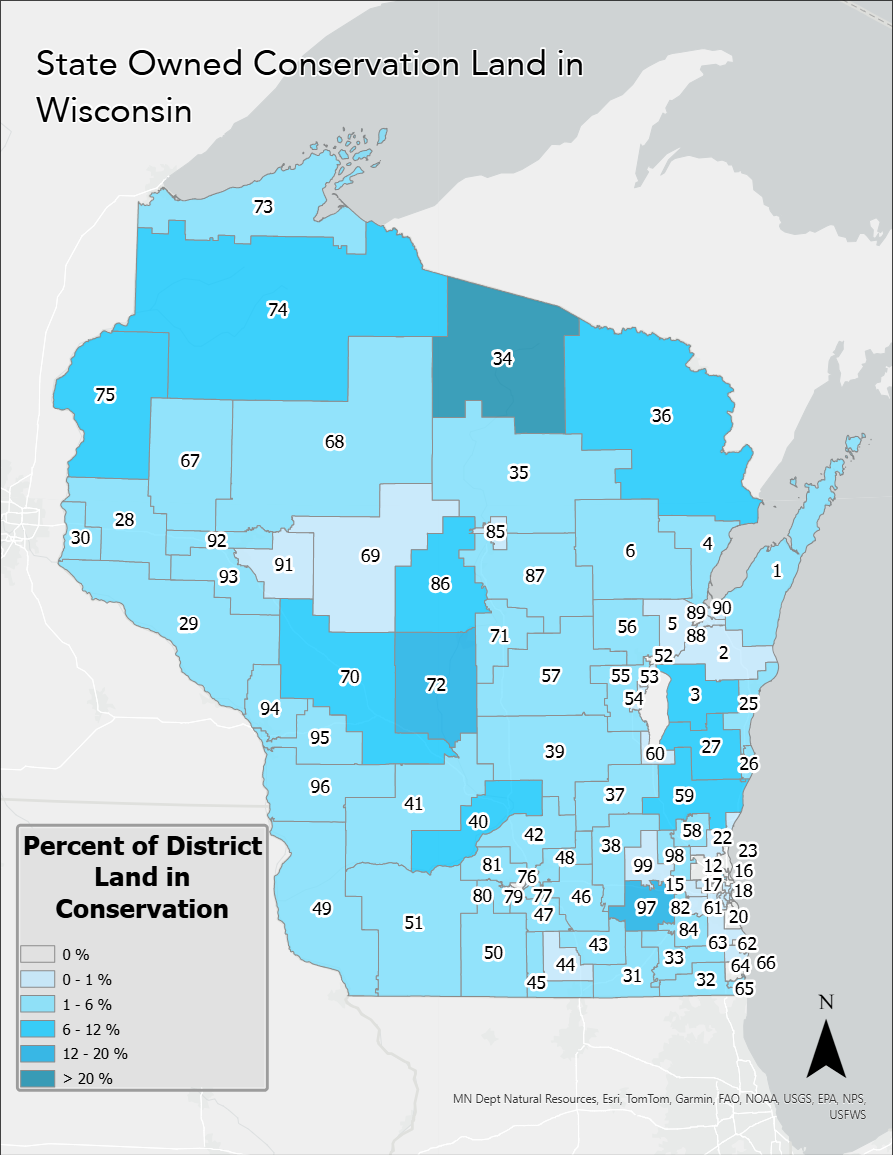
Image from MN Dept Natural Resources.
Other DNR land and federal land take up hundreds of thousands more acres across the state.
The 74th District, represented by Rep. Chanz Green and Sen. Romaine Quinn has the most Knowles-Nelson land at 5.1%. Nearly 11% of the district is other DNR land while 14.5% is federal land and 23.8% is county land.
Twenty Assembly districts have more general DNR conserved land than the 74th has Knowles-Nelson land.Across the five Assembly districts with the most federal land, 1,596,129 acres have been conserved. Across the five districts with the most Knowles-Nelson land, 413,453 acres have been conserved.
The data also contradicts Republican claims that the northern parts of the state unfairly get too much land conservation attention.
The Dane County districts represented by Reps. Mike Bare (D-Verona), Alex Joers (D-Waunakee) and Shelia Stubbs (D-Madison) are all among the 10 districts with the highest percentage of land conserved through Knowles-Nelson. Rep. Karen DeSanto’s Baraboo-area district, Rep. Chuck Wichgers’ suburban Waukesha County district and Rep. Scott Krug’s district south of Stevens Point are also in the top 10.
When divided by dollar amount, Knowles-Nelson is similarly disbursed. Since its inception, $1.2 billion has been given out through the program to all but one of the Assembly districts; the Milwaukee district of Rep. Supreme Moore-Omokunde (D-Milwaukee) is the only district to not receive any money.
The 36th district, represented by Rep. Jeff Mursau (R-Crivitz), has gotten the most of that money — $102 million, which amounts to 7% of the total Knowles-Nelson purchases over the program’s lifetime. But districts have received an average of $13 million through the program.
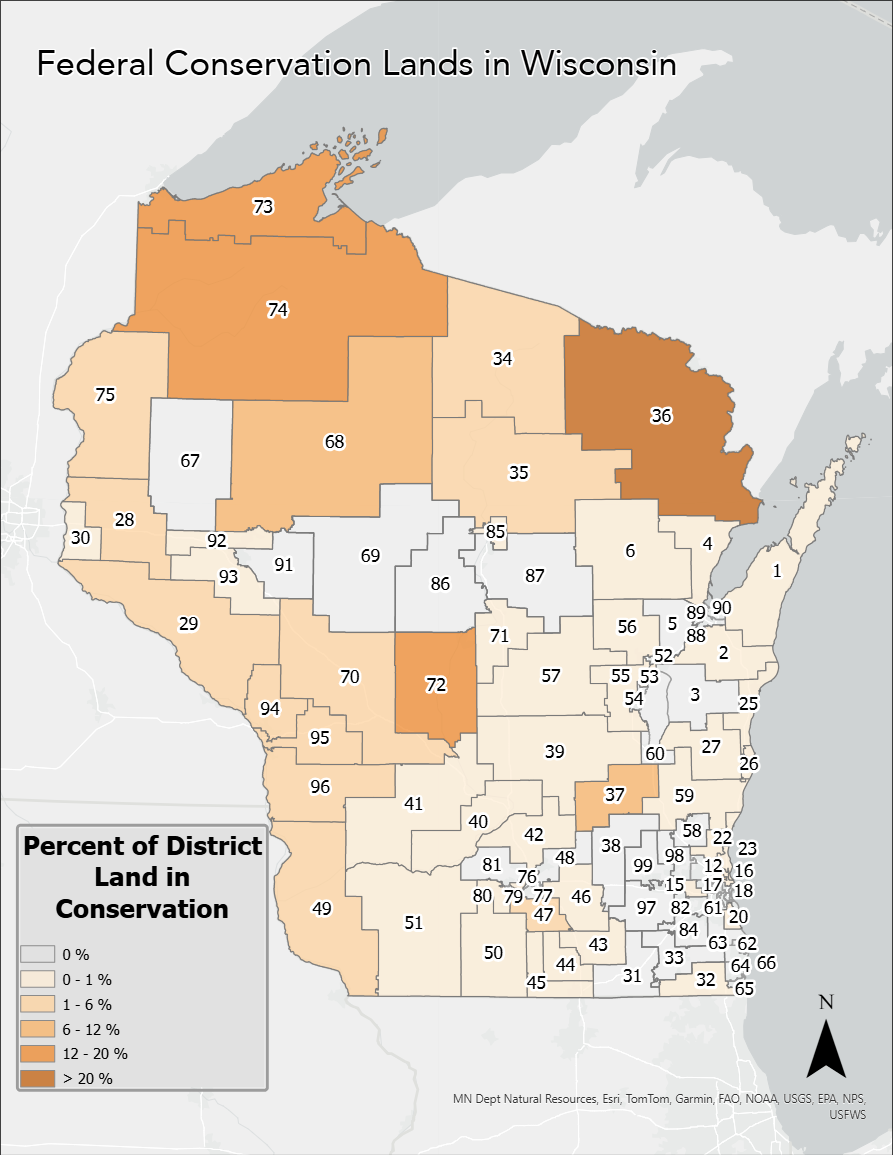
Image from MN Dept Natural Resources.
“While we’ve done some really cool things with Knowles-Nelson, it’s largely been a drop in the bucket of our sort of overall public lands portfolio,” Carlin says. While some critics complain about the state’s total public land portfolio, he adds, “Knowles Nelson investments are really targeted and strategic, and cumulatively not actually that big.”
Republicans defend focusing on Knowles-Nelson because they have limited control over the land conserved by the federal and county governments. Legislators have authority over the program through the biennial budget process and the confirmation of members of the Natural Resources Board, but despite that, have put the stewardship program in the crosshairs.
In the last several years, Republicans on the Legislature’s Joint Finance Committee began using passive review — an anonymous veto system — to selectively block some Knowles-Nelson projects, to the wide condemnation of members of the public and conservation groups. A 2024 state Supreme Court ruling, in a lawsuit filed by Gov. Tony Evers against the committee’s co-chair, Sen. Howard Marklein, found that the “legislative veto” was unconstitutional.
“Until the Evers v. Marklein decision by the liberal Wisconsin Supreme Court, there was a good process in place for new stewardship land purchases,” Sen. Mary Felzkowski (R-Tomahawk) told the Wisconsin Examiner in a statement. “Those checks and balances between the executive branch and the Legislature ensured that it was a collective decision, and that the state did not overpay for stewardship land. Unfortunately, since this process was destroyed, the Legislature is forced to put even more scrutiny on the stewardship program.”
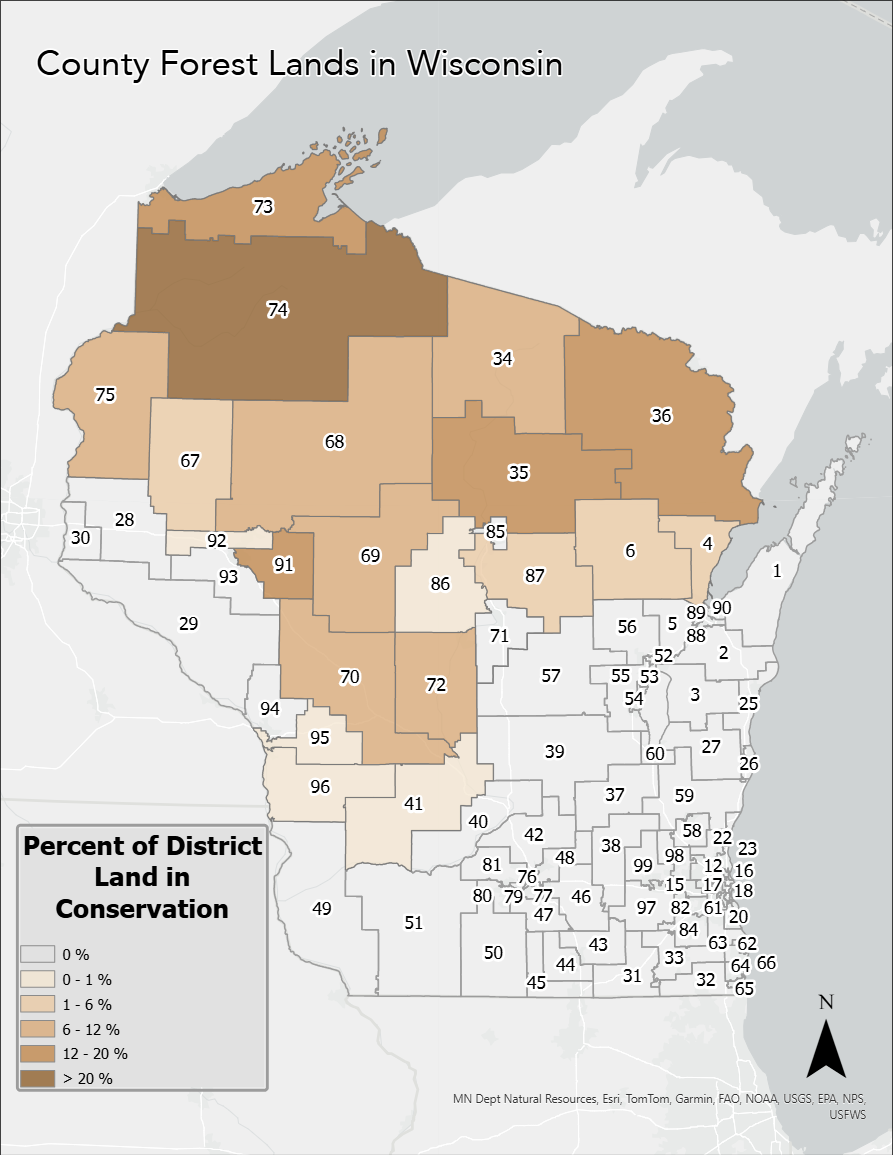
Image from MN Dept Natural Resources.
Carlin says the program has played an important role in helping local governments in more rural parts of the state invest in projects that help the local economy in the long term. Dane County’s recently passed 2026 budget includes $20 million for land conservation, which is not an expense most counties can afford.
“But if collectively, we choose as a state to say this is an important priority, we’re all going to work on this together, then we can make meaningful investments in rural communities that wouldn’t otherwise be able to do it themselves,” Carlin says.
“At a time when there is such incredible inequality of wealth and opportunity,” he adds, “what the data tells us is that Knowles-Nelson has been a really good democratizer of investments in conservation and recreation.”
Republicans attack ‘strawman’ Knowles-Nelson for land conservation was originally published by the Wisconsin Examiner.
If you think stories like this are important, become a member of Urban Milwaukee and help support real, independent journalism. Plus you get some cool added benefits.


















The republicans are extremely short sighted.
Most Wisconsin voters would be at a loss if asked to name at least one Republican initiative that has improved their lives. They continue to the Scott Walker philosophy “What ever it is, I’m against it.”