
Milwaukee’s Financial Strains Growing, Warns Policy Forum
Annual budget analysis says city has made progress, but rising costs and reliance on reserves threaten long-term stability.
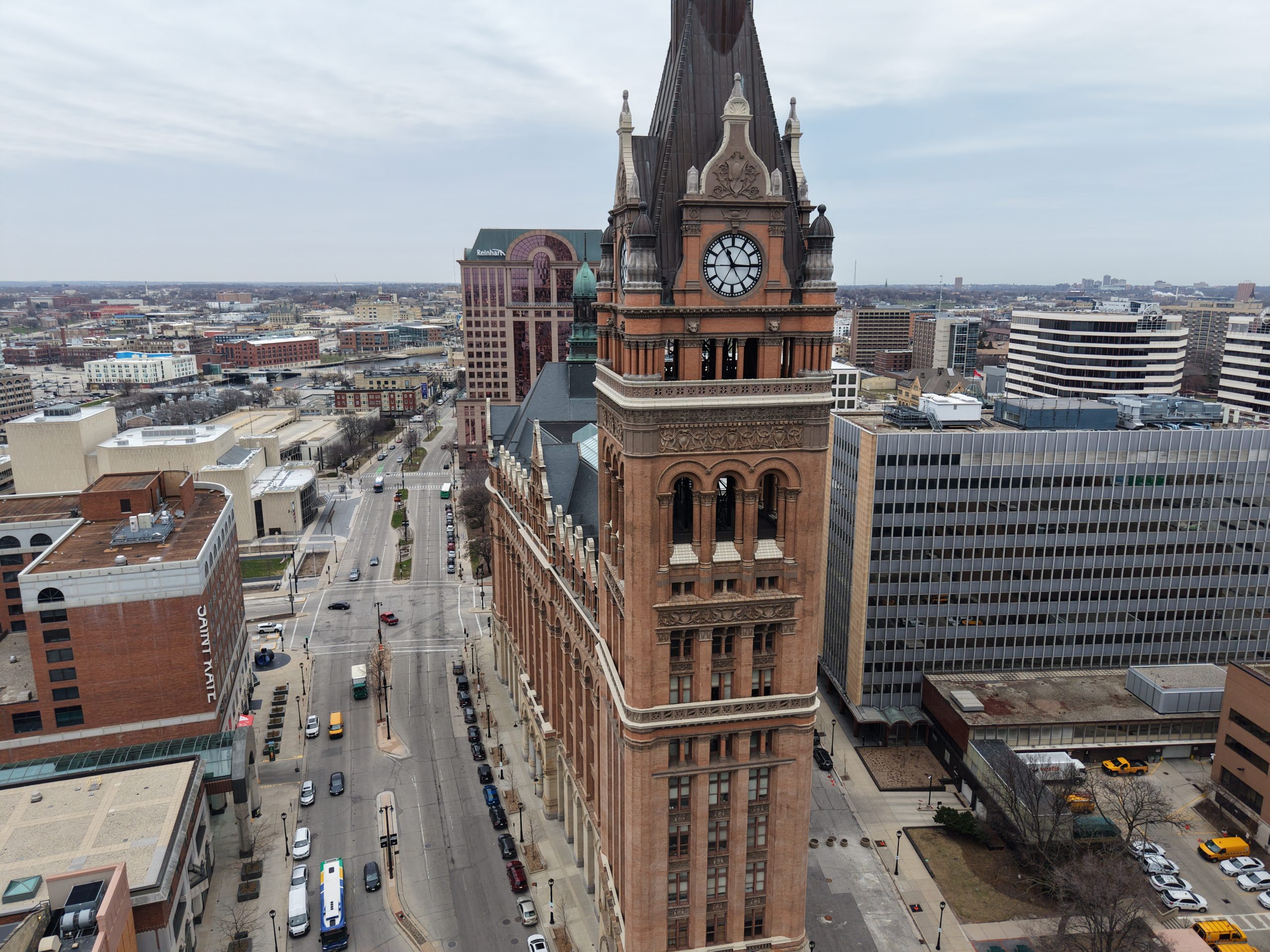
Milwaukee City Hall. Photo by Urban Milwaukee staff.
Milwaukee has made considerable progress in overcoming its financial crisis, but the pressures on city finances are growing again.
That is the conclusion of the Wisconsin Policy Forum‘s (WPF) annual review of the city’s proposed budget.
The 2027 budget proposal from Mayor Cavalier Johnson would avoid layoffs, limit service reductions and hold the property tax levy increase below the rate of inflation. It would also sustain a substantial investment in infrastructure, including a record amount of local funding for street improvements.
But maintaining that stability would require the city to make its largest withdrawals from reserve funds in at least a decade. Meanwhile, the cost of employee compensation, pensions and public safety continues to grow faster than some of the city’s major revenue sources.
“However, the signs of strain on the city’s finances are building and on display in the 2027 budget,” says the report.
A 2022 report from the nonpartisan organization warned that Milwaukee faced a fiscal cliff without changes to state law. The passage of Act 12 in 2023, which authorized a 2% municipal sales tax and increased state aid, helped the city avert major service reductions.
The new revenue has enabled Milwaukee to make progress on its infrastructure needs and meet rising pension obligations. But it came with mandates to increase police and fire staffing and make other changes that will increase costs in the years ahead.
“The city’s overall costs are still growing more rapidly than its revenues, leaving a fundamental imbalance that will grow over time in the absence of action by city or state leaders,” says the report.
Johnson’s proposed $2.26 billion budget started with a $96.8 million gap between departmental spending requests and projected revenue. It would close the gap with $42.8 million in additional reserve withdrawals, $20.5 million in increased revenue projections and $33.5 million in spending reductions.
WPF identifies five keys to understanding the proposed budget: how the city balanced its spending, its growing reliance on reserves, the increasing cost of public safety, pension obligations and the continuation of elevated infrastructure spending.
Reserves Do Heavy Lifting
The mayor’s proposed budget would draw $51.8 million from three reserve funds, the most since at least 2016.
That includes $39.8 million from the Tax Stabilization Fund, $6 million from the Public Debt Amortization Fund and $6 million from the Transportation Fund to support street improvements.
The city’s Tax Stabilization Fund finished 2025 with $79.6 million, its largest balance in decades. The administration proposes withdrawing half that amount to maintain services.
The growing reserve balance has been aided by better-than-anticipated sales tax collections and savings from vacant city positions. But WPF warns those favorable conditions cannot be counted on indefinitely.
“The more the city uses reserve withdrawals to close its fiscal gaps, the more likely it will be to deplete them and have to eventually shift to another strategy,” says the report.
There is one important financial cushion that the city is not proposing to touch.
Milwaukee’s separate pension reserve had $95.2 million as of June 30. WPF says that fund could provide additional stability in 2028 and beyond as other reserves are exhausted.
Public Safety Costs Continue To Rise
Police, fire and emergency communications would account for $542.6 million, or 64% of the city’s general operating budget.
The Milwaukee Police Department would receive a $33.8 million, or 10.9%, spending increase. Part of the increase is tied to retroactive wage payments following approval of a new police union contract.
The department would also add 45.5 full-time equivalent positions, including 34.4 police officer positions and civilian support personnel.
The Milwaukee Fire Department would receive a $7.5 million, or 4.5%, increase and add 19 full-time equivalent positions, including 15 firefighters to staff an additional engine.
But the city has substantial staffing increases still to make under Act 12.
WPF estimates that, even after adoption of the proposed budget, Milwaukee would need to add another 80 sworn police officers and at least 21 firefighters to meet the law’s requirements by 2033.
Those additional employees could cost tens of millions of dollars in salaries, benefits and other expenses.
State law also requires the city to maintain staffing levels from year to year or risk losing 15% of its state shared revenue, a penalty worth approximately $39 million in 2027.
The growing costs are already consuming a large share of the city’s available resources. From 2017 to 2027, emergency services spending would increase by $119.2 million, compared with a combined $94.6 million increase for all other departments.
Pensions Remain Expensive
Milwaukee’s pension costs would continue to rise, though at a slower pace than in recent years.
WPF projects the city’s pension contributions will increase $9.2 million, or 4.4%, to $219.1 million in 2027.
The total is more than three times the $60 million Milwaukee contributed in 2016.
A major driver is the city’s decision to lower the assumed investment return on its legacy pension system from 7.5% to 6.8%, requiring larger contributions to cover future obligations.
The city is also increasingly contributing to the Wisconsin Retirement System, which covers employees hired since the implementation of Act 12.
WPF says those investments strengthen the city’s long-term finances, but the immediate costs limit what the city can spend on other priorities, including libraries, streets and economic development.
Limited Room To Raise Revenue
The proposed budget would increase the property tax levy by 2%, or $6.7 million, to $343.6 million. That is approximately half the increase approved for 2026.
Property owners’ fees would increase by 3%, including for services like solid waste, street lighting, snow and ice removal and stormwater. The city cannot charge fees that exceed the cost to provide the service.
The city’s sales tax is expected to generate $218.2 million in 2027, a $12.7 million increase. Of that, $159.4 million would be directed toward pension costs, with the remaining $58.8 million supporting general city operations.
But WPF notes the city’s ability to raise property tax revenue for operations is limited by the rate of net new construction, which was just 0.91% in 2026.
And the organization cautions that additional state assistance is far from guaranteed.
The city and Milwaukee County have both increased sales taxes since 2020, Milwaukee has raised its vehicle registration fee, and Milwaukee Public Schools voters have approved two operating referendums.
“Given the low incomes of many Milwaukee residents, the question arises as to how much more local governments in the city can do to raise revenues in the near term,” the report says, quoting its analysis from last year.
As a result, the organization encourages city officials to consider additional cost-saving measures, including collaboration with other local governments.
The report highlights Milwaukee’s past discussions with Wauwatosa about sharing fire and emergency medical services, as well as a separate proposal for Wauwatosa and West Allis to merge their fire departments.
“Such efforts take time and are not a panacea, but they hold promise,” concludes the report.
The 17-page analysis was prepared by WPF senior research associates Ashley Fisher and Tyler Byrnes and President Jason Stein.
The Common Council’s Finance & Personnel Committee is reviewing the mayor’s proposal throughout October, with budget amendments scheduled for consideration Oct. 30. The full council is scheduled to adopt a budget Nov. 6.
Legislation Link - Urban Milwaukee members see direct links to legislation mentioned in this article. Join today
If you think stories like this are important, become a member of Urban Milwaukee and help support real, independent journalism. Plus you get some cool added benefits.
More about the 2027 City of Milwaukee Budget
- Milwaukee’s Financial Strains Growing, Warns Policy Forum - Jeramey Jannene - Oct 9th, 2026
- City Budget Boosts Police, Fire and Violence Prevention, But At A Price - Jeramey Jannene - Sep 22nd, 2026
- Mayor’s Budget Proposal Includes Record Amount For Local Streets - Jeramey Jannene - Sep 20th, 2026
Read more about 2027 City of Milwaukee Budget here