MPS Walks A Tightrope On School Discipline and Civil Rights
District efforts to cut suspensions for Black and Brown students now face a Title VI investigation by the Trump administration.
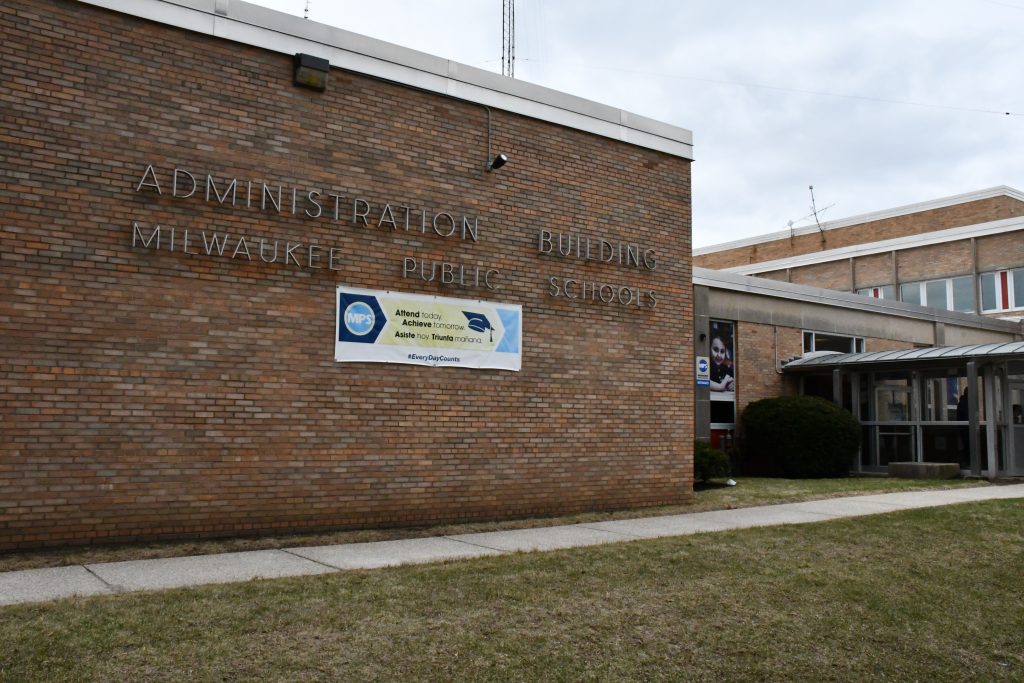
Milwaukee Public Schools Administration Building. Photo by Jeramey Jannene.
Milwaukee Public Schools is trying to reduce suspensions and expulsions by preventing discipline problems before they escalate. The Trump administration is now investigating whether that effort has gone too far.
That tension hung over a school climate and culture report accepted Thursday by the Milwaukee Board of School Directors. The report, first presented to a board committee Sept. 8, lays out the district’s efforts to improve student behavior through stronger relationships, early intervention and alternatives to suspension.
But those efforts are unfolding as the U.S. Department of Education scrutinizes whether MPS has improperly considered race in administering discipline.
On Aug. 18, the department announced an investigation into MPS over possible violations of Title VI of the Civil Rights Act of 1964. Federal officials allege the district may have used race in its discipline practices. MPS says it is unaware of any complaint that prompted the investigation.
The same day, the department issued guidance arguing that federal civil rights law had been misinterpreted during the Obama and Biden administrations in ways that encouraged schools to reduce racial disparities in suspensions and expulsions by considering race in discipline policies.
For MPS, the scrutiny represents a striking reversal. A decade ago, the district was under pressure to reduce disproportionately high suspension and expulsion rates among Black students. Now, the federal government is examining whether its response to those disparities improperly made race a factor in discipline decisions.
It represents a clash of philosophies on how to deal with student discipline. While MPS is trying to prevent and correct discipline issues before they become a major problem, especially with Black and Brown students, the Trump administration believes that the district may not be tough enough with these same students by refusing to impose suspensions and expulsions for many offenses in an equitable manner.
When the district looked at discipline in 2015, it recognized that suspensions, which originally were designed to bring parents to a school to come up with solutions, had, over time, simply become a form of punishment. Today, other solutions may be used, but suspensions are still very common. Expulsions also have changed. Now, when a student is expelled in MPS, that student is placed into an alternative program, not simply turned loose on the streets.
But for all its efforts, suspension and expulsion rates, especially for Black males, remain disproportionately high. The district sees prevention as a first step toward lowering those numbers.
School board members Kate Vannoy and Erika Siemsen sponsored the resolution that created the Department of Equity, Belonging, and Community.
“With this resolution to the board in May… we wanted to make sure important information wasn’t falling through the cracks,” said Siemsen on Sept. 8. Instead of different groups working in silos on different pieces of the issue, “there was an effort to bring this all together in a comprehensive way.”
Jon Jagemann, director of the Department of Equity, Belonging, and Community, presented his report on climate and culture on Sept. 8, outlining how the district might improve student behavior and academic achievement.
Because of the sensitive nature of an ongoing investigation, Jagemann was careful not to refer to the investigation in his presentation to the committee, nor was he willing to participate in a phone interview with Urban Milwaukee. He only answered direct questions by email. But in the end, the link between these two issues could not be avoided.
Asked Vannoy at the Sept. 8 meeting, “What are we doing as an alternative to suspensions at this point?”
“We want to be as preventive as possible, creating those systems in the schools where we have expectations… making our schools a space and community where students, staff, families feel part of that shared community… It starts with greeting students, making those relationships, seeing the needs, all of that. Then, within the code of conduct, every behavior has a minimum and a maximum level. So for behaviors that do not necessitate a required suspension, we have things like detention, counseling, interventions, restorative circles, peer mediation,” said Jagemann.
Superintendent Brenda Cassellius also participated in the discussion. “There are a couple of other things we do on the preventive side. Try to find a licensed teacher for every single classroom. That is our number one prevention. The second is improving instruction and ensuring that children know how to read and that there is good instruction in the classroom… Third, we have used a lot of [paraprofessionals], much more than I’ve seen in other districts. They can take [students] for walks, redirect them in the classroom,” said the superintendent.
In a phone interview, school board member James Ferguson told Urban Milwaukee that he is intensely interested in the district’s support of Black and Brown males.
“Some of our students are middle class; some of our students are upper class; but the majority of our students come from poor families,” he said. “It affects how that student feels about themselves. And your self-esteem is probably the number one indicator of how you’re going to act. People who feel good about themselves don’t put themselves in certain situations. A student’s academics is absolutely impacted by surrounding circumstances.”
Ferguson pointed out that previously, poor students often could not participate in school activities, sports, graduation, field trips because of a lack of payment of school fees. Ferguson sponsored a resolution to allow students, regardless of the ability to pay, the right to participate in these activities. “We made a decision that we didn’t want to be closing those doors,” he said. “All students will benefit from this department, not just Black and Brown students: students with disabilities, LGBT+ as well. This new department is really committed to creating community and a feeling of belonging.”
If you think stories like this are important, become a member of Urban Milwaukee and help support real, independent journalism. Plus you get some cool added benefits.


K-12 Education
-
Lincoln Elementary School Moves to Pulaski High
 Sep 2nd, 2026 by Terry Falk
-
More MPS Students Are Graduating, Going to College
 Aug 8th, 2026 by Terry Falk
-
MPS May Have a Licensed Teacher for Every Classroom
Aug 5th, 2026 by Terry Falk