New ‘Building Bronzeville’ Exhibition Connects Black Art, Power And Everyday Life
Exhibition reveals how Black artists in Milwaukee organized, published and created during the Black Arts Movement.
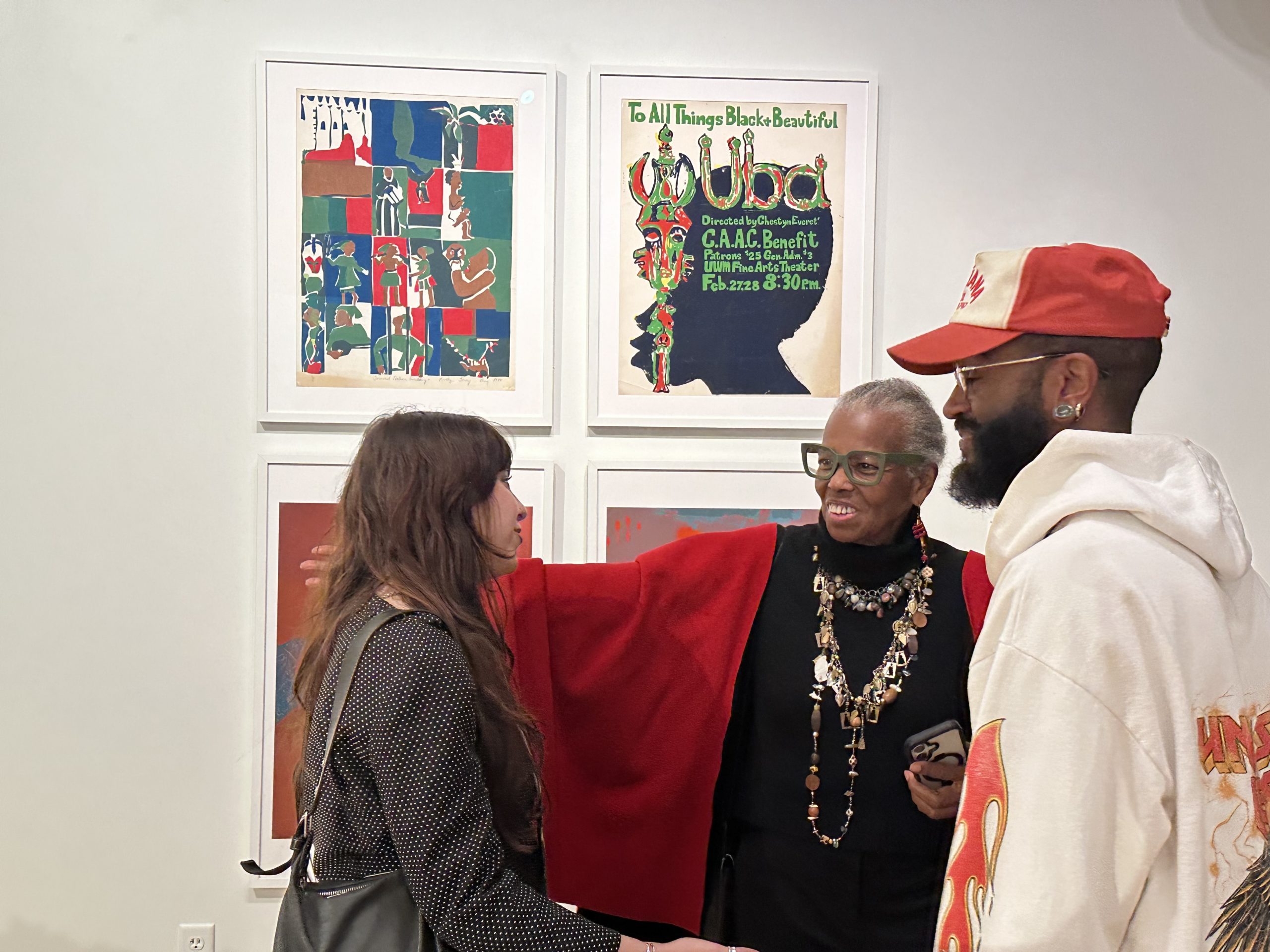
Artist Evelyn Terry with exhibition guests. Photo by Lauren Hafeman.
The Black Power Movement of the 1960s and 1970s saw the rise of political and economic empowerment of Black people across the nation. As political activists marched on centers of power, another movement was taking shape among Black artists, writers, intellectuals and musicians — the Black Arts Movement.
In Milwaukee, the Black Arts Movement emerged boldly in Bronzeville, the city’s historic Black cultural, artistic and economic epicenter. A new exhibition at Gallery 507, a curatorial enclave at the Bronzeville Center for the Arts, opened Thursday, bringing together the work of Milwaukee painters, muralists, screen printers, poets and writers who were shaped by — and ultimately shaped — the Black Arts Movement.
The exhibition, “Building Bronzeville: Milwaukee’s Black Arts Movement,” features more than 40 works by Black artists from 1967 to 1981. It places screenprints in conversation with archival magazines, positions paintings near hand-drawn festival flyers and loops archival visuals alongside printed poetry.
“Layering different disciplines of art shows that artists were always finding a way, finding the means to have a creative outlet,” Phoenix Brown, one of the exhibition’s curators, told Urban Milwaukee in an interview. “Placing these pieces alongside each other, you get the full scope of the movement through the ephemera that was passed out in the community as well as what the artists were producing.”
Milwaukee County Historical Society, Milwaukee Public Library and South Side Community Art Center in Chicago lent art and materials for the project. Artists Frieda High Wasikhongo Tesfagiorgis, Mutópe J. Johnson and Evelyn Terry also lent personal works to populate the gallery’s walls.
While walking through the gallery, Brown specifically pointed to the inclusion of Michael James Ward’s 1973 “The Ghetto Scene (Tenement),” a striking piece by the Milwaukee native that captures the everyday lives of people living in a tenement (a multi-family and usually multicultural, low-rise apartment building typically associated with underserved neighborhoods). “The Ghetto Scene (Tenement),” on loan from the Milwaukee Public Library, uses warm, spicy red-oranges for the tenement’s brick, layering oil, acrylic and plaster to add a roughness that is common on bricked exteriors. A closer look reveals detailed brushstrokes that articulate a woman doing laundry, children playing and a group socializing on their fire escape.
“I can’t stop talking about it,” Brown said. “It’s an ode to a time when community came together in these spaces. It’s an ode to the life and cultural production here.”
“We believe the works that are included in the exhibition are not being presented as artifacts; they are being presented as living, breathing inheritance for us to carry forward,” Ra Joy, Bronzeville Center for the Arts’ executive director, told Urban Milwaukee in an interview.
The artists of Milwaukee’s Black Arts Movement were asked to be more than artists. They also worked as educators, administrators and civic leaders. They organized their own collectives, institutions, galleries and cultural spaces. They founded their own magazines and arts councils, which are celebrated throughout the gallery with the inclusion of archival copies of Echo Magazine and pamphlets by the Inner City Arts Council.
“After the housing movement uprising in the late 1960s, you’ll see many of these magazines and publications shift from everyday Black cultural life to more of a Black self-determination, creative individuality and reclaiming that space for ourselves,” Brown said.
“They didn’t wait for permission. They didn’t wait for somebody to invite them into a large institution. They rolled up their sleeves and made things happen,” said Joy.
“The artists and art collectives that are featured in ‘Building Bronzeville’ understood that creating a painting and creating a public are both acts of community. Emphasizing that deep connection between art and civic life is one of the things that is special about this undertold aspect of American art history,” he continued.
Though the Black Arts Movement rose alongside the Black Power Movement, Brown noted that not all art is created for political purposes.
“I think when Black people make artwork, we assume that it’s always about politics, or that the whole point of Black people having creative self-expression is to make a point. Where sometimes art-making is simply to express whatever is going on inside or what everyday life looks like to somebody,” she said. “Some artists did produce artwork that was in relation to the Black Power Movement, while others are artists who just happen to be Black.”
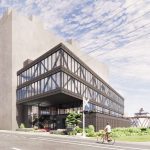
As the Bronzeville Center for the Arts celebrates the exhibition’s opening, it continues to look forward to its goal of redeveloping the site of a former DNR building on the northeast corner of N. Martin Luther King Jr. Drive and W. North Avenue into a world-class art museum for Black art and culture.
Brown said the research, scholarship and collection of archival materials that went into curating “Building Bronzeville” felt like “a threshold” they passed through while moving towards “that next phase.”
“The title of the exhibition is ‘Building Bronzeville’ but Bronzeville is still building. As we move towards a new purpose-built museum, we draw inspiration from this pivotal era of Black cultural production,” Joy said.
“Building Bronzeville” is open to the public until Feb. 27. Gallery 507, 507 W. North Ave., is open from 10 a.m. to 5 p.m. Monday through Friday, and from 10 a.m. to 1 p.m. on Saturdays.
Photos:


Existing members must be signed in to see the interactive map. Sign in.
If you think stories like this are important, become a member of Urban Milwaukee and help support real, independent journalism. Plus you get some cool added benefits.