
How Two Clay Pots In Milwaukee Became A Test Case For Restitution For Enslaved Artists
The deal over David Drake’s ceramics could shape how museums treat the work and heirs of enslaved artisans nationwide.
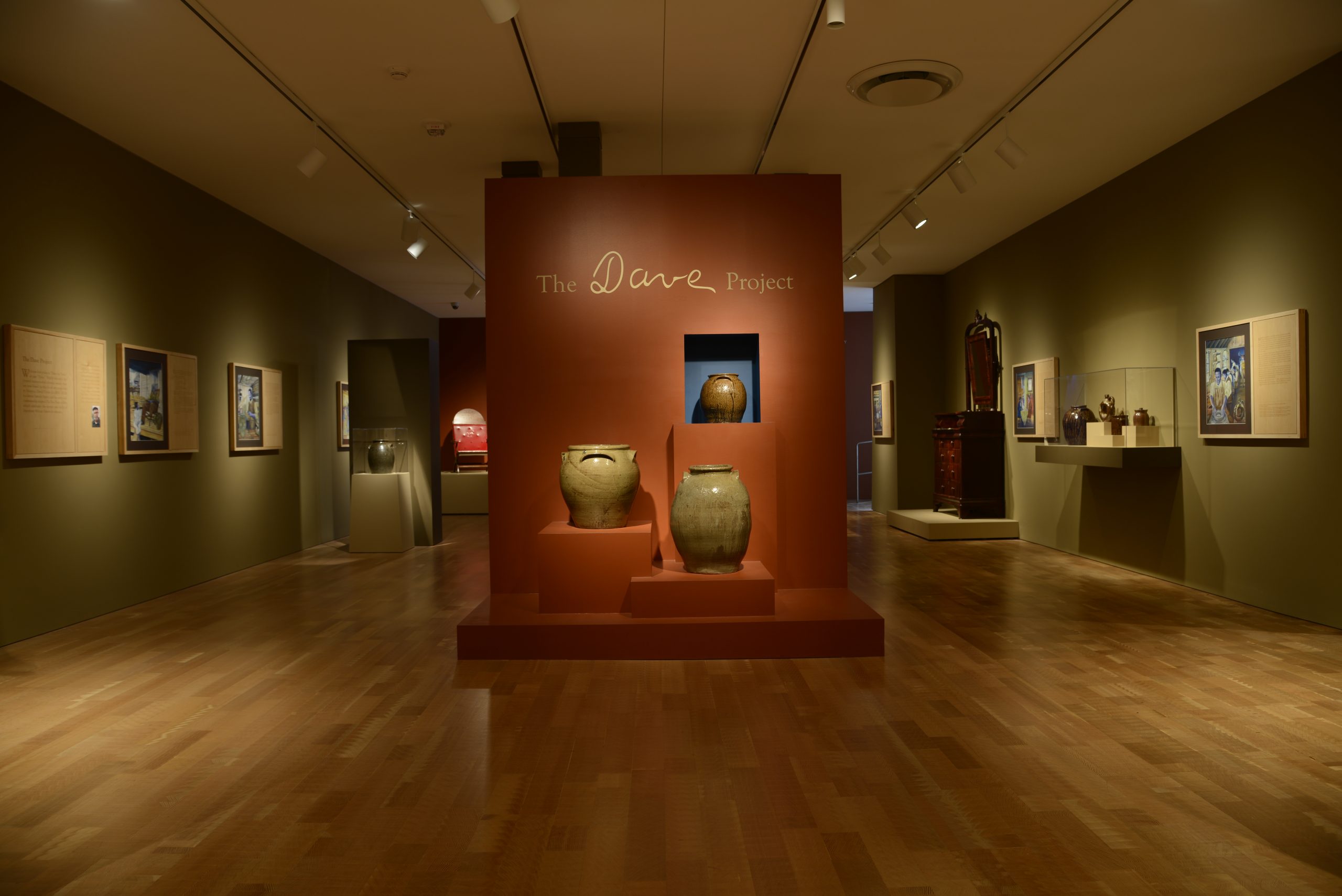
The Dave Project, installation view. Image by Jim Wildeman, courtesy of the Chipstone Foundation
I wonder where is all my relations
Friendship to all—and every nation— Inscription on an 1857 ceramic pot by David Drake
The Milwaukee Art Museum announced Monday that it had reached an arrangement to return two pots in its collection to the descendants of enslaved potter David Drake. The works, however, will remain on view at the museum.
Under the terms, which mirror a similar transaction the Museum of Fine Arts Boston announced in March, the museum purchased one vessel from the family, while the other will remain on long-term loan.
Both have been on display at the museum as part of The Dave Project. It was created following a 2010 exhibition of Drake’s works by Chicago artist Theaster Gates for the Chipstone Foundation. The pioneering exhibition was curated by Ethan Lasser, who is now with the MFA, and was actively involved with the Boston transfer to the family.
Boston Museum Set Stage for Restitution
In late 2025, the MFA reached an agreement with Drake’s descendants to return the works in its collection to the Dave the Potter Legacy Trust, founded in December of that year. The groundbreaking agreement was front-page news in the New York Times on March 25, where reporter Jori Finkel noted:
No other heirs of enslaved artists have received this sort of restitution, and there is no obvious legal framework for it. While the Native American Graves Protection and Repatriation Act of 1990 governs the return of sacred objects to tribal members, and an international network of laws guides the return of cultural patrimony to countries of origin, nothing comparable supports the heirs of enslaved people.
The Boston museum transferred ownership of the pots to the family. Both remain on display in the collection: one bought by the MFA from the trust, with the other on long-term loan.
Chipstone Propelled Drake Fame, Uncovered other Slave Artisans
When I read about the MFA agreement, I contacted Jon Prown, who leads the Chipstone Foundation, devoted to the collection and study American Decorative Arts. I wondered how Chipstone, which then owned the pots, planned to confront the new reality of restitution.
Prown responded on March 27:
This indeed is a very active issue in the museum world at the moment, and we are actively engaged in figuring out proper next steps.
In a follow-up meeting in spring, Prown told me that there were some complications attendant to a transfer of ownership. As noted, no obvious legal framework existed at the time, and lawyers are very particular about such matters. “Moreover, in all endeavors, we need to comply with proper 501(c)(3) law. In all ways, collaborating with MAM was the right thing to do,” said Prown via email.
This month, Chipstone donated the pots to the Milwaukee Art Museum, which in turn gave them to the Dave the Potter Legacy Trust.
The museum then bought the signed and dated 1855 pot. A Poem Jug by Drake has sold for a reported million dollars, but signed or unsigned works would bring considerably less. The MAM purchase was paid for by an anonymous donor according to a source familiar with the transaction.
Dave the Potter was not the only African American artisan lifted from obscurity by Chipstone and its exhaustive scholarship. Others include Thomas Day, a free man, who ran a sizeable furniture factory.
Another is John Hemmings a furniture maker and the brother of Sally Hemmings. He, like his sister, was a slave belonging to Thomas Jefferson.
For the founding father, he created a Campeachy Chair around 1819, and decorated the lounge chair with the presidential seal. You can see it at Monticello, Jefferson’s home in Virginia. Hemmings made another, somewhat simpler one of cherry and mahogany for his own use. Property of the Chipstone Foundation, and on loan to the museum, you can see it in gallery K228.
As a Chipstone survey of “Slavery and Southern Furniture” noted, there were many highly skilled artisans in various trades:
Thomas Jefferson’s use of slave artisans at Monticello was by no means unusual. Southern planters commonly sought skilled joiners, blacksmiths, weavers, and other tradespeople. Southern cabinetmakers, too, used enslaved African-Americans in their shops. So pervasive was the use of slave artisans that German visitor Johann David Schoepf noted in 1783, “There is hardly any trade or craft which has not been learned and is not carried on by Negroes.”
In short, African-Americans played a vital role in the production of much southern furniture, yet their contributions remain unappreciated and unrecognized. To a large extent, this omission reflects the anonymity of these men, whose very existence rarely is noted in historical records. In an advertisement, Williamsburg cabinetmaker Peter Scott offered to sell land, furniture, tools, and “Two Negroes, bred to the Business of a Cabinetmaker.” Even the names of these individuals are not recorded.
It was remarkable that David Drake’s name was recorded, especially that he inscribed it in his works. Will further research — and advancements in DNA testing — reveal more unknown artists, where their works are held, and who are their descendants? It seems entirely likely. The Hemmings DNA has been much discussed of late, and descendants abound.
Move Comes as Focus Heightened on African American Arts
Last Thursday, Gallery 507 held an opening exhibition entitled “Building Bronzeville: Milwaukee’s Black Arts Movement.” It surveys the field from 1969-1981 and includes many source documents from the era, largely originating with UWM and the Milwaukee Public Library. Among the artists was Mutope Johnson, who did a series of paintings for Chipstone featuring Jefferson and his craftsmen slaves.
A few weeks ago it was announced that Lonnie Bunch, the founding director of the National Museum of African American Art and Culture and now the Smithsonian Institution director, would come to Milwaukee to give a talk at the museum. Then it was announced that he was retiring. Then it was announced that the talk was canceled, and finally that it was to be rescheduled for a later date. The Trump administration has led attacks on the African American museum and its leadership. Bunch was expected to outline his work creating the museum as the Bronzeville Center for the Arts undertakes the task of creating a museum here, a block from the gallery at 507 W. North Avenue.
In an email, Ra Joy, the BCA executive director, reiterated an earlier statement. It is probably the smallest organization to have displayed a Drake pot, this one on loan from Chipstone.
Bronzeville Center for the Arts included work by David Drake (also known as Dave the Potter) in our 2025 exhibition Black Defined I: Ceramics to draw a clear creative lineage between the earliest generations of African diasporic art-makers in America and contemporary artists who continue these practices today. The accompanying label text explicitly acknowledged that Drake was enslaved at the time he produced the work, situating the object within its full historical context. BCA is committed to honoring the historic lineage of Black creativity and reinforcing its rightful place within the narrative of American art, including ceramic traditions. To overlook the magnitude of Drake’s impact would not only distort that history, but would also contribute to the continued erasure of Black artistic labor under enslavement.
What Next?
According to the museum, The Dave Project will expand and continue under the leadership of Director Kim Sajet. Trump disparaged her attention to diversity, equity and inclusion while she was the director of the National Portrait Gallery. She considered it a compliment, but added that he should have included “Accessibility” in his list of grievances. She is emphatic that the museum and community are one. According to the statement:
Dialogue has been central to The Dave Project since its beginnings in 2010. The project brought Drake’s story and poetry into schools, libraries, churches, community centers, and other locations throughout greater Milwaukee, where participants interpreted his inscriptions and created their own responses to his words and work.
That history of participation is informing the next phase of the work. The Milwaukee Art Museum, Dave the Potter Legacy Trust, the Chipstone Foundation, the African American Art Alliance, Milwaukee Public Schools Foundation, Bronzeville Center for the Arts, and America’s Black Holocaust Museum, along with additional community partners have engaged in an ongoing conversation about how Drake’s work and legacy might continue to create meaningful connections in Milwaukee. The partners hope to invite community members into that conversation and explore enduring questions concerning family, home, place, creativity, and belonging.
UPDATE: The section on the purchase price has been expanded
If you think stories like this are important, become a member of Urban Milwaukee and help support real, independent journalism. Plus you get some cool added benefits.


Plenty of Horne
-
Donald Baumgartner Remembered In Music, Dance And Laughter
 Sep 11th, 2026 by Michael Horne
-
Juneau Park Will Finally Get Its Sword
 Aug 20th, 2026 by Michael Horne
-
The Homes of General William ‘Billy’ Mitchell
 Jul 23rd, 2026 by Michael Horne