

After Bad Legal Advice, Council Tries Again On Elected Official Raises
A 10–5 vote replaces a raise formula tied to city workers.
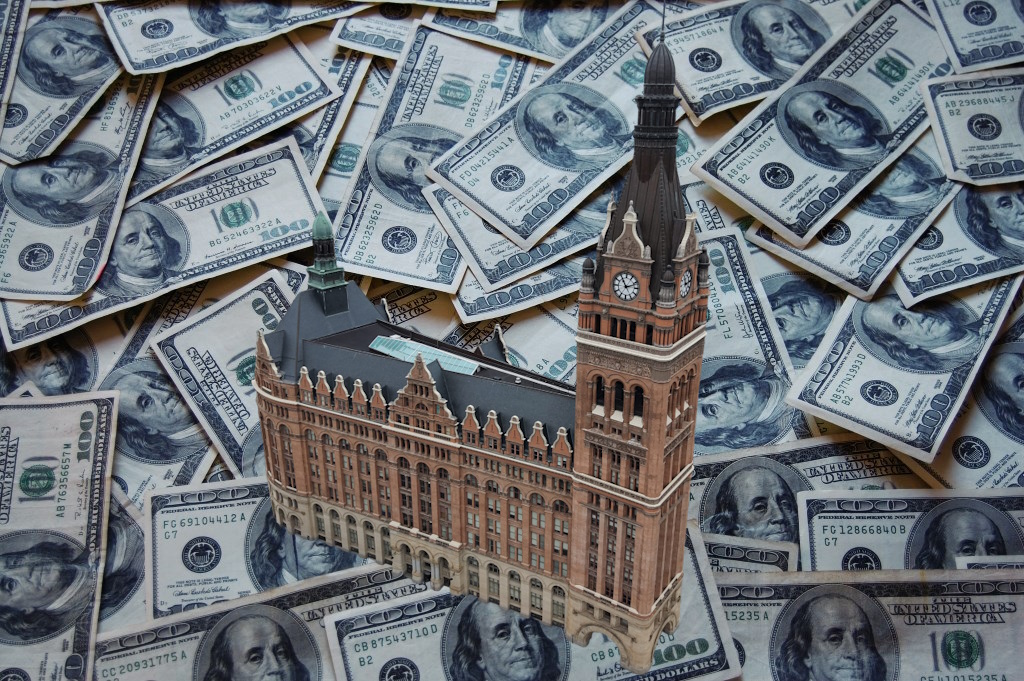
Milwaukee City Hall. Building photo by Jeramey Jannene, background photo by Jericho.
The Milwaukee Common Council voted Tuesday to redo an elected-official pay policy it adopted two years ago after the current City Attorney’s Office concluded the legal advice the council relied on at the time was wrong.
On a 10-5 vote, the council approved a new salary schedule for whoever is elected mayor and to the Common Council in 2028. The policy provides an 8% increase at the beginning of the 2028-32 term, followed by 2% increases in each of the following three years. No member of the current council, nor Mayor Cavalier Johnson, will receive a raise during the current term.
The ordinance replaces a system the council adopted in January 2024 with the approval of the City Attorney’s Office, then led by Tearman Spencer. That policy automatically tied elected-official raises to uniform increases provided to general city employees, capped at 3% annually, and granted a one-time catch-up raise of 15% after wages were frozen since 2008.
Current City Attorney Evan Goyke, who defeated Spencer in the April 2024 election, now says that system violates state law because current officeholders effectively participate in determining their own salaries when they vote on raises for city employees. Goyke’s office has advised that any increase instead needs to be established in advance for a future term.
At last week’s Finance & Personnel Committee meeting, Goyke described his office as having “reviewed and revised and frankly reversed” the advice the city previously provided. Except for the 15% increase, no mayor or council member received the raises the old policy would have produced.
For several council members Tuesday, that history was central to the vote.
“I think what’s being lost in the sauce is why we got here,” said Ald. Mark Chambers Jr. “We received bad information from our previous city attorney.”
The council’s 2024 action was intended to prevent another lengthy elected-official pay freeze. Before a 15% increase took effect at the beginning of the current term, council members had gone without a raise since 2008.
The new ordinance attempts to recreate what council members expected would happen under the 2024 policy, but does so using fixed numbers. Salaries will increase 8% at the beginning of the next term, to catch up to a 9% raise general city workers received since 2025, and then 2% in 2029, 2030 and 2031. The ordinance formally removes the provision tying future raises directly to general city employee wage increases.
If current salaries remain unchanged through the end of the term, the mayor’s annual salary would rise from $169,436 to approximately $182,991 in 2028. A council member’s salary would rise from $84,206 to approximately $90,942, while the council president’s salary would increase from $94,311 to approximately $101,855.
After the three subsequent 2% increases, those salaries would reach approximately $194,192 for the mayor, $96,509 for council members and $108,090 for the council president.
Ald. Alex Brower, who voted for the ordinance, suggested the increases would not necessarily put Milwaukee elected officials ahead of their peers elsewhere.
“I think this might not even bring us in line with other common councils,” he said, citing Portland.
Ald. Sharlen P. Moore said she opposed taking the raises while people were struggling.
Ald. Scott Spiker said the council was doing more than simply correcting the consequences of the earlier legal advice.
Spiker, who called the Spencer-era advice “inaccurate,” noted that the 8% increase is designed as a catch-up mechanism for raises officeholders expected to receive under the prior policy. But the three subsequent 2% increases create a different policy for years that have not yet arrived.
“There is new policy being established here,” said Spiker. “It’s not just addressing the city attorney’s mistake.”
Goyke gave similar advice at the committee hearing about how the council should proceed. He said the “cleanest and clearest” approach under state law is for the current council to set specific salaries and specific dates for the next term, eliminating any need for the 2028-2032 council to take action that would increase its own compensation. A future council could still cancel or reduce a scheduled increase, he said.
Dimitrijevic and Chambers, in conversations with Urban Milwaukee, both confirmed the council intends to cancel the raises if general city employees don’t also receive raises. The council did that in the years following 2008, when the city’s fiscal condition rapidly deteriorated amid the Great Recession.
The Finance & Personnel Committee endorsed the proposal 3-2 on Sept. 16, with Spiker and Ald. Peter Burgelis opposed.
The full council’s opposition Tuesday expanded to five members.
Voting in favor were council members Andrea Pratt, Chambers, Brower, Robert Bauman, Lamont Westmoreland, Milele A. Coggs, Larresa Taylor, Dimitrijevic, Russell W. Stamper II and Council President José G. Pérez.
Voting against it were council members DiAndre Jackson, JoCasta Zamarripa, Moore, Burgelis and Spiker.
The mayor endorsed the general approach a day before the vote.
“The goal here is just to make sure that the elected officials are just keeping pace with pay increases as they happen with the general city employees, not to exceed what general city employees get,” the mayor said Monday.
Johnson also emphasized that the raises belong to the offices, not necessarily the people currently occupying them.
“It could happen that some of those folks are challenged and defeated,” Johnson said. “Whoever takes on that position then would be in line to receive that raise.”
As part of procedural motions, the elected comptroller, municipal judges and city treasurer were also approved to receive the raises, including the 2024 raise schedule and last year’s 3% raise. The positions, according to the City Attorney’s Office, do not directly control the budget and should not have been frozen alongside the mayor and council salaries. Goyke’s salary, $169,436, also could legally be raised because his office does not vote on the budget, but it is frozen because it would exceed the mayor’s, which would violate a different city policy. Only about two dozen employees make more than the mayor.
The treasurer and comptroller are each currently paid $144,449. A 3% adjustment would increase those salaries to approximately $148,783. Municipal judges are paid $143,007, and a 3% increase would raise that amount to approximately $147,297, subject to separate state restrictions governing when judicial pay changes may take effect.
The 2024 vote, which occurred after the city’s 2% sales tax was approved by the state, happened alongside an executive pay increase that boosted salaries for many city administrators. After years of high vacancies and effectively frozen wages, the council has also approved pay increases and reclassifications for most city jobs.
Legislation Link - Urban Milwaukee members see direct links to legislation mentioned in this article. Join today
If you think stories like this are important, become a member of Urban Milwaukee and help support real, independent journalism. Plus you get some cool added benefits.
Political Contributions Tracker
Displaying political contributions between people mentioned in this story. Learn more.
- July 12, 2025 - Cavalier Johnson received $100 from Evan Goyke
- October 23, 2024 - DiAndre Jackson received $75 from Sharlen P. Moore
- December 31, 2019 - Milele A. Coggs received $250 from Tearman Spencer
- October 29, 2019 - Peter Burgelis received $50 from Tearman Spencer
- September 17, 2019 - Cavalier Johnson received $100 from Evan Goyke
- April 23, 2019 - JoCasta Zamarripa received $100 from Peter Burgelis
- March 4, 2016 - Cavalier Johnson received $35 from Sharlen P. Moore
- February 20, 2016 - Cavalier Johnson received $250 from Robert Bauman
- February 13, 2016 - Milele A. Coggs received $10 from Larresa Taylor
- May 5, 2015 - José G. Pérez received $10 from Cavalier Johnson
- May 5, 2015 - José G. Pérez received $100 from JoCasta Zamarripa




















The votes here are so predictable. Kudos to alders Jackson, Zamarripa, Moore, Burgelis and Spiker for voting no. Shame on the rest of you – it should be obvious that elected officials should receive no pay bumps while you close libraries, increase property and user fees, and otherwise hold out the beggar’s cup.
Tillman again with bad legal advice.How much more damage has he done that we don’t know about. And as happened before, his selection represents something other merit.
I like the concept of keeping a tie to the increase schedule of city employees (3% max). Might I suggest the law be changed so the council would vote to get (or reject) the same (cumulative) bump at the next election cycle?
This would put them in compliance with the law and only get them one election cycle behind on keeping up with inflation.