

Planned Parenthood Sues To Overturn Key Wisconsin Abortion Limits
New lawsuit targets 24-hour waiting period and physician-only rule as unconstitutional barriers.
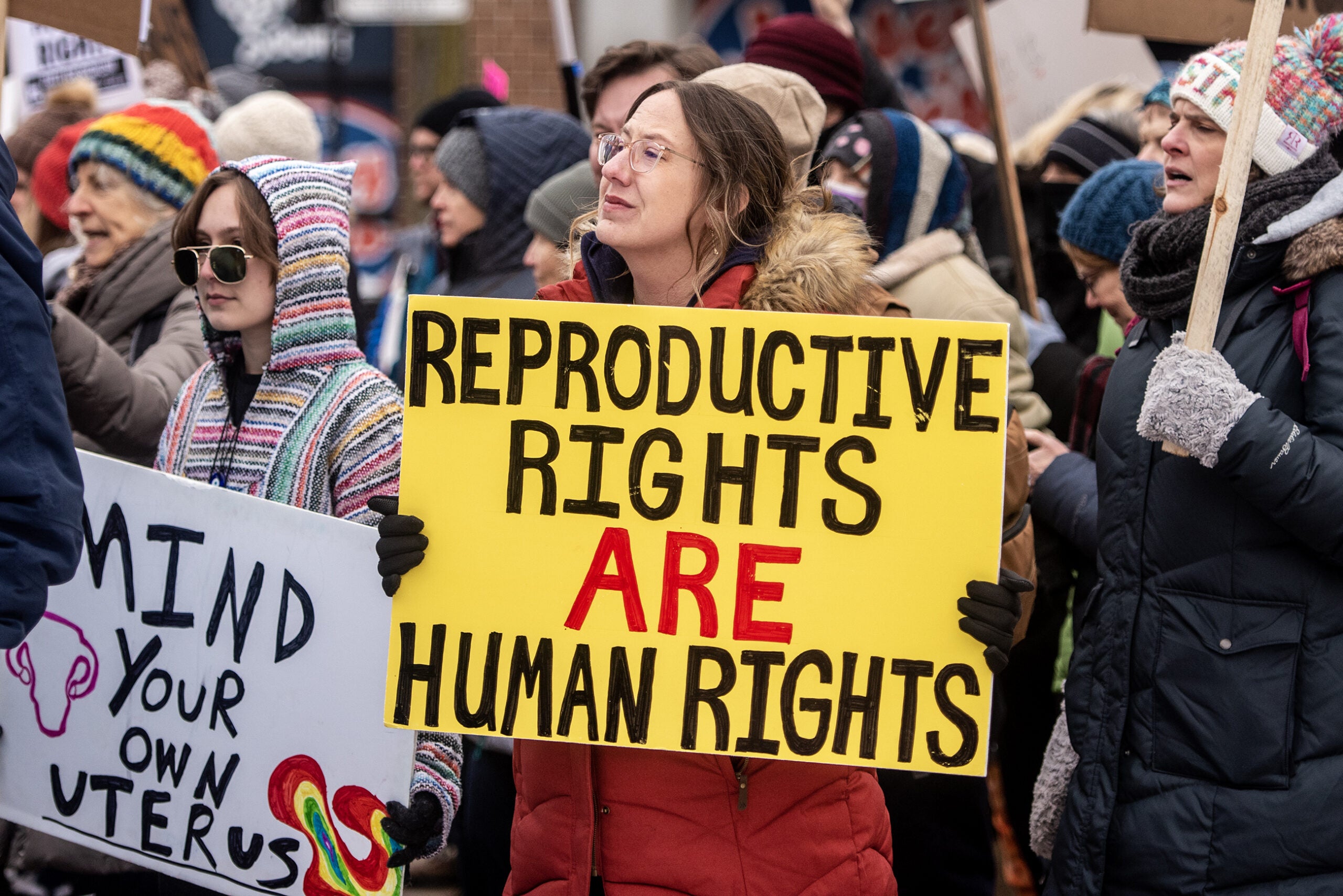
Protester Jennie Klecker participates in a march for abortion rights Sunday, Jan. 22, 2023, in Madison, Wis. “Theres nothing more important right now for my kids,” she said. Angela Major/WPR
Planned Parenthood of Wisconsin filed a new lawsuit challenging Wisconsin abortion restrictions Thursday, just days after the Wisconsin Supreme Court returned to work with a newly cemented 5-2 liberal majority in place.
The lawsuit, filed in Dane County against Dane County District Attorney Ismael Ozanne, argues that two Wisconsin laws violate the state constitution’s guarantee of personal liberty.
One of those laws requires people seeking abortions to wait 24 hours between requesting an abortion and receiving one. The other states that only licensed physicians may provide abortions, which limits a person’s ability to self-administer abortion drugs through telehealth.
“This case asks our court to recognize … that our constitutional freedom includes the ability to make deeply personal decisions about our reproductive health care without unnecessary government interference,” said Tanya Atkinson, the president of Planned Parenthood of Wisconsin, during a press briefing announcing the lawsuit.
The case names Ozanne as a representative of all Wisconsin district attorneys, because they would prosecute violations of the rule that only physicians can administer abortions, said Diane Welsh, a lawyer for Planned Parenthood.
“Anywhere in the state where an abortion would be provided, there could be criminal charges for a person who’s not a physician,” said Welsh.
Lawsuits challenging Wisconsin’s abortion restrictions have been anticipated since Roe vs. Wade — which federally protected abortion access — was overturned in 2022, effectively throwing the issue back to the states. The most significant challenge was over a Civil War-era statute that had been interpreted as banning abortion in Wisconsin, and which went back into effect when Roe was overturned.
That law was at the heart of campaigns to elect liberal justices to the state Supreme Court, and last year, the high court overturned the statute, allowing abortions to be administered within the state under certain restrictions.
In its ruling, the Supreme Court found that the 19th-century law had been superseded by a series of additional restrictions passed in the ensuing decades. Immediately, abortion advocates signaled they might challenge those restrictions.
Thursday’s announcement makes good on those possibilities. In the briefing, attorneys for Planned Parenthood of Wisconsin argued that restricting a person’s ability to use telehealth appointments for medication abortions, and requiring a person to receive counseling and wait a full day before receiving abortion care, are unnecessary and illegal barriers to healthcare access.
“Through this case, we are asking Wisconsin courts to recognize that these restrictions conflict with the freedoms and protections guaranteed to each of us under our state’s constitution,” said Atkinson. “It’s about whether our constitutional freedoms belong to each of us, or whether the government can make our most personal decisions for us.”
In a statement, a spokesperson for Wisconsin Right to Life said Planned Parenthood is seeking a “permanent constitutional shield” for abortion access.
“This lawsuit isn’t about access,” said Samantha Craig. “It’s about removing the last few guardrails standing between a woman and the procedure table. It is incredible to us that such basic protections for informed consent and women’s safety are disregarded for the sake of protecting Planned Parenthood’s abortion-first business model.”
The Wisconsin Supreme Court, which would have the final say in the case, has a definitive liberal slant that is all but guaranteed to be in place for years to come. Liberal Justice Chris Taylor, whose 10-year term began in August, was once a lobbyist for Planned Parenthood. Liberal Justice Susan Crawford, who was sworn in a year earlier, once represented the group as a private attorney.
As Wisconsin Supreme Court starts new term, Planned Parenthood challenges abortion restrictions was originally published by Wisconsin Public Radio.
If you think stories like this are important, become a member of Urban Milwaukee and help support real, independent journalism. Plus you get some cool added benefits.
More about the Overturning of Roe v. Wade
- Planned Parenthood Sues To Overturn Key Wisconsin Abortion Limits - Anya van Wagtendonk - Sep 10th, 2026
- WisDems Statement on Planned Parenthood Lawsuit to Expand Reproductive Freedom - Democratic Party of Wisconsin - Sep 10th, 2026
- New Report Details Post-Roe Abortions in Wisconsin - Sarah Lehr - Jul 24th, 2025
- Three Years After the Dobbs Decision, Wisconsin Republicans are Still Trying to Ban Reproductive Freedom - Democratic Party of Wisconsin - Jun 24th, 2025
- On 3rd Anniversary of Roe Being Overturned, Baldwin, Blumenthal, and Murray Lead Senate Dems in a Bill to Restore Abortion Access Nationwide - U.S. Sen. Tammy Baldwin - Jun 24th, 2025
- Support for Abortion Rights Remains Strong in Wisconsin on Third Anniversary of MAGA U.S. Supreme Court Justices Overturning Roe v. Wade - A Better Wisconsin Together - Jun 24th, 2025
- MAGA Wisconsin GOP Pushed to Restrict IVF Access, Reproductive Freedom - Democratic Party of Wisconsin - Feb 27th, 2024
- Families Are Losing Access to IVF Because of Donald Trump - Democratic Party of Wisconsin - Feb 23rd, 2024
- Planned Parenthood Seeks Wisconsin Supreme Court Ruling On Abortion - Hope Kirwan - Feb 22nd, 2024
- PPWI Asks Wisconsin Supreme Court to Protect Abortion Rights - Planned Parenthood of Wisconsin - Feb 22nd, 2024
Read more about Overturning of Roe v. Wade here






















It sounds like Samantha Craig believes with life-threatening pregnancy complications should wait 24-hours before they can receive life-saving treatment. This is not hyperbole. Women are dying waiting for life-saving treatment in states like Texas. Her so-called common sense “restrictions” are killing women. Groups like Wisconsin Right to Life are only interested in the birth of fetuses. They do not care about women. They do not care about children.
The position of groups like Wisconsin Right to Life that we must overturn anti-choice laws. Healthcare decisions belong to those who must live with the consequences, regardless of their gender.