
The Arguments Against Wisconsin’s Congressional Maps
Are the current maps partisan? Anti-competitive? Supreme Court must decide.
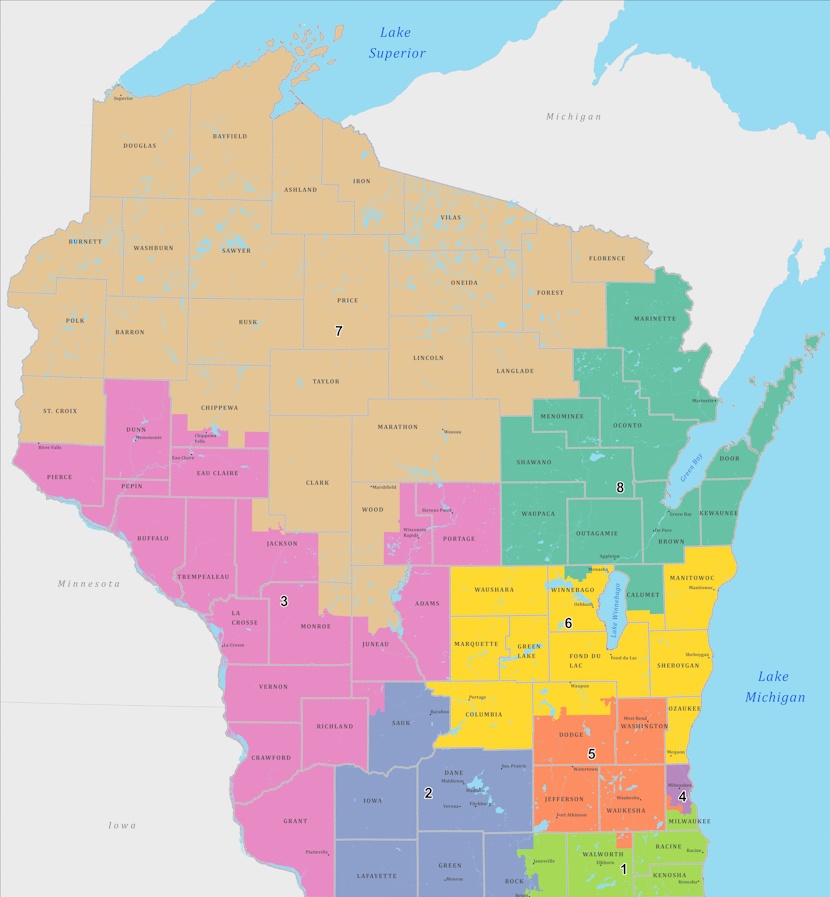
2023 Congressional Districts.
Recent redistricting reform succeeded in making Wisconsin’s Assembly and Senate districts far less gerrymandered. However, the eight Wisconsin congressional districts were left unchanged.
Over the past year, two lawsuits were brought against Wisconsin’s gerrymandered congressional delegation. One is called Elizabeth Bothfeld et al. v. Wisconsin Elections Commission et al. (“Bothfeld” for short) and was brought with the aid of the Elias Law Group, whose website describes it as “a mission-driven firm committed to helping Democrats win, citizens vote, and progressives make change.”
The second lawsuit is called Wisconsin Business Leaders for Democracy et al. v. Wisconsin Elections Commission et al. (WBLD). It was brought with the aid of Law Forward, self-described as “Wisconsin’s only nonprofit pro-democracy law firm. We fight every day to revitalize our democracy and expand our rights under the Wisconsin Constitution.”
In the Bothfeld case, plaintiffs argue that the use of a “least-change” criterion to guide redistricting violated the separation of powers principle. Essentially, applying least change in updating Wisconsin’s legislative districts to reflect the 2020 U.S. Census meant that the new maps were as partisan as the old maps.
On the surface, this decision could be described as a nonpartisan one. After all, it could be done with no attention to how people actually voted in the various parts of the state. In its effect, however, using least-change was a highly partisan decision. The 2010 legislative district maps had been heavily gerrymandered in favor of Republicans. Using the least-change criterion meant that the gerrymander would continue for another ten years.
Bothfeld plaintiffs argued that the Wisconsin Supreme Court, as a nonpartisan entity, should not turn its decision-making over to a highly partisan body, the Wisconsin Republican Party. The least-change criterion violates separation of powers, is not neutral and is incompatible with judicial independence, in the view of the Bothfeld plaintiffs.
The WBLD plaintiffs use a different argument: that the congressional maps are an “anticompetitive gerrymander” that aims to minimize the number of competitive districts. In anticompetitive gerrymandering, incumbents are protected from a serious challenge in the general election.
In the graph below, the blue columns represent the Democratic share of the two-party vote in the current Democratic congressional map based on the 2024 election. Two districts, the 2nd and 4th, containing Madison and Milwaukee, are overwhelmingly Democratic. That allowed the mapmakers to create a partisan gerrymander, winning six out of eight districts in a swing state where the voters are evenly divided.
The blue columns also illustrate an anticompetitive gerrymander. Only two of the districts could be considered competitive.
The yellow columns represent an alternative to the current maps created by Dave’s Redistricting to maximize the number of competitive districts, showing the percentage Democratic in yellow for each district. Six of the eight districts cluster right around the 50% mark.
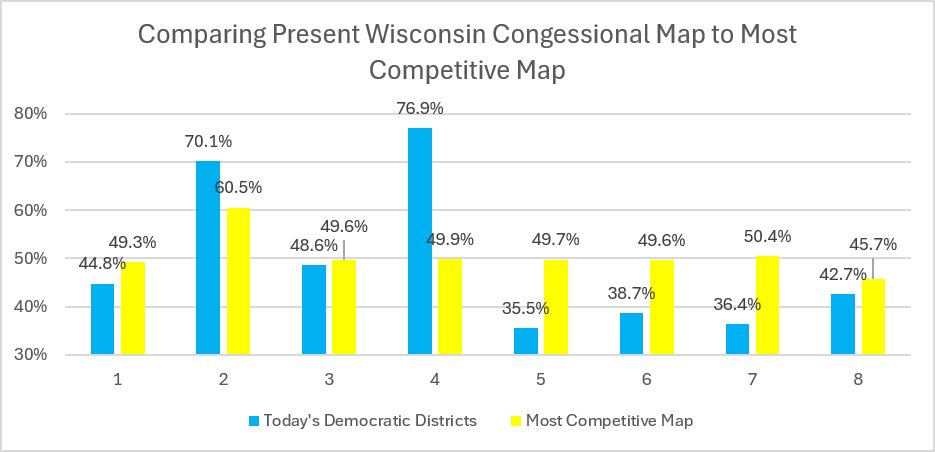
Comparing Present Wisconsin Congressional Map to Most Competitive Map
WBLD argues that the current uncompetitive map violates Wisconsin’s Constitution in several ways:
- The government no longer “derives its just powers from the consent of the governed” when anti-competitive gerrymandering shields legislators from electoral accountability (Wisconsin Constitution Article I). In this situation, the “suffrage” protected by Article III becomes pointless and the “blessings of a free government” can’t be secured through elections with preordained outcomes.
- History also shows that one of the Constitution’s overarching principles is preventing officeholder entrenchment by promoting competition and electoral accountability.
- The brief points to several precedents in previous court decisions in which ruled against an anti-competitive gerrymander.
Eventually, both judicial panels appointed to hear the two cases rejected plaintiffs’ motions for judgment and granted motions to dismiss. But the Bothfeld panel explains that “this panel is not endorsing the current congressional map.” The problem, the panel explained, was that the plaintiffs were asking the panel to make changes in policies passed by the Wisconsin Supreme Court. For example:
The Wisconsin Supreme Court addressed the exact same assertion that Plaintiffs set forth here—whether there is a right to partisan fairness in the Wisconsin Constitution—and a majority of our supreme court held that there is no such right.
The problem is that during this period a series of elections was changing the makeup of the Supreme Court from a conservative court that viewed a Republican-created partisan gerrymander as a fine thing to a majority liberal court that finds such district maps offensive — or from one that believes that the Wisconsin Constitution contains no right to partisan fairness to one that believes there is such a right.
But until the Supreme Court announces that change with a ruling overturning the past decision, district courts and courts of appeal are bound to respect the previous understanding.
Oral hearings on each of the two lawsuits have been scheduled for Sept. 16, 2026, in the Supreme Court’s Madison courtroom (at 9 a.m. for Bothfeld and 10:30 a.m. for WBLD). The hearings are planned to be broadcast on WisconsinEye. (Note that WisconsinEye has the WBLD hearing starting at 11 a.m.)
Both the three-judge panels and the defendants agree that past statements by the Wisconsin Supreme Court are obstacles to the actions proposed by the plaintiffs. It will be interesting to observe whether the justices decide to remove those obstacles.
If you think stories like this are important, become a member of Urban Milwaukee and help support real, independent journalism. Plus you get some cool added benefits.


Data Wonk
-
How Gerrymandered Are Wisconsin’s Congressional Districts?
 Sep 2nd, 2026 by Bruce Thompson
-
Learning Our Lesson From COVID-19
 Aug 19th, 2026 by Bruce Thompson
-
Most Republicans Support Raising the Minimum Wage
 Aug 5th, 2026 by Bruce Thompson