
Lessons From Milwaukee’s Flooding
One year ago the city was deluged with a 1000-year flood. Local officials need to learn from this.
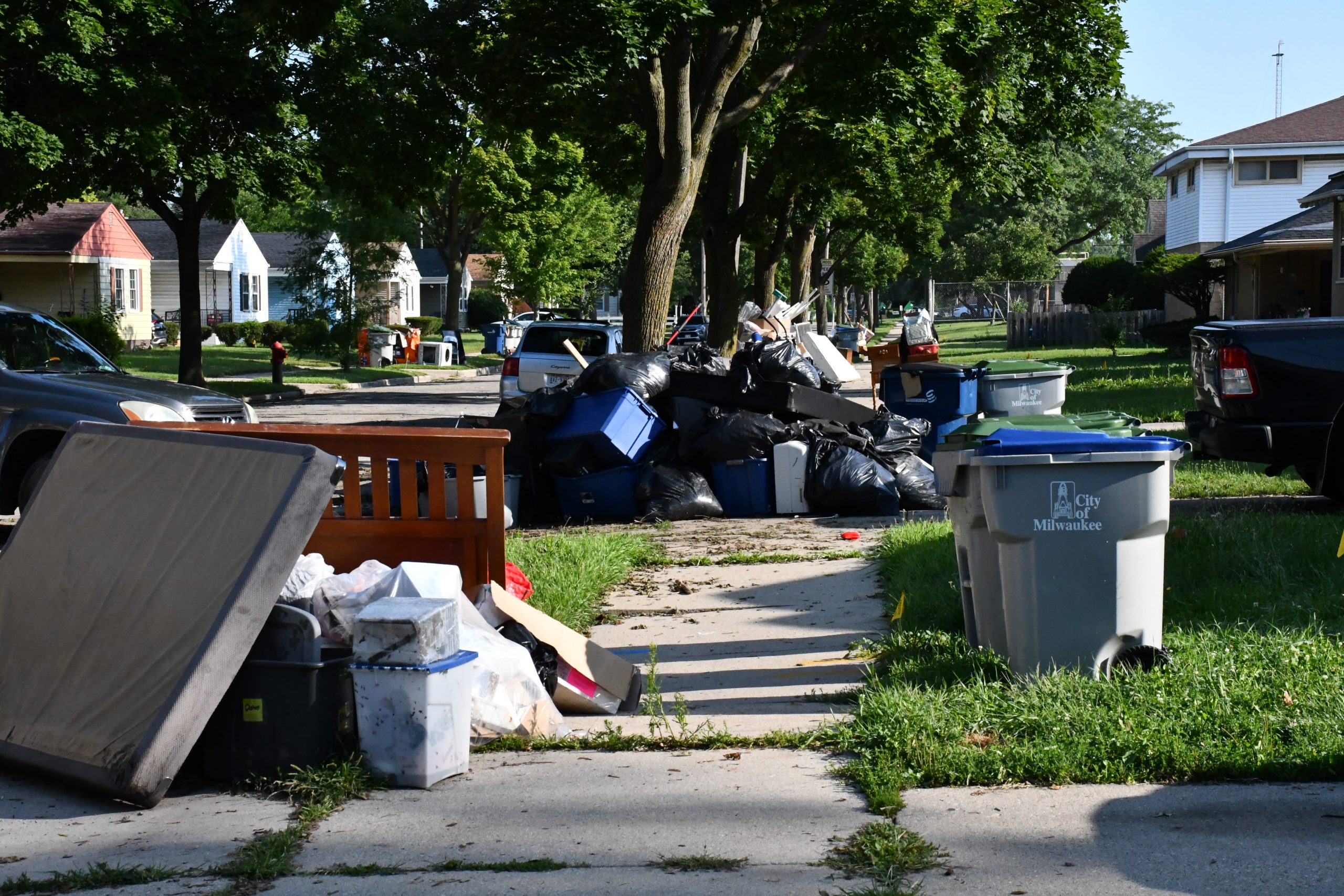
Water-damaged debris on N. 19th Street. File photo by Jeramey Jannene.
One year after Milwaukee’s historic flood, I still think about how fast the water came.
On August 9th, I remember that something felt wrong all day, and I couldn’t put my finger on why. I live in Milwaukee’s Lindsay Heights neighborhood, and sometime around 2 in the morning, I suddenly woke up.
I went down to my basement and heard the storm and rain coming down. Within about 20 minutes, we had roughly 17 inches of water in our basement. In the middle of the fear and confusion, scripture came naturally to me. I thought about Isaiah 43:2, “When you pass through the waters, I will be with you.” The whole thing felt almost biblical.
The rainfall totals tell us how historic that storm was, but they do not tell you what a flood actually costs a family. For my fiancée and me, the flooding caused about $11,500 in damage to our basement and foundation. Insurance covered a good portion of it, but we had to argue to get some things covered, and we still ended up with about $5,000 in costs insurance did not pay for. We dealt with mold concerns, had to do treatment to prevent the problem from getting worse, and went without air conditioning and hot water for weeks.
It took about 10 months before all of the work was finally completed. For almost a year, the flood was not just something that had happened to us. It was something we were still living with.
And as hard as our experience was, we were lucky. Some of our neighbors had little or nothing covered by insurance. People filed claims believing their homeowners insurance would help, only to learn after the flood that much of the damage was not covered. One of our neighbors had their basement collapse completely, and insurance isn’t covering a penny toward the estimated $50,000 repair bill.
The entire experience changed how I think about disasters. We spent a lot of time talking about what happened after the flood, and I think we need to spend more time talking about preparing for the next flood.
For us, prevention meant spending another $2,000 to install a rain garden. We wanted to do what we could to protect our home and reduce the amount of water overwhelming the system during the next major storm. But prevention should not depend on whether a family happens to have additional money available.
We need elected leaders to act to prevent as much damage as possible before it happens. That means investing in stormwater infrastructure, green infrastructure and neighborhood-level flood prevention. It also means helping homeowners pay for practical improvements like rain gardens, better drainage, sump pump backups, foundation work and other measures that can keep water out of homes.
The climate-cost research done last year by Wisconsin for Environmental Justice includes the estimate that Wisconsin communities will need at least $16.7 billion through 2040 to protect people and infrastructure from the growing impacts of climate change. More than $6.6 billion of that is just for stormwater improvements to help communities deal with increased flooding.
One year later, I want our elected leaders to take prevention seriously. We cannot prevent every storm, but we can prevent some of the damage. We can make homes safer, strengthen neighborhoods, and give local governments the resources they need to prepare.
Wisconsin has already embraced the idea that polluters should help pay for the damage they cause, including through PFAS settlements that help fund cleanup. We should apply that same principle to climate pollution and use those dollars to help communities prepare before the next disaster.
Milwaukee County has already passed a resolution calling for fossil fuel companies to be held accountable for climate damages. We need to prioritize that work, and more local cities also need to get involved.
We should act now, not wait until families are once again standing in 17 inches of water, wondering why we did not do more.
Cheron Copeland is a Milwaukee resident.
If you think stories like this are important, become a member of Urban Milwaukee and help support real, independent journalism. Plus you get some cool added benefits.
More about the 1000 Year Storm
- Op Ed: Lessons From Milwaukee’s Flooding - Cheron Copeland - Aug 20th, 2026
- ‘We Drained Our Savings,’ The Long Tail Of Milwaukee’s 2025 Floods - Evan Casey - Aug 6th, 2026
- Gov. Evers Slams Trump Administration for Again Denying Federal Disaster Request for Wisconsin Communities Impacted by August Severe Weather - Gov. Tony Evers - Feb 9th, 2026
- Wisconsin Emergency Management August Flood Response and Recovery a Team Effort at Wisconsin Emergency Management - Wisconsin National Guard Public Affairs - Dec 23rd, 2025
- New 24-Hour Precipitation Record Confirmed for Wisconsin - Press Release - Dec 19th, 2025
- HUD Delivers Disaster Aid, Financial Flexibility for Wisconsin Residents Impacted by Natural Disasters - U.S. Department of Housing and Urban Development - Nov 26th, 2025
- Gov. Evers Urges Trump Administration to Reverse Course on Denying Wisconsin Communities Disaster Relief for Damage Caused by Extreme Weather in August - Gov. Tony Evers - Nov 19th, 2025
- One Week Left to Apply for FEMA Individual Assistance and SBA Disaster Loans - David Crowley - Nov 5th, 2025
- U.S. Small Business Administration Extends Deadline for Physical Damage Loans for Wisconsin Businesses, Residences, and Private Nonprofits Impacted by August Severe Weather - Gov. Tony Evers - Nov 4th, 2025
- After Another Denial of FEMA Aid, Congresswoman Gwen Moore Urges Reconsideration - U.S. Rep. Gwen Moore - Oct 30th, 2025
Read more about 1000 Year Storm here


Op-Ed
-
Milwaukee’s Sewer System Is a Success Story
 Aug 4th, 2026 by Former City of Milwaukee DPW Commissioners Jeff Mantes, Jim Kaminski
-
The Rationale for Rebuilding Milwaukee County’s Public Safety Building
 Jul 23rd, 2026 by Sup. Shawn Rolland
-
MMSD’s Record Shows A Clear Path For Milwaukee’s Water Future
 Jul 16th, 2026 by Michael Murphy