

Crowley Courts Wisconsin Voters With Milwaukee Lessons And Union Jobs Pitch
After dozens of forums statewide, he says what works in Milwaukee can lift every town, village and city in Wisconsin alike.
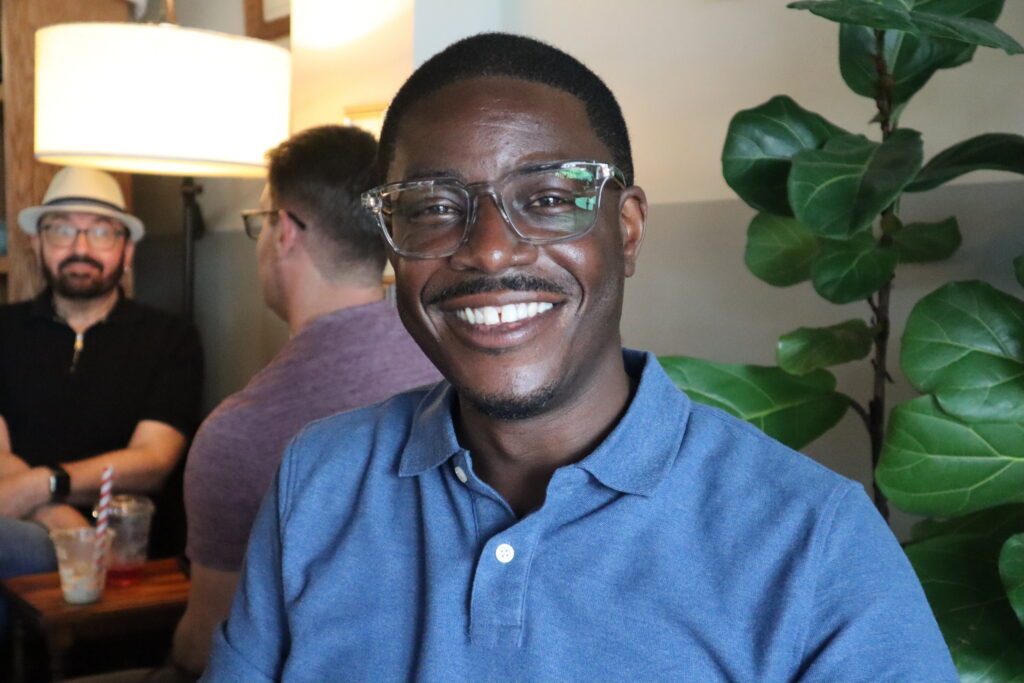
David Crowley, Milwaukee County Executive. (Photo by Isiah Holmes/Wisconsin Examiner)
David Crowley is no stranger to crowded political races. Before becoming Milwaukee’s first African American county executive in 2020, he had to emerge from a hotly contested primary that included Democratic Sen. Chris Larson (D-Madison), former state Sen. Jim Sullivan, Glendale Mayor Bryan Kennedy and then-county board chairman Theodore Lipscomb. Both Larson and Crowley advanced to the general election, which Crowley narrowly won. Over six years later, Crowley again finds himself in a Democratic primary, this time for the governor’s office, packed with experienced policymakers.
Crowley’s opponents this time include Lt. Gov. Sara Rodriguez, state Sen. Kelda Roys (D-Madison), state Rep. Francesca Hong (D-Madison), former Department of Administration chief Joel Brennan, and former Lt. Gov. Mandela Barnes. In a straw poll at the Democratic Party convention in mid-June, Crowley placed fourth, with Rodriguez and Hong finishing first and second and Roys placing in third.
“Even though they’ve done great work in their respective roles, the one thing they’ve never done is actually run government,” Crowley said of the other Democratic candidates during an interview at Pilcrow Coffee in Milwaukee. “I’m the only executive in this race. And what’s also different for me is that I know what it means to be accountable and responsible for my actions and decisions, and how they’re going to affect the masses and the people that I represent.” Another key difference, he added, is that he’s got the “receipts.”
Crowley highlighted how, under his tenure, close to 1,000 units of affordable housing have been created across Milwaukee County. The past four years have also seen drug overdose deaths decrease by 40% with the expansion of harm reduction strategies. In 2023, the county also saw the largest property tax cut in its history, totalling $21 million.
“What sets me apart is the fact that I’ve delivered for folks,” said Crowley. “And I continue to deliver for folks, and I’ve been able to do it in some of the most contentious times, if you will — especially with how partisan we are nowadays — as a lead Democrat representing the largest and most diverse community in the state of Wisconsin.”
In his first statewide race, Crowley said he wants to avoid labeling himself. “I’m a voting Democrat,” said Crowley. “I’m a Democrat that gets things done.” Crowley scoffs at ideological purity tests and the buzz about a rift among Democrats who identify as Socialists versus those who see themselves as moderates. “This is about how do you fight back against the Trump administration, but more importantly not just reacting, but how do we become more proactive when it comes down to Democratic policy that we need to push so we can actually win?”
Crowley is leaning on his track record in his campaign. His platform is laid out in what he calls his “Badger Basics Plan” which includes:
- Bringing universal childcare to Wisconsin, and working to cap childcare costs at 7% of household income
- Establishing universal K-4 across Wisconsin, giving kids a better foundation of learning before entering the school system
- Making sure that school districts have the funding, staff and resources that they need
- Expanding Badgercare as a public health option, and increasing reimbursements
- Repealing Act 10 and restoring the collective bargaining rights for workers
- Implementing restrictions on data centers and Artificial Intelligence (AI), while making sure AI enhances productivity rather than replacing job opportunities
- Supporting programs for vulnerable people, especially the victims of domestic violence
When he’s not busy with his full-time day job running the county, he has been campaigning all over the state. “We have been everywhere,” he said. “I think we’ve done 40-plus forums around the state already, whether we are in southeastern Wisconsin, or Taylor County, or in Brown County, or in Marinette County, or Wausau, La Crosse. We’re traveling everywhere not only to spread the message, but more importantly to listen.” When he was a young organizer, Crowley likes to say, he learned that “if you don’t have a seat on the table, you’re on the menu.”
Confronting questions about race
In his travels, Crowley said, he believes he can overcome negative racial perceptions some voters have about him and the county he represents. “It’s not a real concern for me,” he said of the history-making task of becoming Wisconsin’s first Black governor. “They already trust me to deliver because I’ve been doing it as a county executive and I’ve done it as a state representative.”
In fact, Crowley feels that the question of race comes up mostly in the state’s more diverse communities. “We have been conditioned, because we have been listening to the Republican talking points for so long, to where we have internalized it more and we use it as a reason as to why we can’t get certain things done,” he said of all the conversation about Wisconsin’s racial divide. “And honestly, I think it stops us from getting comfortable with being uncomfortable. Building those relationships, going outside of our geographic comfort zone to talk about the things that we have done here, in one of the largest urban centers in the entire country, and how we can bring those best practices to communities across the state. What’s good for Milwaukee is good for every single town, village, and city in the state of Wisconsin.”
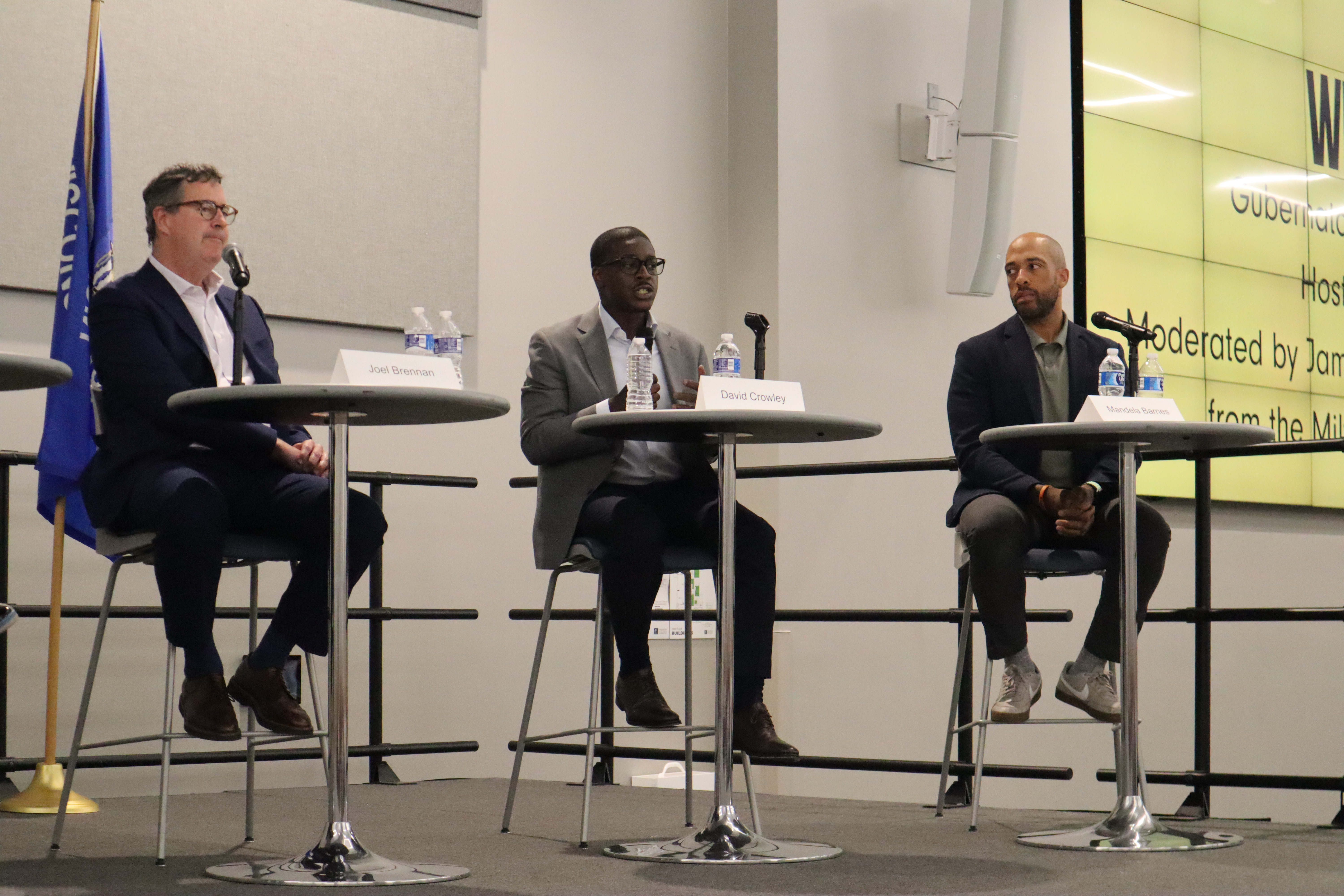
Joel Brennan (left), David Crowley (center) and Mandela Barnes (right). (Photo by Isiah Holmes/Wisconsin Examiner)
Crowley points out that Wisconsin elected Tammy Baldwin, its first openly LGBTQ U.S. Senator. Wisconsin voters also elected “a skinny kid with a funny name by the name of Barack Obama,” he said. “We have been put into a box. It’s our job to think outside that box. It’s our job to shatter that glass ceiling and focus on how we’re going to deliver. Because people don’t care where you’re from. People don’t care what you look like. People don’t care who you love. They care about whether or not you’re going to care for them, and deliver real results moving forward.”
The fact that he performed well in his election to his current post in suburban areas built up Crowley’s confidence. “I know they’ll vote for me, because they voted for me twice already,” he said. “That’s the type of experience that we need to not only stand up to Donald Trump, but that’s going to be proactive and be on the offense to deliver for the 6 million people that call Wisconsin home.”
Going around the state, Crowley has met people who want their voices heard on important issues from childcare and healthcare to lowering utility costs and making housing more affordable. He said he’s learned that even in a divided state like Wisconsin, people agree on more than they realize. “I think that in this particular political climate, as things become more polarized, no matter if you’re the far left or the far right, I think we can all agree that government isn’t working,” he said. “And right now, we need to make sure that we are electing individuals who are not just going to fight back against policies that are going to leave families behind, but how are we going to be proactive in making sure that we’re pushing policies to make sure that when the tides rise, all of us rise.”
Data centers
One of the hottest issues in local communities around the state is the rise of giant data centers, proposed in communities across Wisconsin, and needed to feed the energy demand of a rapidly expanding artificial intelligence infrastructure. By 2023, a United Nations report found, global data centers will require the same amount of water annually as the 1.3 billion people who live in Sub-Saharan Africa, and require enough electricity to equal the annual needs of Pakistan, Bangladesh and Nigeria combined. Communities in Wisconsin have been pushing back on data centers due to concerns about increased utility costs, environmental fallout and the trajectory of AI.
Crowley said “it’s asinine” that the Legislature ended its recent session without doing anything to regulate data centers.
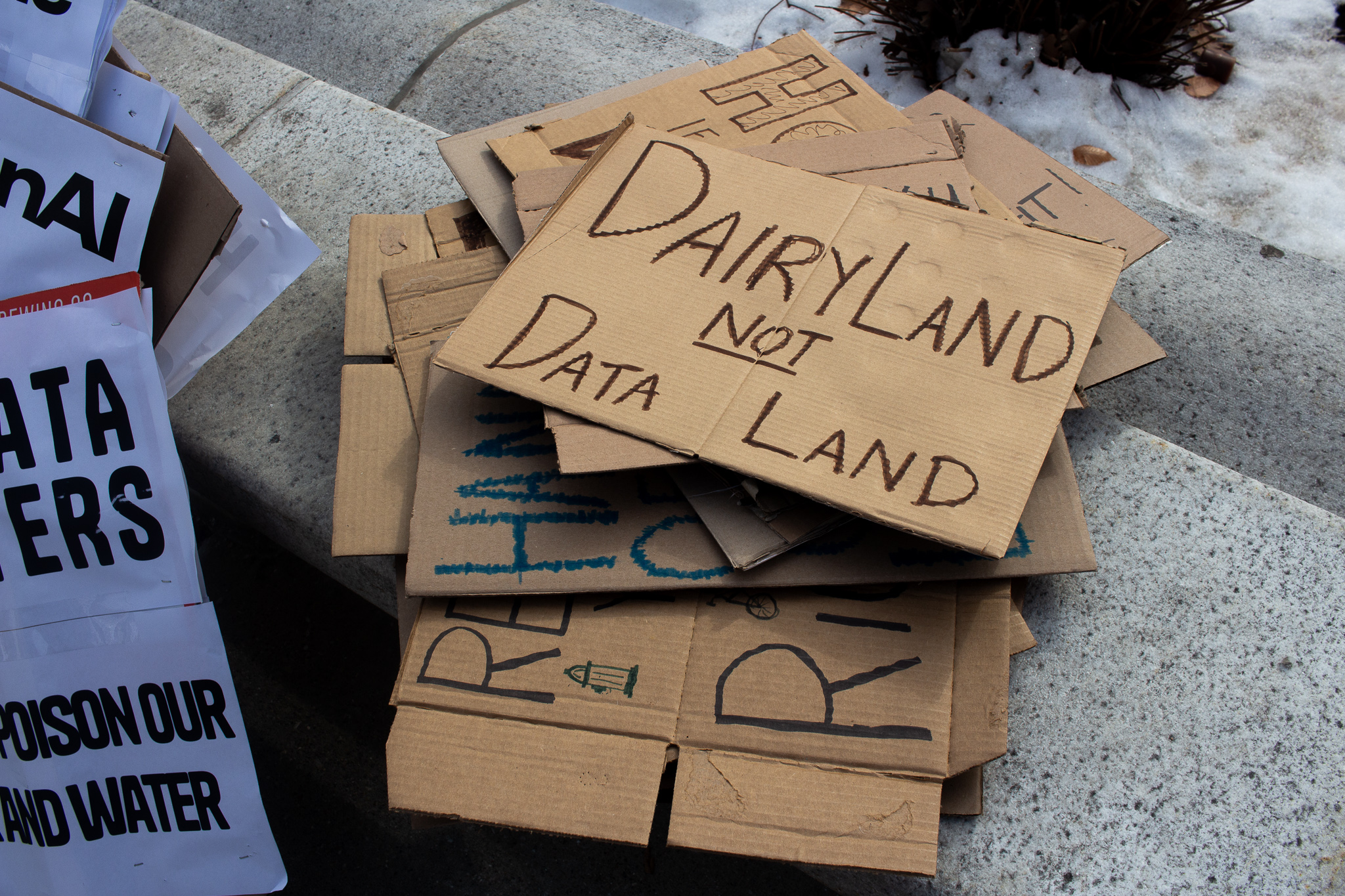
Residents of communities across Wisconsin have opposed the construction of hyperscale data centers. (Henry Redman | Wisconsin Examiner)
Crowley, who is not opposed to data centers, said it’s crucial that the state develop a “framework” to protect natural resources and the people of Wisconsin.
Earlier this year, the Wisconsin Public Service Commission approved an energy rate, requiring data centers to pay 100% of their own energy costs. Data centers should also have to pay 100% of the cost of the energy grid upgrades they require, Crowley said, as well as any infrastructure upgrades. He also wants to tie their development to investments in renewable energy. “I want to see more energy opportunities that don’t cost us any money,” he said. “Wind doesn’t cost us. Sunlight doesn’t cost us.” If Wisconsin invests in renewables, “moving forward it won’t be a huge drain on resources for ratepayers, or for these utility companies.”
Crowley also said that as governor he would require data centers to use union labor, project labor agreements and community benefit agreements. He added he wants to explore how data centers could be leveraged to benefit public schools, communities and already existing industry.
As the leader of a county that has experienced the rise and fall of heavy industry, he said he thinks about how to plan ahead 50-100 years with data centers, to prevent them becoming empty shells, like abandoned Rust Belt factories, in the communities where they are built. He also feels that moving forward, Wisconsin needs to be “intentional” when it comes to giving out tax exemptions and tax credits for data centers, which have already been given $2 billion in tax exemptions. Crowley said that it’s not just the surge of up-front jobs that build the data center to consider, but also the smaller number of long-term jobs on the back-end. Protections need to be put in place to make sure communities are getting ahead, Crowley said.
Education and school choice
Crowley describes himself as a strong advocate for public schools. He, his wife, and his three daughters are all public school graduates But, he said, he also doesn’t believe in eliminating Wisconsin’s entire private school choice system outright. Half of the kids enrolled in school in Milwaukee go to public school while the other half go to private or charter schools. If charter schools were eliminated, that would create a strain on an already stressed public school system, Crowley said. He said he believes in accountability for choice schools and recognition that public schools have a greater responsibility and level of accountability, since they are required by law to serve every child who comes in the door.
Working across the aisle
Crowley is optimistic that, as a Democratic governor, he can work with Republicans in the Legislature, especially since, he says, new voting maps will help depolarize the state. He believes that the old maps forced people into separate corners. “We have to focus on partnerships and collaboration if we want our state to move forward,” said Crowley. He also feels that Democrats need to be prepared to play offense and be proactive. He said voters will need to be patient with a Democratic governor as the party adjusts to its new identity after this year’s elections. With the new voting maps, Democrats have an opportunity to gain a majority in the Legislature as well as the governor’s office for the first time in almost 30 years.
“We have a lot to prove as Democrats,” Crowley said. “We have a lot to prove as leaders of our community, to show that we can govern, we can win elections moving forward, and we can plan for the long term.”
Editor’s note: The Examiner is running periodic profiles of the contenders in the Aug. 11, 2026 gubernatorial primary as well as the candidates in the general election Nov. 3.
Crowley says he has the experience and the ‘receipts’ to be Wisconsin’s next governor was originally published by Wisconsin Examiner.
Political Contributions Tracker
Displaying political contributions between people mentioned in this story. Learn more.
- June 27, 2016 - David Crowley received $50 from Bryan Kennedy




















Astounding to me that David Crowley still touts the 2023 property tax decrease- a PR stunt that was reversed the very next year. Additionally he endorsed the historic MPS property tax hike referendum that year which more than made up for the county’s small decrease.
David Crowley is the best candidate for Governor because he is forward thinking and because he has an excellent record of delivering results as a government executive.
Sadly, as we travel the state in our motorhome, people are shocked when we say we live in Milwaukee. The attitude of those outside Milwaukee’s borders are that we live in a crime ridden, highly dangerous city. This attitude is fed by our current administration. David Crowley will be held responsible for the supposed hell we live in. Our fellow campers have mostly never been to the city but they have stories to prove thier point of view. We try and tell them we have lived here 30 years and never seen a shooting, but that falls on scared attitudes. David Crowley does not stand a chance outside of Milwaukee.
Crowley nor Barnes do not stand a chance of winning the state. Especially since those in central and northern Wisconsin have heard how Crowley let the Milwaukee County employees health insurance lapse and how he allowed MCTS to be mismanaged, causing fare evasion, higher fares and decreased service. He can’t effectively run a county. What makes him think he can lead a state, especially if the Republicans maintain control of the legislature?