

Milwaukee Scooter Crash Spurs Calls For Tougher Scooter Rules
Other Wisconsin cities also considering restrictions on electric-powered devices.
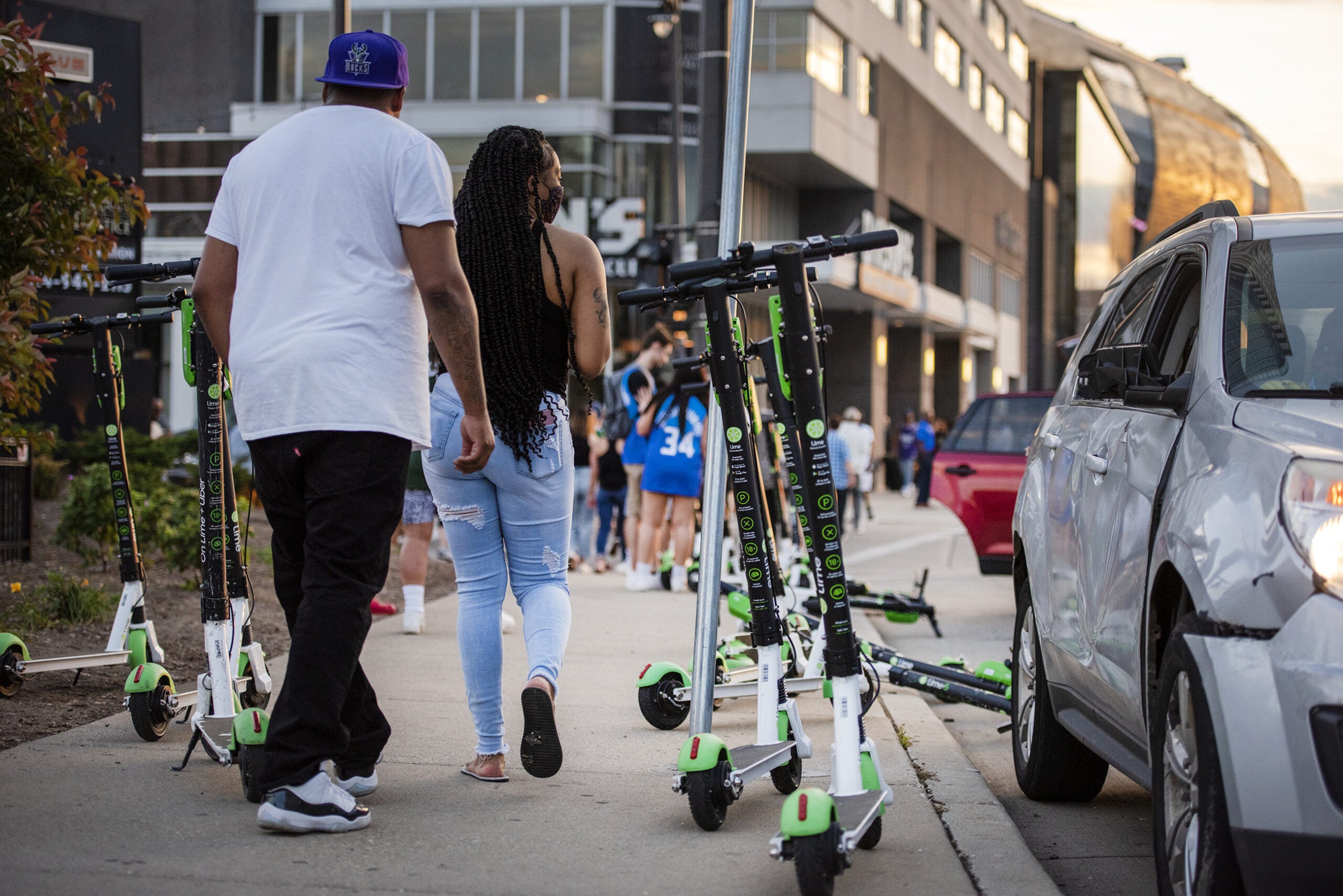
People walk past electric scooters parked on a sidewalk Wednesday, June 23, 2021, in downtown Milwaukee, Wis. Angela Major/WPR
Some Wisconsin communities are considering placing restrictions on electric bikes and scooters.
Waukesha’s Common Council could soon discuss an ordinance to regulate the use of e-bikes and e-scooters in the city. The mayor of Muskego said a city committee may draft a measure aimed at limiting the use of e-transportation devices there.
The West Bend Common Council just passed an ordinance banning people over 16 from riding e-bikes on city sidewalks. The police chief for the city of Chetek in Barron County also recently announced e-scooters and golf carts are banned from operating on county roads within the city.
Meanwhile, a Milwaukee man was hospitalized this week after he was hit by someone riding a Lime scooter in downtown Milwaukee. The person who hit the man has been charged with second degree reckless injury, a felony. A criminal complaint said he was riding the scooter on the sidewalk.
That incident prompted Milwaukee Alder Robert Bauman to push for a review of “safety protocols in our scooter program.”
“I have to say, I wasn’t particularly surprised, because this has been a potentiality since the day scooters were introduced in Milwaukee,” Bauman said.
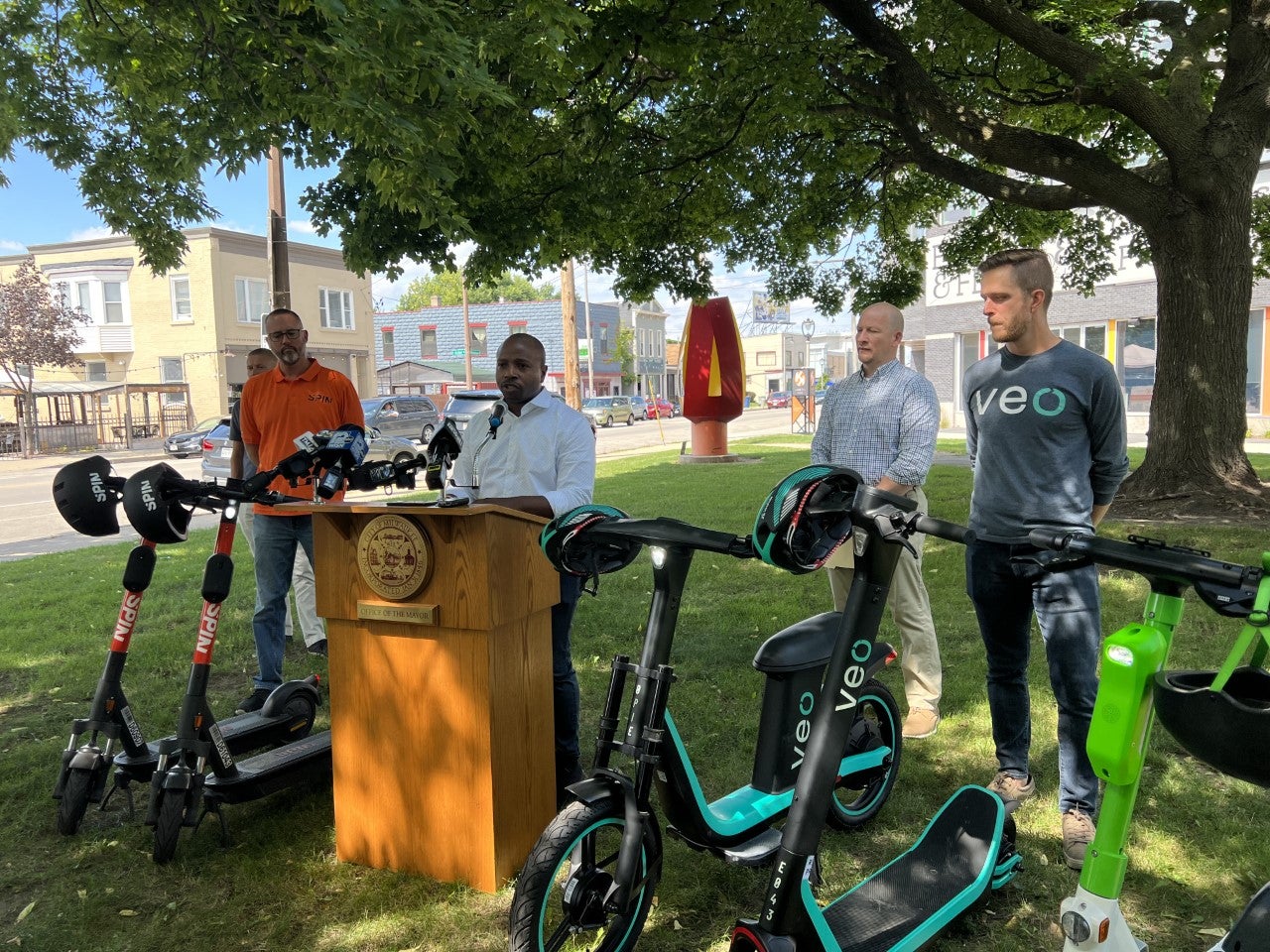
Milwaukee Mayor Cavalier Johnson announces the start of the 2022-2023 Milwaukee electric scooter pilot study on Sept. 9, 2022. Evan Casey/WPR
In Muskego, Mayor Rick Petfalski said there has been a “huge uptick in the last year of the use of all types of e-transportation throughout the community.”
Petfalski said most people are operating e-bikes safely. But he said some young people are now riding e-motos, which do not have pedals and can travel at high speeds.
“They almost look like a little motorcycle,” Petfalski said. “There’s been a large amount of these that have been popping up throughout the community in the last year.”
Petfalski said a city committee could soon draft an ordinance that could limit where e-transportaton devices are allowed.
“It’s only a matter of time before, if we don’t do anything, before someone gets hurt, either the rider of the e-moto or innocent pedestrian or somebody on a regular bike or just walking down one of the trails,” he said.
In the city of Waukesha, Mayor Alicia Halvensleben said a common council committee will be meeting soon to discuss specific regulations around e-bikes and e-scooters. Halvensleben said she saw what happened in Milwaukee this week.
“I don’t want to see that happen here in Waukesha,” Halvensleben said. “I just want to make sure that everyone is safe, and sometimes that means that we have to put in some additional regulations.”
In early June, the West Bend Common Council passed an e-bike ordinance, which says that, “No user over the age of 16 years shall operate an electric bike on permitted sidewalks,” with the exception of a sidewalk that, “has been designated as a recreational trail,” or “For the sole purpose of accessing a crosswalk, recreational trail, or parking lot.”
A news post on the city website said riders who are 16-years-old and younger can still ride e-bikes on the sidewalk.
“Our goal is to ensure the health and safety of residents and visitors, not to prohibit electric bicycles,” West Bend Police Chief Tim Dehring said in the news post. “These bikes are heavier and faster than traditional bicycles, which can create hazards for pedestrians when they’re operated on sidewalks. At the same time, we do want to be conscientious of our younger riders and keeping them out of the street.”
Under Wisconsin law, e-bikes have three different classes.
“According to state statute, e-bikes and e-scooters are considered vehicles on Wisconsin roads, which means they must follow the same traffic laws although Wisconsin DMV does not require a driver license or registration for either one,” a news post from the Wisconsin Department of Transportation said. “Always check before riding on a sidewalk or bike path and refer to the Department of Natural Resources for information on riding e-bikes on state trails.”
“Local ordinances may have additional rules for e-bikes and e-scooters,” the news post added.
Milwaukee alder wants review of city scooter program
The city of Milwaukee has an electric scooter rental program. Last year, riders used the Lime scooters for 1.2 million trips in the city, according to an annual report.
There were 266 scooter program complaints reported to the city’s Department of Public Works last year, with 16 percent of those complaints regarding sidewalk riding.
Bauman said sidewalk riding has been “rampant” in Milwaukee.
“Now we’ve seen what can result from that,” he said.
Kelly Harrop, Senior Regional Lead of Government Relations for Lime, said the company lets users know that riding on sidewalks is prohibited in Milwaukee.
“Lime communicates that to riders through multiple channels, including in-app reminders, our in-app safety quiz- which requires users to affirm they will not ride on sidewalks- as well as stickers on every scooter stating that sidewalk riding is not allowed,” Harrop said in the statement.
Milwaukee Mayor Cavalier Johnson said he reached out to the city’s Department of Public Works after he watched the video of the incident. He said he still believes the city should have an electric scooter program.
“It still has value, it still has importance, but if there’s any other ways in which we can make it safer for … the users of it, but then also for pedestrians as well,” Johnson said.
Some Wisconsin communities considering restrictions on use of e-scooters, e-bikes was originally published by Wisconsin Public Radio.
If you think stories like this are important, become a member of Urban Milwaukee and help support real, independent journalism. Plus you get some cool added benefits.
More about the Milwaukee scooter rollout
- Milwaukee Makes First Move on Scooter Crackdown After Sidewalk Crash - Jeramey Jannene - Jul 2nd, 2026
- Milwaukee Scooter Crash Spurs Calls For Tougher Scooter Rules - Evan Casey - Jun 19th, 2026
- Scooter Users in Milwaukee Smash Ridership, Revenue Records - Jeramey Jannene - Apr 13th, 2026
- Scooters Still Getting Riders in Winter, Raking in Cash - Jeramey Jannene - Jan 29th, 2025
- Milwaukee Scooter Ridership Soars, City Raking in Cash - Jeramey Jannene - Oct 29th, 2024
- Scooters Return To Milwaukee’s Streets, This Time Permanently - Jeramey Jannene - May 17th, 2024
- Scooters Could Net Milwaukee $400,000 Per Year - Jeramey Jannene - Mar 12th, 2024
- Full Legalization of Scooters Ends Up In City Budget - Jeramey Jannene - Nov 3rd, 2023
- Dockless Scooter Pilot Program Begins - Sophie Bolich - Sep 2nd, 2022
- Transportation: Milwaukee Wants Your Input on Future of Dockless Scooters - Jeramey Jannene - Oct 19th, 2021
Read more about Milwaukee scooter rollout here
Political Contributions Tracker
Displaying political contributions between people mentioned in this story. Learn more.
- February 20, 2016 - Cavalier Johnson received $250 from Robert Bauman


Transportation
-
Streetcar Hops To Festival Line Configuration
 Jun 15th, 2026 by Jeramey Jannene
-
Which Urban Areas Do Transit-Oriented Development Best?
 Jun 14th, 2026 by Jeff Wood
-
Wisconsin Now Lets Drivers Buy State Park Passes With DMV Renewal
 Jun 11th, 2026 by Avery Martinez



















I do believe the e-scooters are a good thing in Milwaukee, as for some people, it’s a way to get from point A to B. I also believe that people who ride them, often ride them on sidewalks for their own safety, because they don’t want to get hit by a car. I get it. But as an avid walker / pedestrian, I have almost been hit by scooters a number of times while walking on city sidewalks. You can’t hear them coming and the next thing you know, one is zipping past you. Education and then enforcement are essential.
I’ve never been almost hit by a scooter. I have been almost hit by a cyclist several times, and I’ve been hit by a motorist multiple times while running. The problem isn’t with scooters, it’s with recklessness. Reckless people should face tough consequences. If we’re not banning cars, we shouldn’t be banning scooters.
My opinion: e-scooters are not transportation, but an amusement (operating largely on public property). Not only is their operation a dangerous nuisance, but the ones that are abandoned willy nilly in front yards, at bus stops, and sometimes smack in the middle of a sidewalk are a hazard.
If the answer is more regulation, who will pay for enforcement? – probably taxpayers and not the rental companies. Another example of “Privatize the profits, socialize the costs”.
These scooters don’t belong on the sidewalks, but as a cyclist, I understand that the poor condition of our streets may invite some scooteristas to take the sidewalk. “Scooter Lanes”?
“Privatize the profits, socialize the costs.” An excellent way of illustrating what is going on with these scooters. My observations of riders is…….they are young, urban, disregard most safety measures, ride on sidewalks however, when on the roadway they dip in and out causing dangerous situations for motorists and themselves. I also see scooters abandoned all over the city including my residential neighborhood. This is another example of poor city leadership, including the alders and mayor. They failed again at anticipating problems with this nuisance.
It would be interesting to know how many police citations have been issued to people operating scooters on our city’s sidewalks. Regulating without enforcement is a useless attempt to control a growing problem and yet another case of foisting an added responsibility onto an understaffed police force.
Operation of scooters should be suspended until the owners of Lime and other scooter companies have sound solutions in place and approved by the Common Council.
Most of the issues cropping up with electric scooter riders using spaces that are not meant for them are based in obsolete infrastructure. When mass-produced cars were introduced 100+ years ago, the streets were for all users and the cars were all driven by people who didn’t understand how their speed could kill. Unsurprisingly, there was so much death back then that cities all over the country had mass protests pushing to ban cars from the cities altogether. Cities considered putting speed governors on cars to limit how fast they could go.
We can talk about whether or not that should have happened, but the point is that the infrastructure updated and changed with the times. The streets became the dominion of the cars, and other users were pushed to the outer edges and sidewalks. Walking in the street outside of designated crossing zones got you labeled a “jaywalker” in clever auto industry propaganda to shame people using the street exactly as their ancestors had for thousands of years. The ensuing decades led to the US and other countries tearing down the infrastructure built for everyone and rebuilding it specifically for the car and car alone.
Sure, that was partially due to the automotive industry’s efforts at propaganda and lobbying governments in order to sell more cars and the oil needed to run them, but it was also due to the fact that cars are an incredibly useful tool at getting from exact point A to exact point B over long distances with decent comfort, ease and speed. It’s to the point that for almost all living memory, basically none of us remember a time when cars were not the kings of the road.
But transportation is evolving again. Miniaturization of electricity is in the early stages of changing how we get around. The bicycle, which never lost its usefulness in dense urban settings and efficiency in cost and energy, has gained a larger following due to the advent of the electric bike. Electric scooters, like the Lime one ridden by the misguided individual on Old World Third Street the other night, have taken something that was a kid’s toy and turned it into a dynamic, cheap mode of transportation. It’s not a shock that these two cheap types of travel are seeing an explosion of popularity right as the average annual cost of ownership of an automobile in the US has reached $12,000 at the same time we’ve been experiencing the most major cost of living crisis since those mass protests were trying to get cars banned.
It is a result of evolving transit options in cities with infrastructure that is increasingly becoming obsolete. Streets being the sole dominion of cars is an antiquated notion and building our infrastructure to only support the automobile is going to result in more and more incidents like the other night.
Yes, this scooter rider made a bad decision and endangered the life of the owner of a prominent local nightclub as well as everyone else he didn’t hit on that sidewalk. But the setup of Old World Third Street – with a faded painted “bike lane” that does *zero* to protect its occupants from fast cars, ending abruptly right before the scene of the other night’s collision – played a very, very big role in the scooter rider making that bad decision.
Walk that space. You will see that even if the scooter rider had ridden where he was supposed to go, he would have been in a lane separated from fast moving cars only by a totally faded line of paint and that completely ended when the parklets for local bars and restaurants came in. Needing to abruptly merge with car traffic at night – hoping that the person behind the wheel of the car you’re going to move in front of isn’t staring at their phone – is exactly the kind of setup that will drive an inexperienced young road user to take to the sidewalk.
It’s not that the car is obsolete the way it made horses and buggies obsolete. Instead, we need to move back to a time where the streets were the dominion of all users regardless of their chosen mode of transportation. That’s because cars are capable of very high speeds and bikes/scooters are capable of significantly higher speeds than pedestrians.
So we need our infrastructure to segregate and protect road users of different speeds. Pedestrians need to be the only users of the sidewalk. That means that bikes and scooters, both of which travel in that 10-20 mph speed, should be grouped with each other. And we need curb-protected space to enforce that segregation. Cars =/= Bikes/Scooters =/= Pedestrians. Keep them separated, physically and visually limit the speeds of cars to lessen the damage done in collisions, enforce laws banning children from riding electric bikes/scooters, and push these electric motorcycles into the car lanes where they belong if they’re capable of speeds over 28 mph.
Mayor Johnson and his staff have been better than expected at guiding the evolution of our infrastructure to its multimodal future. Curb-protected bike/scooter “micromobility” infrastructure on streets like Walnut, Van Buren, Lake Drive and now Jefferson are strong examples of the city working to make things right.
But time has come to ramp up their efforts. We need a real network and we needed it yesterday. Everywhere the protected bike network becomes fully built out, ridership soars. The more people feel safe to ride these efficient modes of transportation in protected space, the fewer cars there are on the road – which has the added benefit of freeing up congestion for car drivers and buses.
By the way, if you’re someone who drives a car and never wants to do anything but drive a car, you should take solace in the fact that the country that is the absolute craziest about bicycles – the Netherlands – only has about 27% of its road network carrying protected bike lanes. That’s another benefit of the bikes – they take up very little space compared to my SUV that’s the size of a studio apartment.
We can do better and we must do better, but don’t let a bad decision by a misguided young man distract you from the fact that our street infrastructure is in desperate need of modernization.
My guess is that there is little to no enforcement of violators. At least, not enough to penalize those who violate the rules and make the penalty stiff enough to take it seriously AND set an example.. As gerrybroderick says, it would be nice to know the numbers when it comes to the violations and citations. 266 complaints, not action taken.– doesn’t tell us much. There are ways to track the user/violators electronically when they rent them with a credit card/digital wallet info. . Lets see what happens with the guy that violated the rules for this event, and crashed into the pedestrian. There must be a substantial penalty. And not the usually “naughty naughty” slap on the wrist that we see given out in Milwaukee so often. In 2025, the City reported revenue of $728,494.25 from the rentals. That is enough to say it can pay for enforcing safety on the sidewalks.
The city makes over $700K a year from this program that it uses to give out bike helmets and fund bike infrastructure improvements. This funding is irreplaceable for the long-term transition to a more bike/scooter friendly transportation system. In the end, this comes to education and enforcement. Many parents don’t do much to teach their kids how to ride a bike beyond getting them out of their training wheels. Our schools need to step in and do more in that regard.
The negative scooter comments here would apply orders of magnitude higher in a similar situation for vehicles, but for some reason we don’t care as much about those risks, or the nuisance of, the use of public property, or “privatizing profits, socializing the costs” when it comes to cars. For me the sad part here is yet another reactionary action by an alderperson which is likely to result in more poorly written ordinances. Time for some strategy in advance for a change, but I’m not sure our alders are capable of it.