

Comptroller’s Audit Finds Little Financial Oversight of Bus System
Muddled governance, lack of financial oversight for MCTS goes back many years.
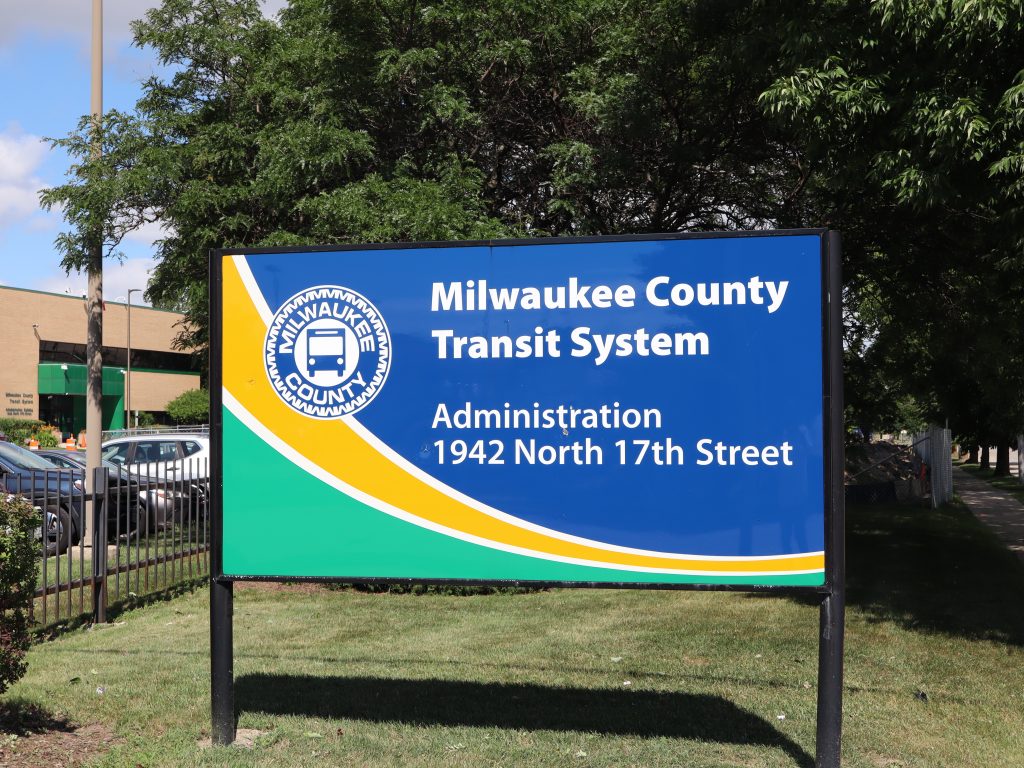
MCTS Administration building, 1942 N. 17th St. Photo taken July 18, 2025 by Graham Kilmer.
Muddled governance and a lack of financial oversight likely contributed to the Milwaukee County Transit System‘s unexpected and controversial $10.9 million budget deficit midway through 2025.
An audit of MCTS by the Office of the Comptroller paints a picture of a transit agency operating with little financial oversight and expansive authority to spend money without approval from elected officials. Mysterious financial reporting and a muddy governance structure have also confused supervision of the system, which had a $151.6 million operating budget in 2025.
In June 2025, MCTS released a statement to the press announcing an unexpected $10.9 million budget deficit for the year and plans to cut service by 20,000 hours. Elected officials were blindsided by the announcement. The Office of the Comptroller announced an audit less than two weeks later.
Emails later obtained by Urban Milwaukee showed top system officials planned to keep the deficit concealed from the Milwaukee County Board of Supervisors until the fall budget process, but were forced to report it when it became too big to close without cuts. MCTS officials pushed a statement out to the media before notifying elected officials, worried the Amalgamated Transit Union (ATU) Local 998 would notice the service cuts when drivers received their fall schedules.
Since then, there has been significant turnover at the top levels of MCTS and the Milwaukee County Department of Transportation (MCDOT). Both have new leaders in MCTS president and CEO Steve Fuentes and MCDOT director Joe Lamers. On May 16, they signed a letter to the comptroller’s office agreeing to respond to the 15 recommendations in the audit, ranging from financial reporting to compliance with public meeting laws.
“The Milwaukee County Department of Transportation (MCDOT) and Milwaukee County Transit System (MCTS) are committed to improving clarity and transparency related to MCTS in coordination with the Milwaukee County Board of Supervisors,” Lamers told Urban Milwaukee Friday in an email. “We are already looking into the implementation of recommendations outlined in the comptroller’s report and will work with Milwaukee County departments including, but not limited to, the Office of the Comptroller and Corporation Counsel to provide updates to the board and other stakeholders on progress.”
MCDOT and MCTS are connected through the complicated governance structure of county transit. In 1975, Milwaukee County took possession of the failing Milwaukee & Suburban Transport Corporation, a private mass transit system. It contracted with Milwaukee Transport Services Inc. (MTS) to run the system. For nearly four decades, MTS legally operated the system on a contractual basis. Then in 2014, it was legally recognized and transitioned to a quasi-governmental instrumentality of MCDOT, no longer operating the system on a contract basis.
The transition was codified with changes to the bylaws for MTS. The comptroller’s audit found these changes and the lack of legal clarity during the transition in 2014 likely contributed to the muddled financial oversight and the eventual 2025 deficit.
MCTS is overseen by the MTS board. The majority of the board is made up of MCDOT employees, including the director. Also sitting on the board is the president and CEO of MCTS and one Milwaukee County supervisor. The system is also overseen by two county board committees. The Committee on Transportation and Transit has authority over route changes and policy. The Committee on Finance oversees spending.
But under the existing oversight structure, the majority of spending that caused the 2025 deficit did not receive the approval of either the MTS board or the county board. When MCTS needed bailing out, however, it required spending approval from the county board.
“While there are bylaws for the MTS board to follow, the roles of the county board, the MTS board and MCTS are unclear,” the comptroller’s office found. “Due to the unique funding structure for MCTS, it is difficult to analyze its finances, and the majority of drivers for the 2025 deficit fall outside of items approved by either the MTS or county board.”
Spending Without Oversight
Under the current oversight structure, MCTS is able to enter into massive contracts without seeking approval from either the MTS board or the board of supervisors.
For example, in 2024, MCTS switched to a single-source contract for paratransit, the system’s mass transit program for people with disabilities. To do this, it ended up contracting with Transdev, a French multinational transportation corporation. In 2025, the value of the contract was $22.4 million. Other county departments must seek county board approval for any contract worth more than $100,000.
“Based on 2025 costs, the projected seven-year cost of [the Transdev] contract is over $156 million without including escalators,” according to the report.
The Transdev contract has also been a fiasco for MCTS. When the company took over, service quality immediately dropped, and riders have complained of persistently poor service ever since, as Urban Milwaukee has reported. The contract was also one of the primary causes of the 2025 deficit, as Transdev ran $3.4 million over budget.
Financial Reporting a Mystery
MCTS is supposed to provide financial reports to the county’s Office of the Comptroller to ensure the system is managing to its annual budget. During the audit, it became unclear how MCTS has been tracking its finances for the past few years.
“According to interviews with MCDOT and MCTS, there is uncertainty on how the previous MCDOT senior financial manager pulled together the monthly reports for each section of MCDOT,” the report said, and “the previous MCDOT senior financial manager had often entered breakeven fiscal status to the comptroller’s office because there was COVID money to cover the projected deficit.”
Is MCTS Following County Laws?
When the comptroller’s office tried to determine who was responsible for making sure MCTS was following county ordinances, it couldn’t get a clear answer.
Some MCTS officials thought it was MCDOT’s duty, while MCDOT officials thought it was MCTS’s role. When they requested a list of ordinances that MCTS consults to determine it is following local laws, MCTS replied by simply stating it is following “applicable ordinances.”
But the county’s ordinances don’t provide much guidance anyway. Most of the county’s ordinances regarding transit and county authority are either vague or simply cover the county board’s Committee on Transportation and Transit.
What Does the MTS Board Do?
The answer, not very much. Since 2014, the board has only met 17 times. The last time it met for more than 20 minutes was 2020. It was never briefed on the 2025 budget deficit.
The board mostly meets to rubber-stamp administrative items, according to the comptroller’s report. Other boards with oversight of county-owned properties or operations meet far more frequently. One example held up by the comptroller, the Mental Health Board, meets frequently and engages in extensive discussion of matters related to the mental health system.
Looking at other counties and transit agencies, the comptroller’s office struggled to find a direct comparison. “We did not find a transit system with the same management model as MCTS,” the office reported. But it did find other county and transit oversight boards engaged in far more robust financial briefing and oversight.
The understanding among top transit officials has been that the MTS board plays a mostly perfunctory role, meeting infrequently. The county board is viewed as the actual board of directors, despite MCTS failing to loop the board in on major contracts and federal investigations.
The MTS board also has a history of taking action without even meeting. For more than a decade, it has at times reached decisions by voting over email.
MCTS Never Reports Federal or State Investigations
MCTS is regularly reviewed and investigated by state and federal agencies, but the findings or recommendations never make it to the county board or the MTS board.
In December 2025, the Federal Transit Administration (FTA) found MCTS was showing deficiencies in four areas, including “Financial Management and Capacity” for its inability to fund its existing system. This information never made it to elected officials on the county board. It has been more than 10 years since MCTS reported the findings from an FTA review to the county board.
Legislation Link - Urban Milwaukee members see direct links to legislation mentioned in this article. Join today
If you think stories like this are important, become a member of Urban Milwaukee and help support real, independent journalism. Plus you get some cool added benefits.


MKE County
-
Mayor, Congresswoman Moore Stump for Crowley As Early Voting Begins
 Oct 21st, 2026 by Graham Kilmer
-
Republicans Attack Crowley Over Wife’s Nonprofit Work
 Oct 19th, 2026 by Graham Kilmer
-
Zoo’s New Parking System Is a Success
 Oct 17th, 2026 by Graham Kilmer
Transportation
-
Wisconsin Wins $218 Million Grant To Extend Hiawatha To Madison
 Oct 16th, 2026 by Jeramey Jannene
-
MCTS Reports Rising Fare Collection
 Oct 15th, 2026 by Graham Kilmer
-
$80 Million Air Cargo Center Takes Off At Mitchell Airport
 Oct 15th, 2026 by Graham Kilmer


















For health reasons, I have always been dependent on MCTS. Because of that, I have been considered a second class citizen by many. Until about 15 years ago, when MCTS underwent a major management change, MCTS wasn’t perfect, but it was so much better than it is now.
I blame the ineffective County Board, the entitled culture that until recently ran MCTS and the fact that not enough folks realize the importance of how a dependable, affordable transit system is vital to a thriving community. When I was still on site, I always noticed how full the buses were during bad weather.
Fare evasion still continues. Current management should prove they are serious about cutting it down to zero fare evasion by not allowing any nonthreatening person (and most are nonthreatening, IMO) on the bus. I am paying the price for the inept management of the County Board and MCTS. I have a larger fare and fewer options. More of my time is spent getting places, while I subsidize the entitled culture. IMO, this includes numerous operators who I see allow nonthreatening folks on the bus. They should be penalized by having an hour’s pay docked for every nonthreatening person they allow on board without paying fare.
Too bad folks don’t realize how vital a decent transit system is to a community. The inept County Board should be ashamed of itself, as should the County Board. IMO, the former lax, inept management of MCTS does not know the meaning of the word “shame.” They are nothing but scam artists, IMO.
This is another example of the incompetence of county officials. Tax payers are viewed as open bank accounts with unlimited resources. From the County Executive to the managers to the elected officials, all have demonstrated poor skill sets in managing tax payers money. And to think the County Executive wants to be Governor is scary. The checks and balances of good governance is no where to be seen. It seems the only activity the County Board engages in are the useless feel good resolutions that have no purpose other than to make it look as something is being accomplished.
One footnote about the transition for MTS from a contractor to a quasi-governmental instrumentality: This change happened because the Feds and/or State ruled that if MTS was truly a contractor, then the contract must be put out to open and competitive bidding at renewal. This was tried once but the process was flawed (to put it politely) and abandoned. The county board (presumably on advice from counsel), was told that if MTS became attached to county government (i.e.: quasi-governmental instrumentality) the requirement for bidding would not exist. This is why the change occurred in 2014.
Thank you for this report. It nearly makes one’s head explode. As James says above: “,,,,, to think the County Executive wants to be Governor is scary…”.Clearly, public sector honchos hold those jobs because they could not succeed elsewhere. Sadly, as in this example, they keep reminding us of that so “voters beware”.