

Milwaukee Area Homes Are Least Affordable in Midwest
New analysis shows Milwaukee metro area had the highest housing price-to-income ratio in the region.
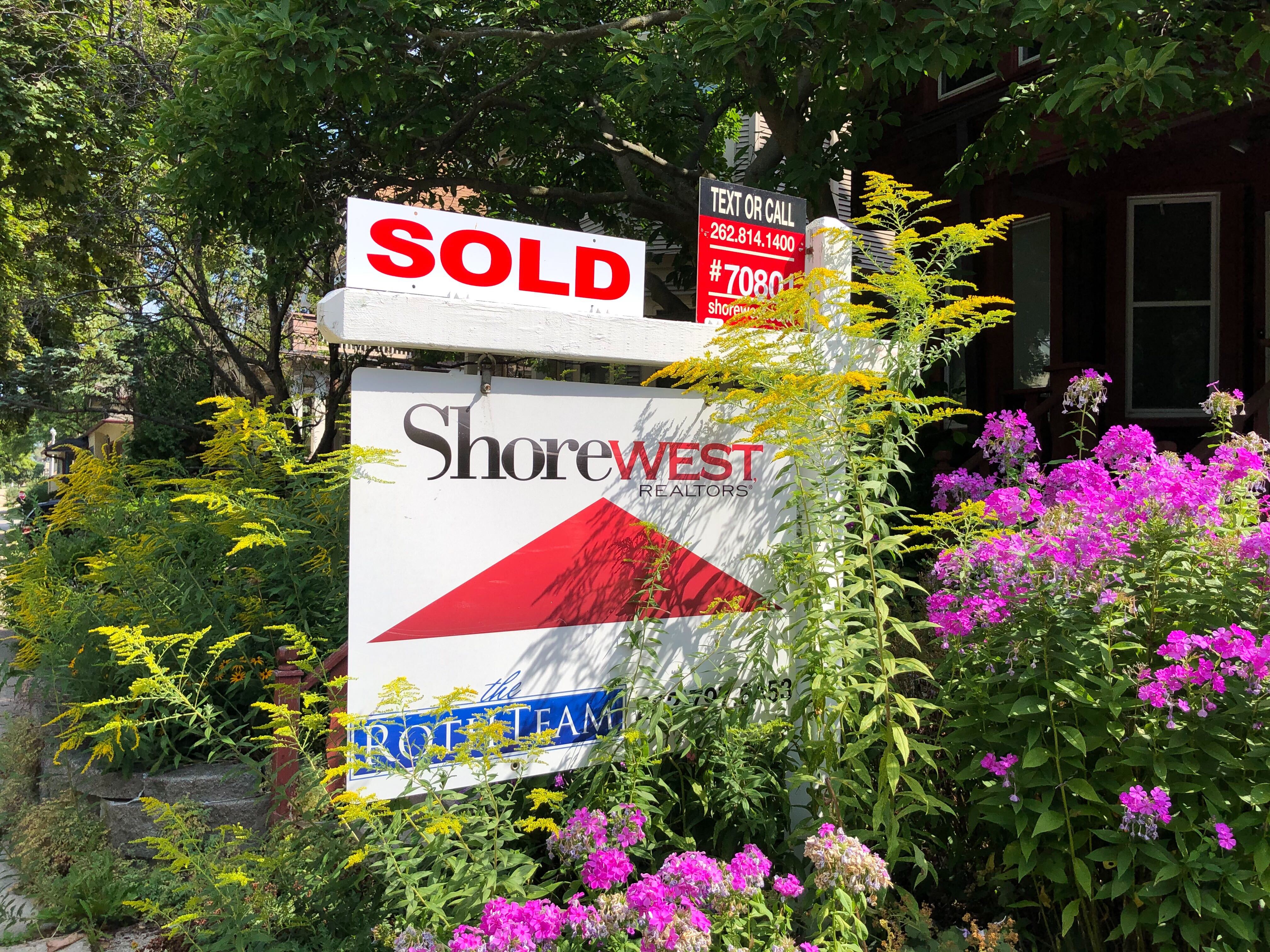
Sold sign. Photo by Dave Reid.
The median home cost in Wisconsin’s two biggest metro areas is at least five times the median household income in those communities, among the highest in the Midwest.
That’s according to a New York Times analysis using data from Moody’s Analytics, which found that housing across the country has become less affordable as home prices have risen much faster than incomes.
The data showed the Milwaukee metro area — which includes suburban Waukesha, Ozaukee and Washington counties — had the highest home price-to-income ratio in the Midwest as of 2025, with median home prices about 5.2 times higher than median incomes.
The Madison metro area wasn’t far behind, with the median home price five times higher than the median income.
Milwaukee’s median price, according to the Moody’s data, was $421,900 with a median household income of $81,300. Madison’s was $465,400 with a median household income of $93,700.
Kurt Paulsen, a professor of urban planning at the University of Wisconsin-Madison, said the price-to-income ratio is a measure of housing affordability that adjusts for both changes in incomes and housing supply and demand.
He said a median-priced home generally cost around three times a median income for much of American history, but that number has risen in recent years. Nationally, the median home now costs about five times the median income.
“It basically tells you that the income you have does not go as far because in order to buy a home you need more income,” Paulsen said.
Those affordability pressures are being compounded by rapidly rising home prices in recent years.
Wisconsin, particularly the Milwaukee metropolitan area, ranked near the top of the country for home price appreciation over the last decade, according to a recent report from Construction Coverage, a company that provides research to the construction industry.
Wisconsin had the 13th highest home price growth over the last decade, while Milwaukee ranked second among large U.S. cities, with median home values climbing 138 percent between 2016 and 2026, according to the report.
Jonathan Jones, the report’s author, said in a statement that those rankings suggest some of the strongest price growth in the country has occurred in “more historically stable and affordable Midwest markets.”
“Part of what makes Milwaukee stand out is that it started from a relatively low price point, but the scale of the appreciation also points to sustained demand and growing competitiveness in the market over time,” he said. “Even after that growth, Milwaukee remains substantially more affordable than many large coastal metros.”
Data from the Joint Center for Housing Studies at Harvard University shows the price-to-income ratio rose faster in the Milwaukee and Madison metros than in either the Chicago or Minneapolis metros from 2014 to 2024.
Paulsen said the Madison and Milwaukee metros both have high incomes and strong job growth, which helps drive housing prices.
But the growth of new housing in both regions over the last 15 years has been “significantly below what it was” in the 1990s and early 2000s, Paulsen said.
“We had a significant decline in production due to the Great Recession, and we have simply never recovered,” he said.
That’s contributed to a supply and demand imbalance that’s helped drive higher prices.
Madison Ald. Will Ochowicz, who is also a lead for the Madison is for People housing advocacy group, said home prices outpacing incomes makes it more difficult for residents to save for a home and qualify for a mortgage.
“High home prices relative to income are definitely a significant barrier for people,” he said. “These rising home price ratios are very bad in terms of new buyers getting into the market.”
The Joint Center for Housing Studies data also shows that median home prices in all of the state’s metropolitan areas rose faster than incomes over the same period.
“It’s especially acute in Madison and Milwaukee because Madison and Milwaukee have both higher income and faster job growth than the rest of the state,” Paulsen said. “What drives that unaffordability change in the rest of the state is partially due to a lack of new housing being built, but is mostly driven by just the increase in construction costs.”
Paulsen also said housing development in Dane County has “recovered significantly, but not sufficiently” to keep up with population growth over the last decade, while the Milwaukee metro still has a “high shortfall in housing production.”
From 2015 to 2025, the New York Times analysis showed the Madison metro had an average of 61.2 annual housing starts per 1,000 households and the Milwaukee metro had an average of 17.9 housing starts per 1,000 households.
While Madison, like many communities, is working to address its housing shortage, Ochowicz said he fears it won’t be enough.
“The Madison metro area is the fastest growing part of the state, so for all of those housing starts, we’re also getting a significant number of people who are moving here,” Ochowicz said. “We’re expecting tens of thousands of people to move here over the next several years, and I don’t think we’re building enough owner-occupied housing to meet the demand for that.”
Homes in Wisconsin’s largest metros among least affordable in Midwest, analysis finds was originally published by Wisconsin Public Radio.
If you think stories like this are important, become a member of Urban Milwaukee and help support real, independent journalism. Plus you get some cool added benefits.



















As a homeowner, I am not comfortable about this but certainly dont want my house to depreciate in value. Can we engage a dialog with out “sewer socialist” friends to think “outside the box” how to address stagnant wages, inflated home prices, and returning to a sanity that will allow and encourage home ownership by individuals, couples, trouples, & families, and enhance in neighborhoods we all take pride in? Or am I in a fantasy land?
What do you mean by “sewer socialist” and why should any voice be excluded from discussions of our housing shortage.
Do you realize that such services as plowing snow, wastewater management, road maintenance are all examples of how socialist efforts have make life better. Mayor Daniel Hoan introduced public health nurses to help stem TB especially among the poor and immigrant communities. That is also an example of socialism at work.
The best way to address the housing shortage in the Milwaukee era, would be to talk with those impacted by the shortage. That is not the developers. And is certainly not the national property management companies (think of the “We buy ugly houses.”) Also keep in mind that, while homeownership is a good thing, it is not appropriate for everyone. What Milwaukee needs is plan with stated goals and criteria for meeting housing needs. We need to be creative including public/private initiatives like the JFS proposal to replace the McGovern Park Senior Center with a community center and senior housing. This area can no long afford to simply say NO to unconventional projects. Instead, we need to think in terms of Cost/Benefit analysis. The question should be, how can a project be structured to meet the needs of everyone impacted. We need to develop a collaborative instead of advocacy approach. Which is also advocated by socialists.
MKWagner: I totally agree. “Sewer socialists” is descriptive, not demeaning. Lots of our past mayors– including Daniel Hoan, Frank Ziedler, and a bunch others contributed mightily to our community.