Microsoft Doesn’t Fear Review of Its Data Centers by Great Lakes Compact
Its data centers in Mount Pleasant projected to use 8.4 million gallons of water per year.
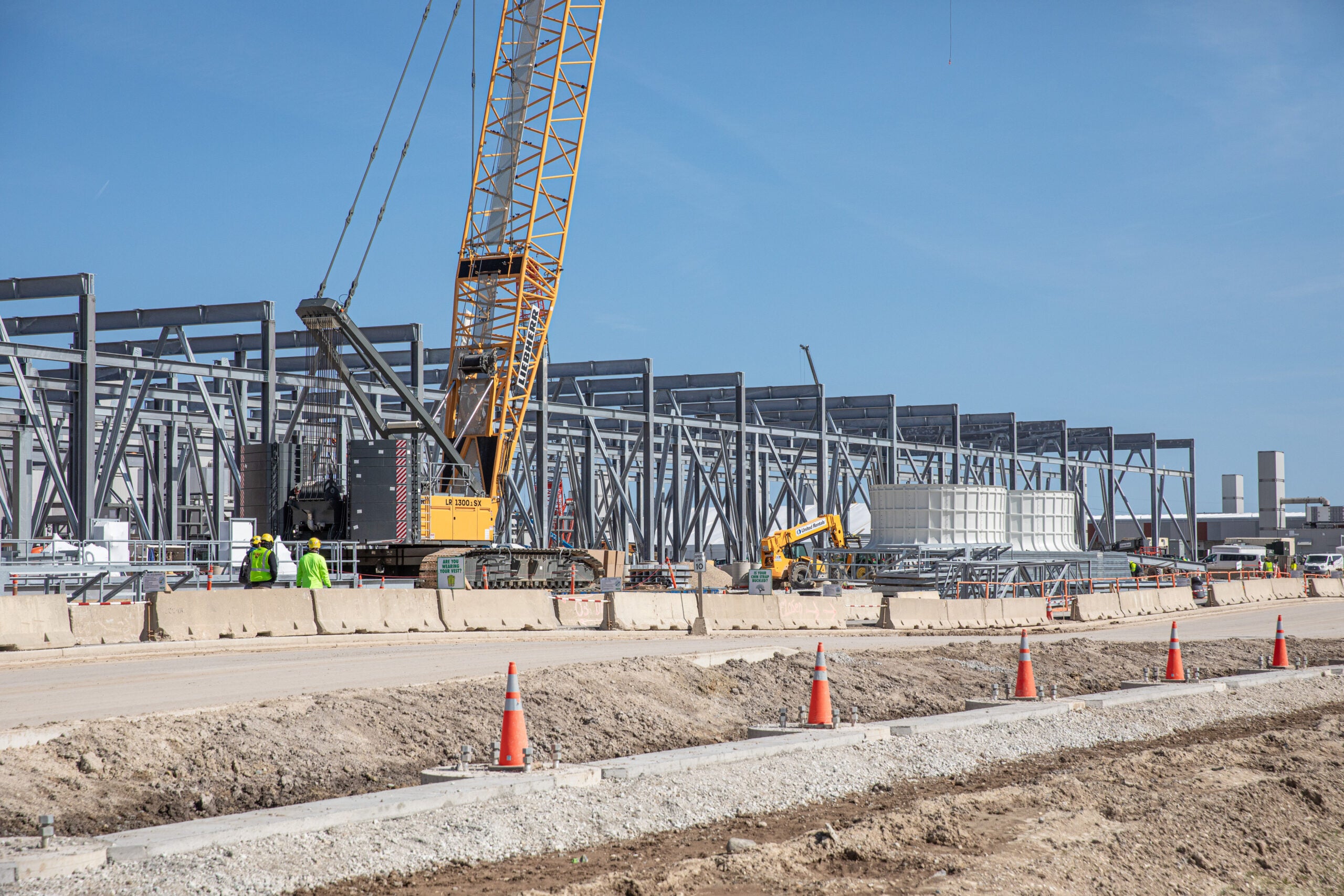
Construction is ongoing on the first phase of Microsoft’s data center project in Mount Pleasant on March 11, 2025. Photo courtesy of Microsoft
A Microsoft official said Tuesday the company doesn’t expect its data centers in the Great Lakes region will reach a threshold that would trigger greater review under the Great Lakes Compact.
The remarks came during a panel discussion about data centers, their water use and the landmark agreement that largely bars water diversions outside the Great Lakes basin. The event was hosted by the Conference of Great Lakes St. Lawrence Governors & Premiers, which works to protect 20 percent of the Earth’s fresh water.
Microsoft Corp. is investing $20 billion in data centers at Mount Pleasant, which can divert Great Lakes water because the community straddles the basin line. The company is also building data center campuses in Michigan and Indiana, which are among eight Great Lakes states that are subject to the compact.
When withdrawals occur inside the basin, individual states manage those proposals. However, they must notify other Great Lakes states and two Canadian provinces if a project would result in the loss of 5 million gallons daily over any 90-day period. At that point, a proposal would be subject to nonbinding regional review.
Jonathan Noble, Microsoft’s senior director of infrastructure government affairs, said the company’s projects would not come close to hitting that threshold.
“At this point, the majority of those projects are expected to be closed-loop (systems) and therefore would be comparable to what we’re seeing at Mount Pleasant, if not, even less,” Noble said.
Closed-loop systems rely on less water to directly cool chips in servers compared to evaporative cooling that uses more water. According to projections released by the city of Racine last year, Microsoft’s data centers at full buildout would use up to 8.4 million gallons each year.
The city released that information only after an environmental group sued when it was refused the data in a public records request.
Microsoft reported its Mount Pleasant data centers would use an average of roughly 15,000 gallons daily and 468,000 gallons per day on the hottest days, according to Adam Freihoefer, water use section manager for the Wisconsin Department of Natural Resources.
Early on, Freihoefer said the DNR had been “flooded” with questions about water use because large data centers can use up to 5 million gallons daily.
He said data centers have not hit those water volumes yet. But he said their vast demand for electricity would also have an impact on water use.
“We may see that with energy … if there’s going to be a larger demand on grid peaking plants, for example,” Freihoefer said. “We’re starting to see those come in for natural gas.”
We Energies is adding 3 gigawatts of power to the grid to meet data center demand, including gas-fired plants.
Freihoefer said the state’s 10 largest power plants used about 715 billion gallons of water in 2024, of which 9.7 billion gallons were lost. That year, more than 1.2 trillion gallons were withdrawn for power generation, the lowest volume on record in Wisconsin amid plant closures.
Under the compact, states track water used and lost to determine cumulative impacts to the Great Lakes Basin, which are assessed every five years.
Peter Johnson, deputy director of the Great Lakes St. Lawrence Governors and Premiers, said the last few assessments show there hasn’t been substantial impacts from water withdrawals and diversions to Lake Michigan.
“But we are continuing to keep our eyes on that,” Johnson said.
At the end of 2024, the Great Lakes region hosted 20 percent of all data centers nationwide with more than 500 facilities, according to University of Virginia researchers.
When asked whether water availability plays a role in siting data centers, Noble said Microsoft’s growth in the Great Lakes region is the result of customer demand, shovel-ready industrial sites and access to power — not proximity to fresh water.
Amid data center growth, tech companies have faced backlash over a lack of transparency and reporting requirements around their water and energy use. In March, Microsoft announced it was ending nondisclosure agreements with local governments related to data centers.
While a welcome shift, environmental advocates noted neither Microsoft nor other companies are required to end secretive deals, said Helena Volzer, senior source water policy manager for the Alliance for the Great Lakes. She added there are no water use reporting requirements for data centers.
“If they’re using public supply, which 97 percent of data centers are, that reporting requirement would fall to the water system,” Volzer said. “As long as the water system has the capacity to supply, there’s really no requirement to report on that water usage.”
While Microsoft is using closed-loop systems, she said data centers still need a lot of energy that’s driving additional water use at power plants. A Clean Wisconsin analysis last year estimated that energy used to power data centers in Port Washington may use at least 54 million gallons daily if provided by nonrenewable sources.
Microsoft doesn’t expect its data centers will trigger review under Great Lakes Compact was originally published by Wisconsin Public Radio.
If you think stories like this are important, become a member of Urban Milwaukee and help support real, independent journalism. Plus you get some cool added benefits.