

How Monopoly Power Killed a Key Milwaukee Industry
Anti-union mega corporations led to end of 150 years of meatpacking in Milwaukee.
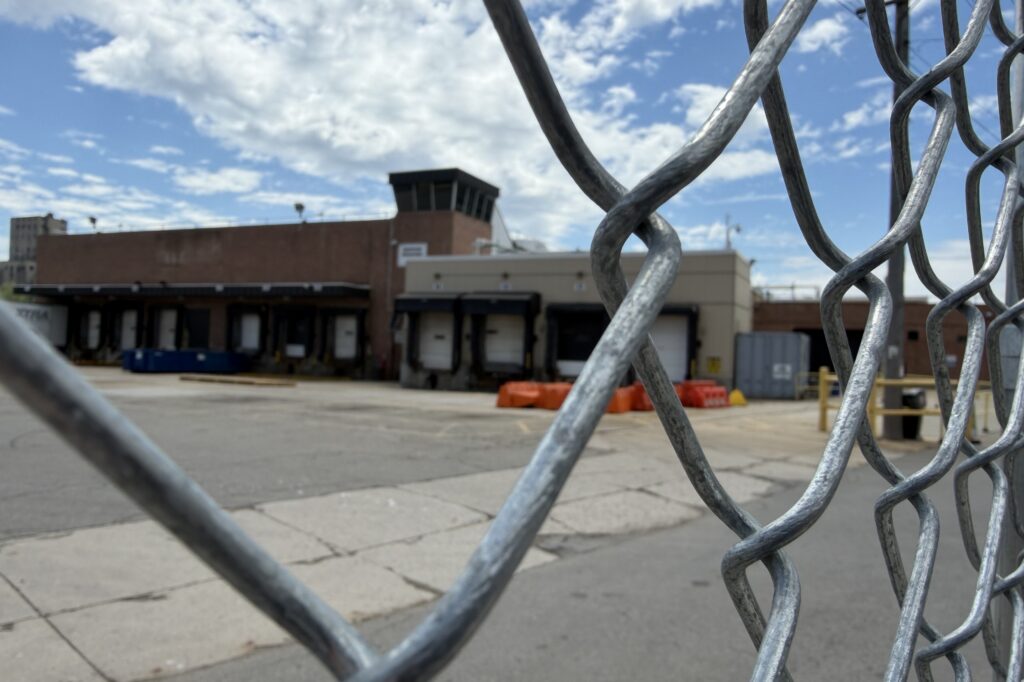
The Cargill plant in Milwaukee’s Menomonee Valley was the last of what was once a vibrant meatpacking industry in Wisconsin’s largest city. (Photo by Michael Rosen)
The announcement that Cargill is closing its Menomonee Valley plant and laying off 221 packinghouse workers is just the latest blow to Milwaukee’s industrial working class. It marks the end of more than 150 years of meatpacking in the Menomonee Valley. It is a cautionary tale illustrating how huge, highly concentrated industries dominate the United States economy to the detriment of workers, family farmers and consumers.
Meatpacking was one of Milwaukee’s leading industries through much of the 19th and 20th centuries. The industry and city grew together as firms slaughtered, processed and packaged livestock — particularly hogs and cattle — purchased from local farmers and distributed products for regional, national and international markets. Because the work was hard, dangerous, cold and dirty, it provided an entry into the working class for Milwaukee’s newest residents — immigrants from Germany, southern and eastern Europe at the turn of the 20th Century, then from the Jim Crow South, Mexico and more recently even Myanmar and the Middle East.
Some of Milwaukee’s most iconic names are associated with meatpacking. John Plankinton, for example, opened a butcher shop in 1844 on what is now West Wisconsin Avenue, and John and Frederick Layton opened Layton and Son a short time later on what is today North Water Street. In 1852 the Laytons partnered with another firm to establish a larger meatpacking operation in the Menomonee Valley. As the marsh was filled in and canal and rail networks developed, the valley’s large, flat areas emerged as an ideal location for the city’s fledgling meatpacking district that lasted until Cargill announced it was closing its last remaining Milwaukee plant.
The loss of the plant’s 221 jobs was not preordained or a consequence of Adam Smith’s invisible hand. Rather it was the direct result of anti-union corporate policies and the federal government’s failure to pursue existing anti-monopoly regulations that once protected regional meatpacking firms, their unionized employees and the ranchers and farmers who produced the cattle.
The fight against monopolies
The Sherman Antitrust Act, the nation’s first law to prohibit monopolistic business practices, was actually passed following a congressional investigation of price fixing in meatpacking. Five companies — Armour, Swift, Morris, Wilson and Cudahy, together known as the Beef Trust — controlled 55% of the market at the beginning of the 20th century. For decades, the federal government tried to break up the Beef Trust without success. But after an FTC inquiry concluded that these companies had conspired to raise prices and shared livestock information to lowball ranchers for their cattle, the Beef Trust members were forced to sign a consent decree in 1920.
The agreement required them to sell off their stockyards, retail meat stores, railway interests and livestock journals. A year later Congress created the Packers and Stockyards Administration (PASA) to prevent price fixing and monopolistic behavior. These changes established federal oversight over the industry and helped reinvigorate packinghouse workers’ efforts to unionize, which culminated in the 1930 industrial union drives. In the decade after World War II, almost 90% of the industry was unionized. Pattern bargaining established master agreements that standardized wages, benefits and working conditions at the major packing companies. Smaller firms signed contracts that matched those at the larger firms. Packinghouse workers’ wages rose to 20% above average manufacturing wages.
For the next 50 years the large meatpackers competed with hundreds of small regional firms like those in Milwaukee’s Menomonee Valley. As recently as 1970 the nation’s four largest meatpackers slaughtered only 21% of the nation’s cattle.
But beginning in the 1960s packinghouse workers and their unions came under attack when Iowa Beef Processors was organized as a nonunion operation in the countryside of Iowa and Nebraska, far from the unionized urban meatpacking centers. Currier Holman, one of its founders, was blunt, declaring, “Business, as we pursue it here at IBP, is very much like waging war.” Iowa Beef used its cost advantage to undermine the unionized packing plants. “The price cut should be deep enough to force some of our competitors . . . out of business,” declared IBP vice president Perry Haines in the early 1970s, according to an internal memo disclosed years later in court records.
And Iowa Beef was successful. Profits at the country’s largest meatpacking firms soared as labor costs declined and labor productivity increased. In the late 1970s and early ‘80s, more than a thousand packing plants closed. Between 1963 and 1984, the number of packinghouse workers in urban areas fell by more than 50,000; workers in rural plants went from 25% of the national workforce to 50%. Packinghouse workers’ wages were decimated. By the 1990s, packinghouse workers’ wages were 20% less than the average manufacturing wage. Today, meatpacking workers are among the lowest paid and most exploited manufacturing workers.
A union defeat sets the stage for monopoly
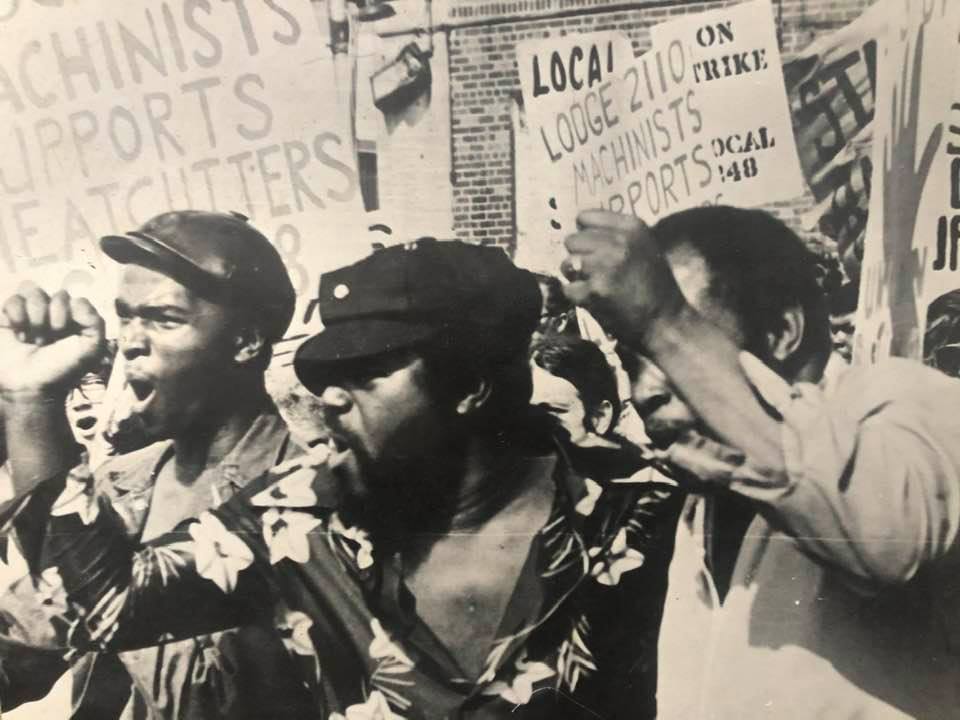
Presented with a contract cutting wages, Milwaukee meatpacking workers went on strike in 1975. The employers hired replacement workers, an action that until then was almost unheard of in industrial Milwaukee. (Photo by Bill Drew/from the collection of Michael Rosen)
In 1975, Milwaukee was the scene of a heroic fight that packinghouse workers and their union waged against the draconian cuts in compensation and to protect their jobs. It began with a contract proposal from the Milwaukee Independent Meatpackers Association, representing eight companies in the city, that slashed wages and benefits. Local 248 of the Meat and Allied Foodworkers Union went on strike.
The day the strike began, the eight employers began hiring replacement workers, some recruited from as far away as Nebraska and Texas. It was the first attempt by Milwaukee employers to bust a union since World War II. The Menomonee Valley filled with angry picketers — Black, Latino and white, rallying together to protect their jobs. But after 15 months, the employers association had their victory and decertified the union, while hundreds of hard-working union men lost their jobs. Full-time permanent employees were replaced by low-wage workers, frequently hired through temp agencies. The strike legitimized replacement workers, setting off waves of attacks on Milwaukee’s working class and their unions, including at Patrick Cudahy 10 years later, and contributed to the economic collapse of Milwaukee’s Black community.
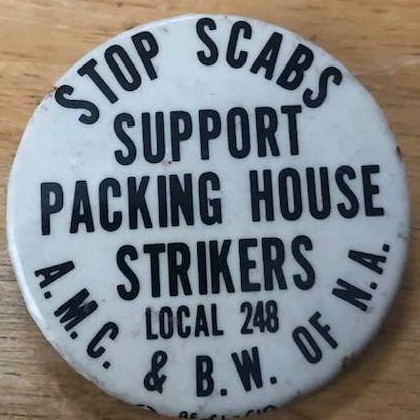
A pin in support of striking packing house workers in 1975. (From the collection of Michael Rosen)
As the strike dragged on, Bernie Peck, the owner of Peck Packing, the largest of the firms in the employers’ association, bought out smaller firms in the group. He eventually sold the company to Sara Lee Meat Group in 1985. Sara Lee Meat Group was sold to Emmpak, which was eventually sold to Cargill Inc. — today one of four meatpacking firms that control the U.S. market. Cargill shuttered most of the Milwaukee operations in 2014, laying off over 600 workers, leaving only the ground beef plant that is now being eliminated, the last remnant of the historic Menomonee Valley meatpacking district.
Today, Cargill, the largest privately held company in the United States, and the other three giants — Tyson Foods, JBS USA and National Beef — dominate more than 80% of the U.S. fed-cattle market. That gives them near-total control over cattle prices and the national beef supply chain, a power they have abused relentlessly against ranchers and consumers alike. The words of Upton Sinclair from “The Jungle” ring as true today as when he wrote them in 1906: “They were a gigantic combination of capital, which had crushed all opposition, and overthrown the laws of the land, and was preying upon the people.”
In February 2025, JBS USA agreed to pay $83.5 million to settle a class-action antitrust suit alleging that the company, along with Tyson, Cargill and National Beef, colluded to suppress the prices paid to ranchers and inflate downstream margins — one of several cases documenting the industry’s monopoly practices. In October, Tyson and Cargill settled for a combined $87.5 million. These are not isolated incidents but part of a broader price-fixing economy, in which the meatpackers share market data, restrict capacity and move in lockstep to extract profit from both ranchers and consumers. The meatpackers also delay slaughter schedules to force ranchers into distressed sales and manipulate captive-supply contracts that lock independent producers into one-sided terms.
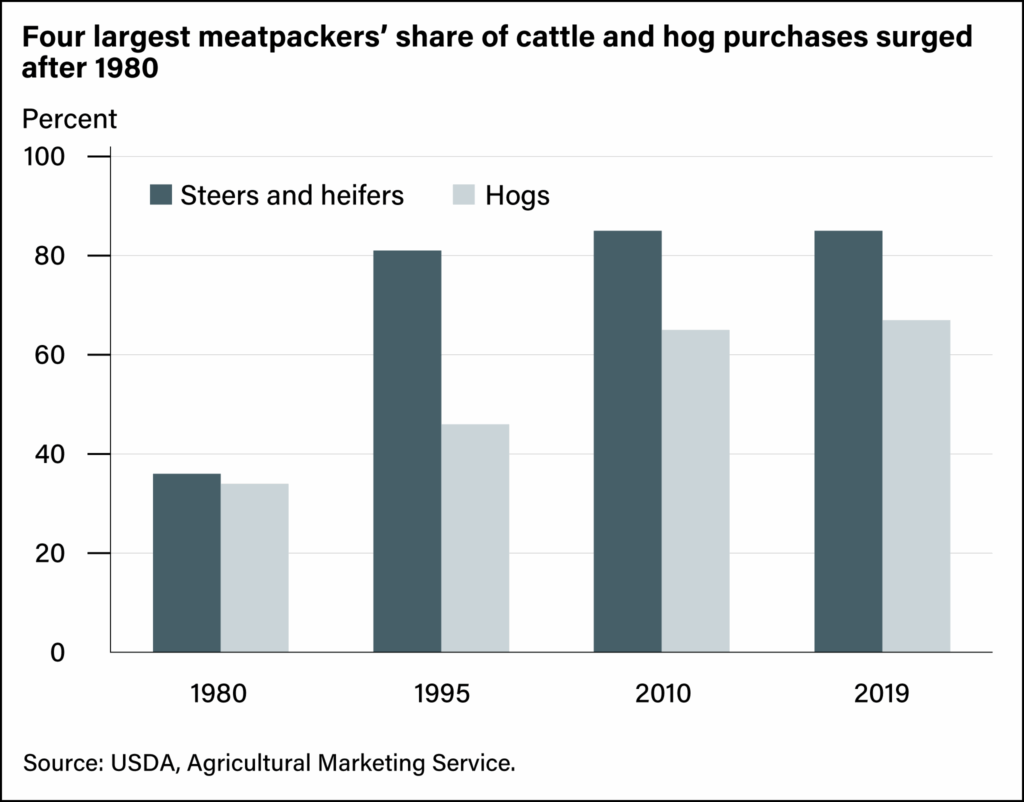
Between 1980 and 2019, the four largest meatpacking companies in the U.S. came to dominate the market for cattle and hog producers. (US Department of Agriculture graphic)
The repeal of Country-of-Origin Labeling (COOL) has amplified meatpackers’ power. With labeling transparency gone, packers can legally import cheap beef from Mexico, Brazil, or Argentina, blend it with U.S. product, and sell it under a domestic label. Consumers pay premium prices believing they’re buying American, while ranchers receive depressed bids for cattle amid increasing import competition. COOL’s repeal effectively legalized country of origin misrepresentation, enabling packers to and reap near-monopoly profits from deception and price fixing.
While ranchers lose leverage and see their herds shrink, and consumers pay more at the supermarket, the meatpackers’ margins have soared. USDA data show that the gap between what ranchers are paid for cattle and what consumers pay for beef has widened sharply in recent years — clear evidence that meatpackers are capturing an ever-larger share of the final beef dollar even as U.S. cattle inventories decline.
How monopoly power costs workers — and the community
The result is a market that looks competitive on paper but operates like a monopoly — where a handful of corporations control price setting, labeling, and distribution from feedlot to grocery shelf.
The number of workers in the industry has fallen precipitously, while output per worker has increased by 79%, according to the Department of Labor. In essence, fewer people are producing more and working harder. As the meatpackers increased chain speeds, the number of debilitating injuries to workers caused by the repetitive motions of their arms, wrists and hands began increasing. Labor Department figures show that from 1973 through 1986, the number of workdays lost each year to injury or illness at meat plants rose from 136.6 per 100 workers to 238.3. By contrast, among manufacturers overall, lost workdays over the same years hovered between 70 and 90 per 100 workers and at several points dipped below 70.
The attacks on packinghouse workers’ unions and the increased economic concentration of meatpacking firms are bad for workers, ranchers and consumers. And it is not an anomaly. Most important sectors of the United States economy — industries as varied as airlines, cereal, soft drinks, fire trucks and even concert ticket sales — are dominated by a handful of firms. The result is monopoly profits for the companies while workers are exploited. Meanwhile the consumers and the suppliers that survive are at the mercy of these ravenous companies.
The lack of antitrust action has destroyed an iconic Wisconsin industry and the jobs of its packinghouse workers. The end of Cargill is a canary in the coal mine for the U.S. economy.
Anti-union monopoly power kills an iconic Milwaukee industry was originally published by Wisconsin Examiner.


Op-Ed
-
Joel Brennan Will Be Ready on Day One To Be Governor
 Jun 30th, 2026 by Tom Barrett
-
Former Wisconsin Governor Announces Endorsement
 Jun 25th, 2026 by Martin Schreiber
-
Coal Is Not Beautiful, Clean or Cheap
 Jun 23rd, 2026 by Jonathan Patz

















Thanks, Mike. Great article. This reminder that the days of the robber barons continues unabated, in some part explains the current and growing support for the Democratic Socialists’ of America. Calling those who yearn for fairness in the market place, ‘Commies’, no longer works for those intent on maintaining their wealth and privilege through the use of transparent propaganda. Here’s to the continued success of the D.S.A.!