Net Zero Greenhouse Gas Emissions by 2050 for Wisconsin Farms Unlikely
Emissions rose by 20% over last two decades. New report says bold actions needed.
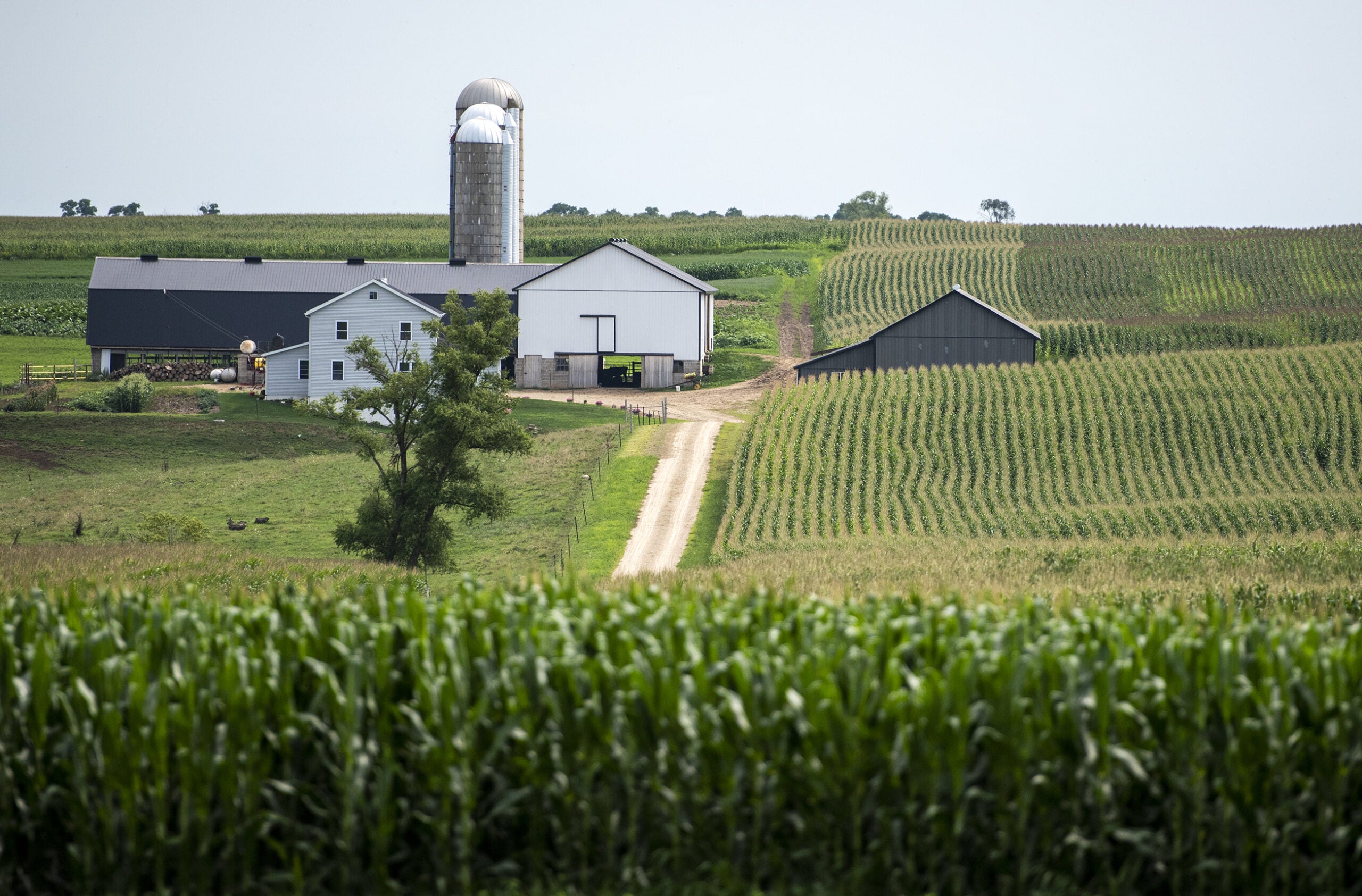
Rows of crops grow near a farm in Lafayette County on Thursday, Aug. 12, 2021. Angela Major/WPR
A report released this month finds Wisconsin farming would have to undergo a major transformation to reach net-zero greenhouse gas emissions by 2050.
Even so, authors admit the changes they propose aren’t likely to be realistically achieved under current political and socioeconomic constraints.
Environmental group Clean Wisconsin released the report along with groups that include the Savanna Institute, Michael Fields Agricultural Institute and the University of Wisconsin-Madison’s Grassland 2.0 initiative.
While hurdles exist, they say their findings identify barriers and changes needed to reduce state agriculture emissions, which rose by 20 percent in the last two decades.
The report’s authors note Wisconsin’s climate action plan currently recommends using state programs and funding that pay farmers to increase carbon storage through practices that include no-till farming, cover crops and management of nitrogen fertilizer.
Paul Mathewson, the report’s lead author with Clean Wisconsin, said increasing those practices alone would only offset 6 to 9 percent of the roughly 19 million metric tons of greenhouse gas emissions produced by the state’s agriculture sector. At most, tweaks to growing crops like corn and soybeans, as well as confined dairy production, would only offset a third of those emissions.
“Simple changes to that system — the annual cropping systems — like no-till and cover crop, are really just not adequate to really get us anywhere close to net-zero,” Mathewson said.
As farmers face rising costs and lower prices for corn and soybeans, the report states Wisconsin could reach net-zero goals by embracing perennial systems and reducing fertilizer. Those systems include growing perennial crops, such as hazelnuts and Kernza, along with agroforestry and silvopasture that combine trees with crops and livestock.
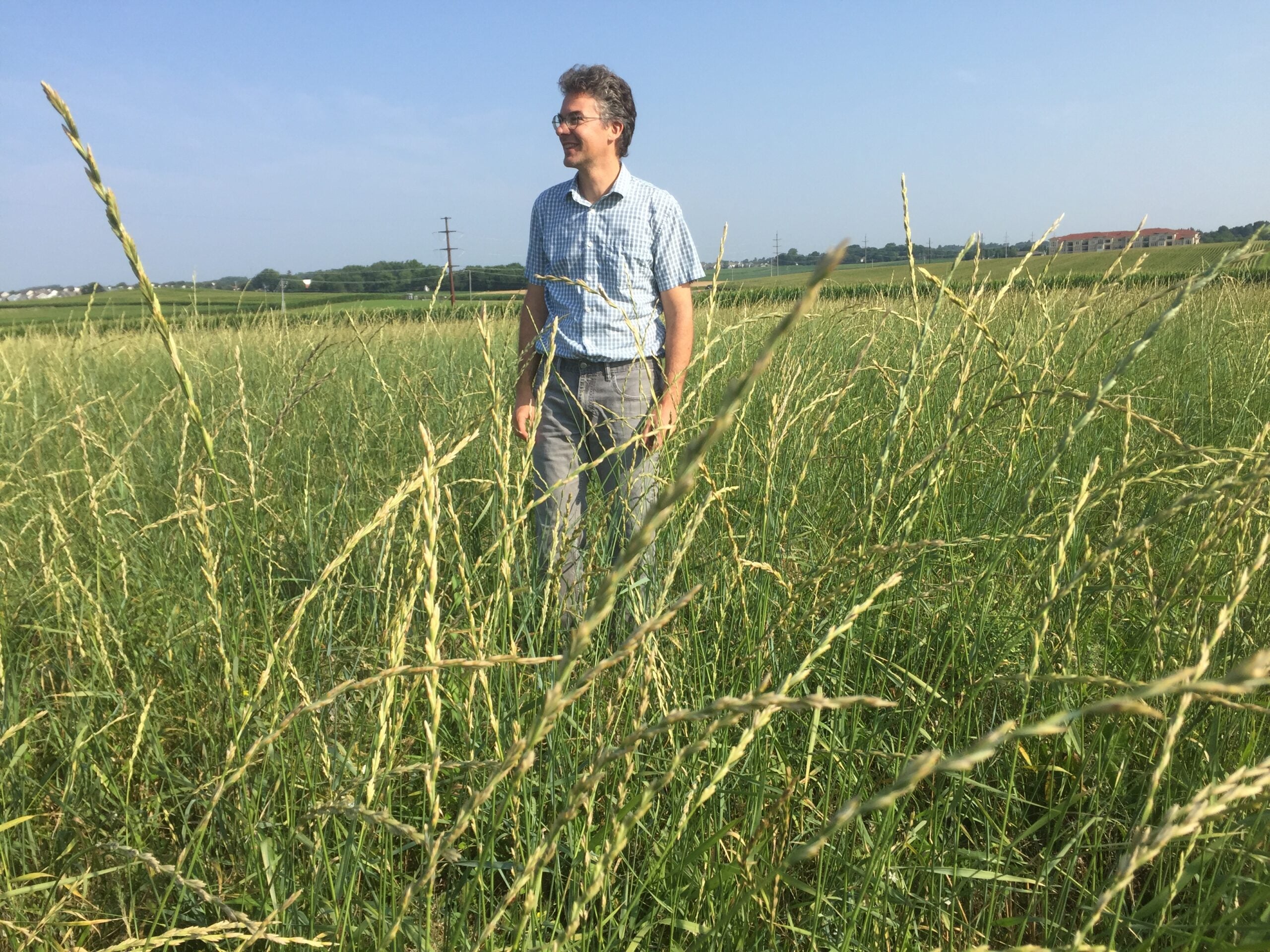
Valentin Picasso, associate professor in the UW–Madison Department of Agronomy, standing in a field of KernzaⓇ, a perennial grain crop. Photo courtesy of Picasso
Report urges reduction in fertilizer, shift to perennial systems
To meet or exceed net-zero goals, the report says that would require 100 percent adoption of no-till farming and cover crops, a 20 percent reduction in nitrogen fertilizer use on cropland and improved grazing practices.
In addition, the state would have to shift to perennial agriculture practices on 30 to 43 percent of annual cropland. Those changes would shift current land use on roughly 4.1 to 5.9 million acres in Wisconsin.
Under the most aggressive transition, those practices would be combined with shifting large dairy operations to a 100 percent grass-fed diet. But since grass-fed cows produce less milk, the transition would result in a 42 to 57 percent drop in milk production.
The report notes its findings are strictly ecological and do not include a comprehensive economic analysis of impacts to farm communities and the economy.
Randy Jackson, a contributing author of the report, argued there shouldn’t be more animals than the land can support. Jackson, a UW-Madison professor of grassland ecology, said shifting to more perennial grasslands would lead to cleaner water, more biodiversity and more land storing carbon.
“If we switch from a confined feeding operation to a grass-fed operation, you’re going to have fewer animals, they’re going to produce less, but it should be a lot more profitable on a per-cow basis, even if it’s less productive,” Jackson said.
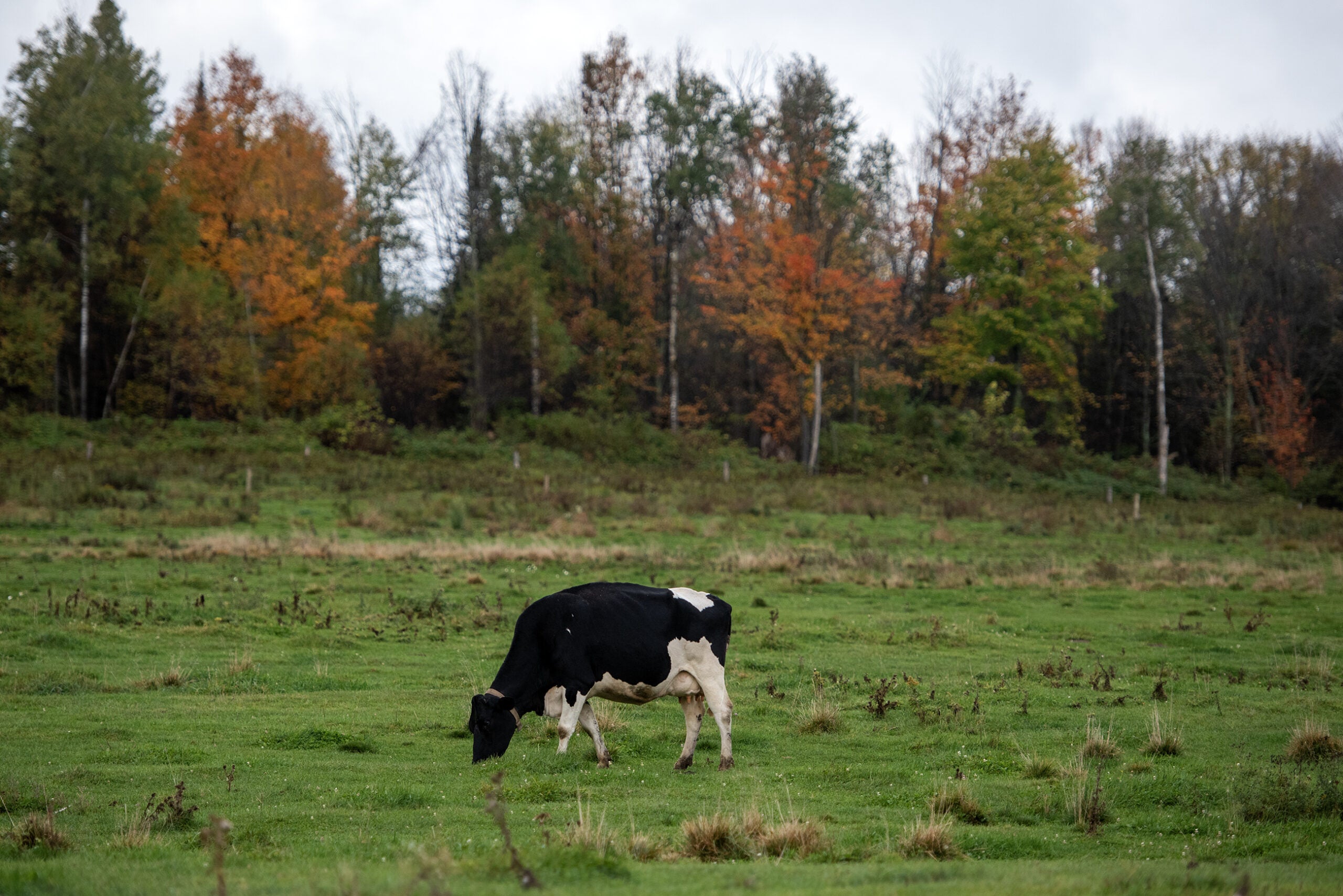
A cow raises in front of changing fall leaves Friday Oct. 6, 2023, in Emery, Wis. Angela Major/WPR
However, he said shifting to perennial systems would take a concerted effort by the private sector and consumers. The report cites limited technical assistance and lacking financial support for such a transition, as well as limited markets and a lacking supply chain.
Nicole Tautges, research director with the Michael Fields Agricultural Institute, contributed to the report. She’s conducted research on Kernza, a perennial grain crop. The relatively new crop provides environmental benefits by reducing soil runoff and improves water quality. But farmers have faced challenges with low yields and limited markets.
“We need to be developing novel food products. People need to eat more locally. We need to develop supply chains that can support practices that support this goal in the state,” Tautges said.
UW-Madison researchers have estimated Wisconsin agriculture contributes between $902 million and $3.3 billion worth of damages tied to greenhouse gas emissions each year. Wisconsin’s ag industry generates $116.3 billion to the state’s economy each year.
The Dairy Business Association and members of the multi-state association Voice of Milk have invested considerable resources to develop farmer-led solutions to address challenges highlighted in the report, said Jim Eckberg, the association’s director of science and innovation. He said farmers have made improvements in tackling greenhouse gas emissions, sediment loss and phosphorus runoff.
“While we are encouraged by current work being done on farms, we realize there is still opportunity in farmer-led innovation for holistic approaches to address whole farm emissions,” Eckberg said.
“It is important to take the entire farm, the local resources and the farm’s overall objectives into consideration when looking at environmental impacts,” Eckberg continued. “Innovation in animal nutrition, genetics and breeding, herd management decisions, cow comfort and care and more can accelerate improvement in emission reduction.”
Eckberg said farm groups welcome collaboration to develop innovative and economical solutions on environmental issues facing agriculture.
As agriculture emissions rise, report says bold change needed to reach net-zero in Wisconsin was originally published by Wisconsin Public Radio.
If you think stories like this are important, become a member of Urban Milwaukee and help support real, independent journalism. Plus you get some cool added benefits.