
The Impact of Two Cases Challenging Wisconsin’s Congressional Districts
Both judicial panels have essentially kicked the cases back to Wisconsin Supreme Court.
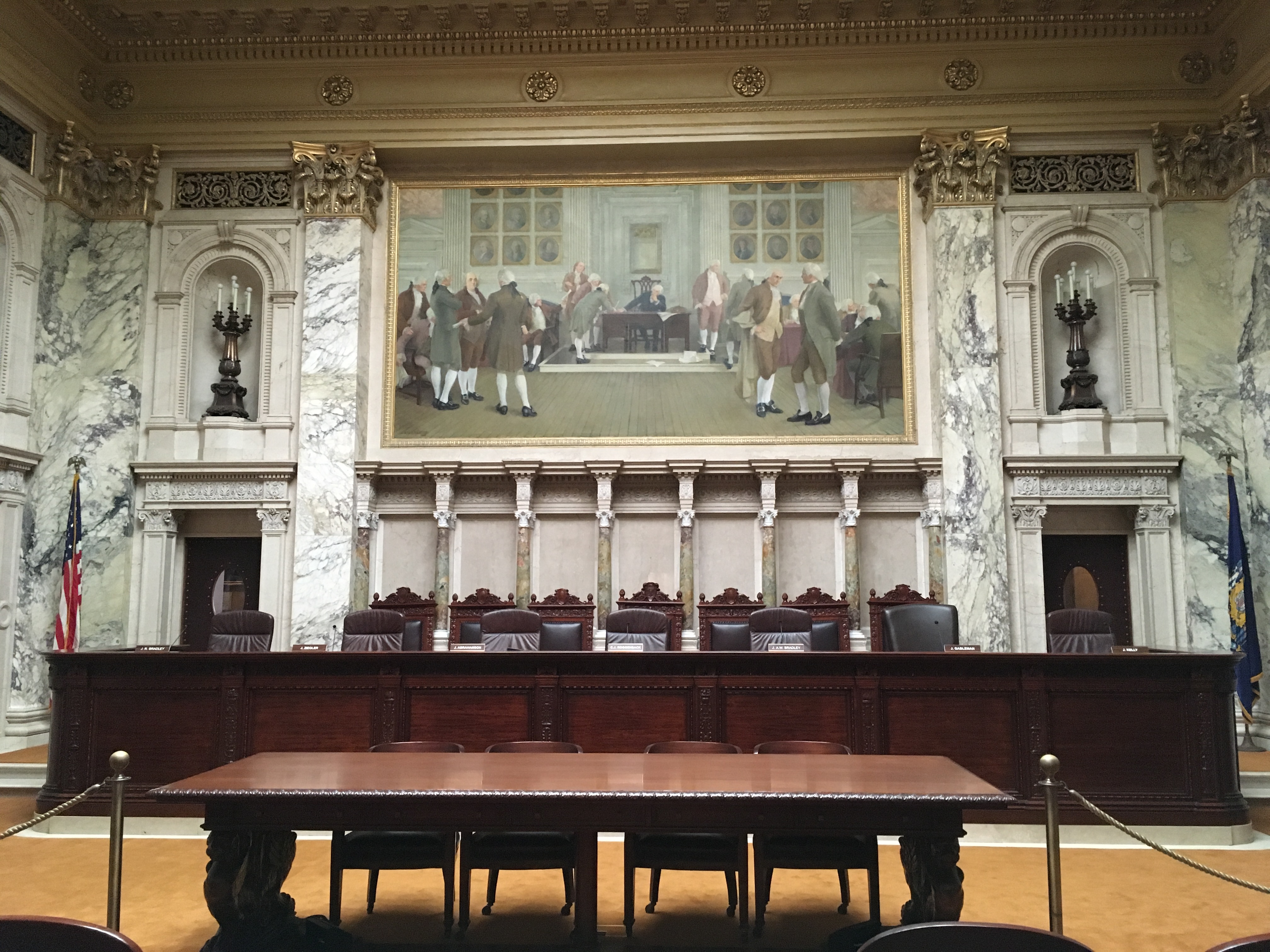
Wisconsin Supreme Court. Photo by Mariiana Tzotcheva.
Following the 2020 U.S. Census, the Wisconsin Legislature set out to redraw state legislative and congressional districts to reflect population changes in the state since the previous census in 2010. This map was passed by the state Senate and Assembly but vetoed by Gov. Tony Evers.
In a lawsuit called Johnson v. WEC (Wisconsin Elections Commission), a group of voters asked the state Supreme Court to revise the maps. The court announced that in choosing maps it would not consider their partisan composition.
Instead, it would use a “least change” criterion, favoring maps that made the least change to the maps adopted 10 years earlier. Because the previous maps had been heavily gerrymandered to favor Republicans, this decision had the effect of perpetuating the gerrymander over the next 10 years.
The gerrymander was not the only thing brought over from earlier maps. Many of the Wisconsin Senate and Assembly districts included “islands” of territory that were completely surrounded by other districts. These resulted when a city or village would redraw its boundaries to include nearby but noncontiguous territory and the legislative map followed suit.
These noncontiguous islands ran directly counter to the Wisconsin Constitution, which required that state Senate and Assembly districts be contiguous, requiring that “such districts … be bounded by county, precinct, town or ward lines, … consist of contiguous territory and be in as compact form as practicable.”
Following an election for a Wisconsin Supreme Court justice in which a 4-3 majority supportive of the least-change test was replaced by a 4-3 majority that opposed it, the court ruled that the state district maps violated the contiguity requirement of the Wisconsin Constitution. It also declared that partisan fairness was one factor it would consider in adopting remedial maps. The eventual result was the replacement of the original state legislative districts by a far more competitive set of districts.
That left unchanged the eight districts in the Wisconsin congressional delegation. Even though Wisconsin is among the most competitive states, its congressional delegation consists of six Republicans and two Democrats. The Cook Political Report rates both Democratic districts as Solid Democrat and four of the six Republican districts as Solid Republican. The remaining two districts, both currently occupied by Republicans, are rated Likely Republican and Toss-up. But whatever their defects in partisan fairness, the current congressional districts do not appear to violate any specific federal or state requirement.
Two lawsuits challenge those district maps. The first is called Bothfeld v. Wisconsin Elections Commission (also referred to as Bothfeld 2). The plaintiffs are represented by Abha Khanna of the Elias Law Group.
The second suit is Wisconsin Business Leaders for Democracy vs. WEC (WBLD). Plaintiffs’ attorneys are Douglas Poland and Jeffrey A. Mandell of Law Forward and Nicholas Stephanopoulos of the Election Law Clinic at Harvard Law School.
While both lawsuits have the same goal — to replace the partisan congressional district plan favoring Republicans with one that doesn’t favor either party — the two lawsuits make quite different arguments.
The Bothfeld team argues that the use of the least-change criterion violated the separation-of-powers principle. The Supreme Court, nominally a nonpartisan body, transferred its power to a highly partisan group, the designers of the 2010 map. As a result, the attorneys argue, “the Wisconsin Supreme Court improperly substituted the partisan judgment that prevailed in the 2011 political process as its own.”
Business Leaders for Democracy argues that the 2010 map was an “anticompetitive gerrymander,” deliberately designed to protect incumbents. Using it as the starting point for the subsequent maps assured that the new maps would also be noncompetitive gerrymanders. Over the following 10-year period, the brief noted, no incumbent lost reelection and only one race was decided by fewer than 10 percentage points.
The process used to handle the two lawsuits was based on language in legislation that was passed by the Assembly and Senate and then-Gov. Scott Walker in 2011, but never put into practice. Newly enacted section 801.50 (4m) states:
Venue of an action to challenge the apportionment of any congressional or state legislative district shall be as provided in s. 751.035. Not more than 5 days after an action to challenge the apportionment of a congressional or state legislative district is filed, the clerk of courts for the county where the action is filed shall notify the clerk of the Supreme Court of the filing.
Section 751.03 Assignment to a judicial panel; appeals states that:
(1) Upon receiving notice under s. 801.50 (4m), the Supreme Court shall appoint a panel consisting of 3 circuit court judges to hear the matter. The Supreme Court shall choose one judge from each of 3 circuits and shall assign one of the circuits as the venue for all hearings and filings in the matter.
(2) Notwithstanding s. 801.58, no party may move for substitution of any circuit court judge assigned under this section.
(3) An appeal from any order or decision issued by the panel assigned pursuant to sub. (1) may be heard by the supreme court and may not be heard by a court of appeals for any district. (These provisions were contained in Sections 28 & 29 of 2011 WISCONSIN ACT 39.)
On March 31, 2026, the Bothfeld panel was the first to issue its decision and order, ruling against the challenge to the congressional districts. Their core reason is a concern that, as district judges, they do not have the authority to second-guess decisions by the Supreme Court.
In denying the plaintiffs’ motion for judgment on the pleadings and granting intervenor-defendants’ motions to dismiss, this panel is not endorsing the current congressional map. Rather, we, as circuit court judges, do not have the authority to read into a Wisconsin Supreme Court case an analysis that it does not contain.
Without a clear statement from our highest court, we are unable to find that the Wisconsin Supreme Court in Johnson II abdicated its authority in violation of the separation-of-powers doctrine.
About a month later, the Wisconsin Business Leaders for Democracy panel issued its judgment in favor of the defendants, noting that “the only court with the authority to change this outcome is the Wisconsin Supreme Court.”
What happens next? Wisconsin Business Leaders for Democracy has sent in a notice of appeal. As orders and decisions from both three-judge panels acknowledge, both cases are now up to the present Wisconsin Supreme Court.
If you think stories like this are important, become a member of Urban Milwaukee and help support real, independent journalism. Plus you get some cool added benefits.


Data Wonk
-
ACA Premium Costs Rose 40% in Milwaukee
 May 2nd, 2026 by Bruce Thompson
-
The Irony of Trump’s SAVE Act
 Apr 22nd, 2026 by Bruce Thompson
-
Who Do You Trust to Conduct Elections Fairly?
Apr 6th, 2026 by Bruce Thompson