
Wisconsin Lost Thousands of Manufacturing Jobs in 2025
'For the Upper Midwest, some indicators are kind of looking down.'
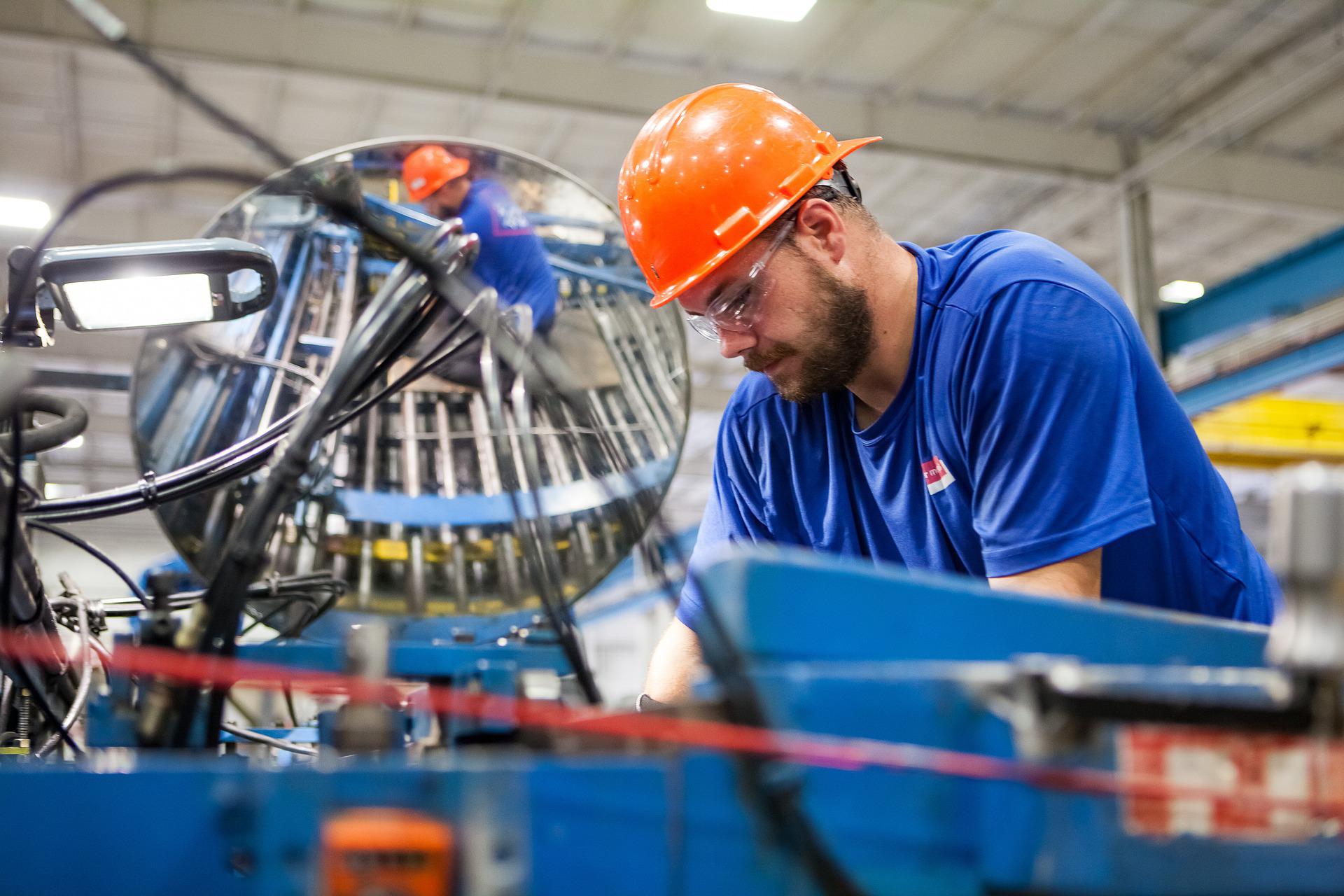
Manufacturing. (Pixabay license).
Wisconsin lost thousands of manufacturing jobs in 2025, driven in part by an aging workforce and hesitancy to expand hiring in an uncertain economy.
Between January 2025 and January 2026, the state’s manufacturing workforce shrank by about 9,500 jobs, falling from 461,100 workers to 451,600, according to data from the U.S. Bureau of Labor Statistics compiled by the Federal Reserve Bank of St. Louis. The manufacturing workforce nationally declined by about 91,000 jobs over the same period.
Industry leaders say the job losses were driven more by worker retirements than widespread layoffs, though shifting tariffs and broader economic uncertainty have made some manufacturers more reluctant to hire.
Steve Deller, professor emeritus in the Department of Agricultural and Applied Economics at the University of Wisconsin-Madison, told WPR’s “Wisconsin Today” that the state is still heavily dependent on manufacturing, an industry that “tends to be more sensitive to downward trends in the economy.”
“Some of the leading economic indicators out there that do a really good job of forecasting what’s going to happen to the economy, zero-in on what’s happening to manufacturing,” he said. “And for the Upper Midwest, some of those indicators are kind of looking down, so these employment numbers are not completely surprising.”
The state’s manufacturing workforce generally follows national trends. Both contracted sharply during the 2008 Great Recession and gained ground during the 2010s, according to federal data.
The manufacturing workforce shrank again during the COVID-19 pandemic, before growing steadily until late 2022 in Wisconsin. From April 2020 to October 2022, Wisconsin’s manufacturing workforce grew from 438,900 workers to 484,300, but it has declined steadily since, federal data shows.
Preliminary numbers for March show the state’s manufacturing workforce rebounded slightly, up from 451,800 workers in February to 453,600 workers in March.
Scott Paul, president of the Alliance for American Manufacturing, described the industry as a bit of a “leaky boat” that’s been “slowly losing something.” While he said the economy is not in a recession, he called the wider economic environment “very unstable.”
Throughout 2025, he said manufacturers navigated a host of on-again, off-again tariffs. The Trump administration has framed tariffs as being aimed at bolstering domestic manufacturing.
While Paul said tariffs can benefit manufacturers, he said the rollout over the last year has been far too chaotic.
“I believe that tariffs strategically placed over the long run can have a positive impact if there is certainty to the policy, if they’re applied in a strategic way and if you have other tailwinds behind you as well,” he said. “But really, none of those features have been present over the last 16 or 17 months.”
On top of tariffs, Deller said manufacturers now also face higher oil prices related to the war in Iran, which he said could threaten to further destabilize the economy.
“If you look at the U.S. economy overall, and you look at periods that we’ve gone into economic downturns, a lot of times, that’s predicated by shocks to the energy market,” he said. “This goes back to post-World War II. Whenever we see a real shock to the energy market, that’s a real warning flag.”
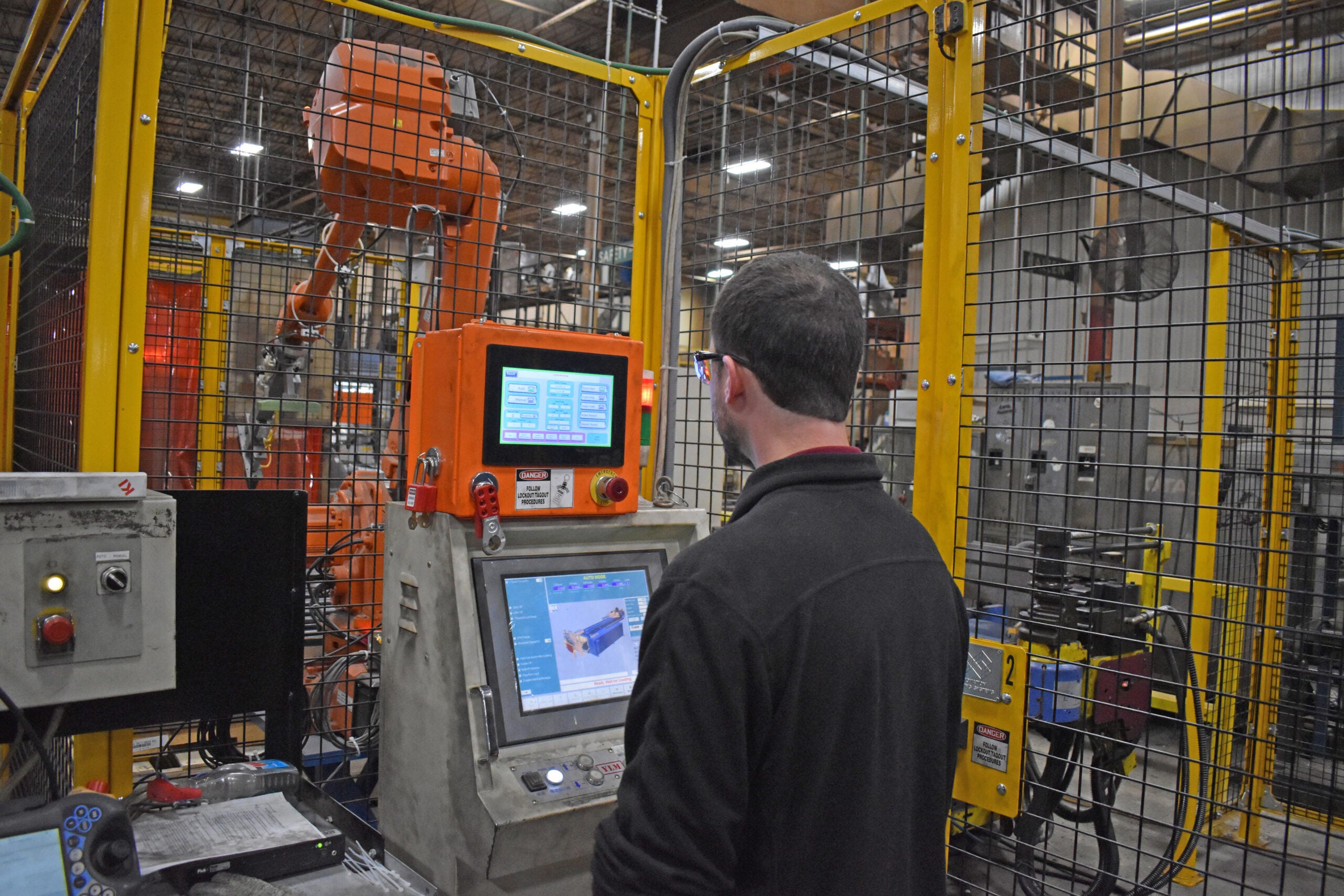
Alex Peters, automation engineering manager for Green Bay furniture manufacturer KI, programs a computer on one of the company’s machines. Joe Schulz/WPR
In an unpredictable economic environment, companies have been slow to both hire and lay off workers, said Buckley Brinkman, former chief executive officer of the Wisconsin Center for Manufacturing and Productivity.
“It’s really like trying to run your company with one foot on the gas and one foot on the brake,” he said. “People have opportunities and they want to grow their companies, but the uncertainty in the market and the inability to really have a clear, predictable path forward is making it difficult to hit the accelerator and let off on the brake.”
Both Brinkman and Paul said they believed demographics have played a larger role in the industry’s workforce decline than mass layoffs. The U.S. population is aging and Wisconsin’s is aging even faster.
As older workers leave the workforce, companies may not be replacing them right away. Instead, they are opting to get more work out of their remaining workers, to increase automation, to look for additional efficiencies or some combination of all three, Paul said.
“There still is, paradoxically, this need to bring new workers on and have some skill development through technical schools or community colleges,” Paul said. “Because there is going to be this big demographically-caused exit from manufacturing that’s going to continue and only accelerate.”
Wisconsin lost thousands of manufacturing jobs in 2025 was originally published by Wisconsin Public Radio.
If you think stories like this are important, become a member of Urban Milwaukee and help support real, independent journalism. Plus you get some cool added benefits.