

Second Judicial Panel Rejects Challenge to WI Congressional Map
Law Forward promises to appeal to Wisconsin Supreme Court.
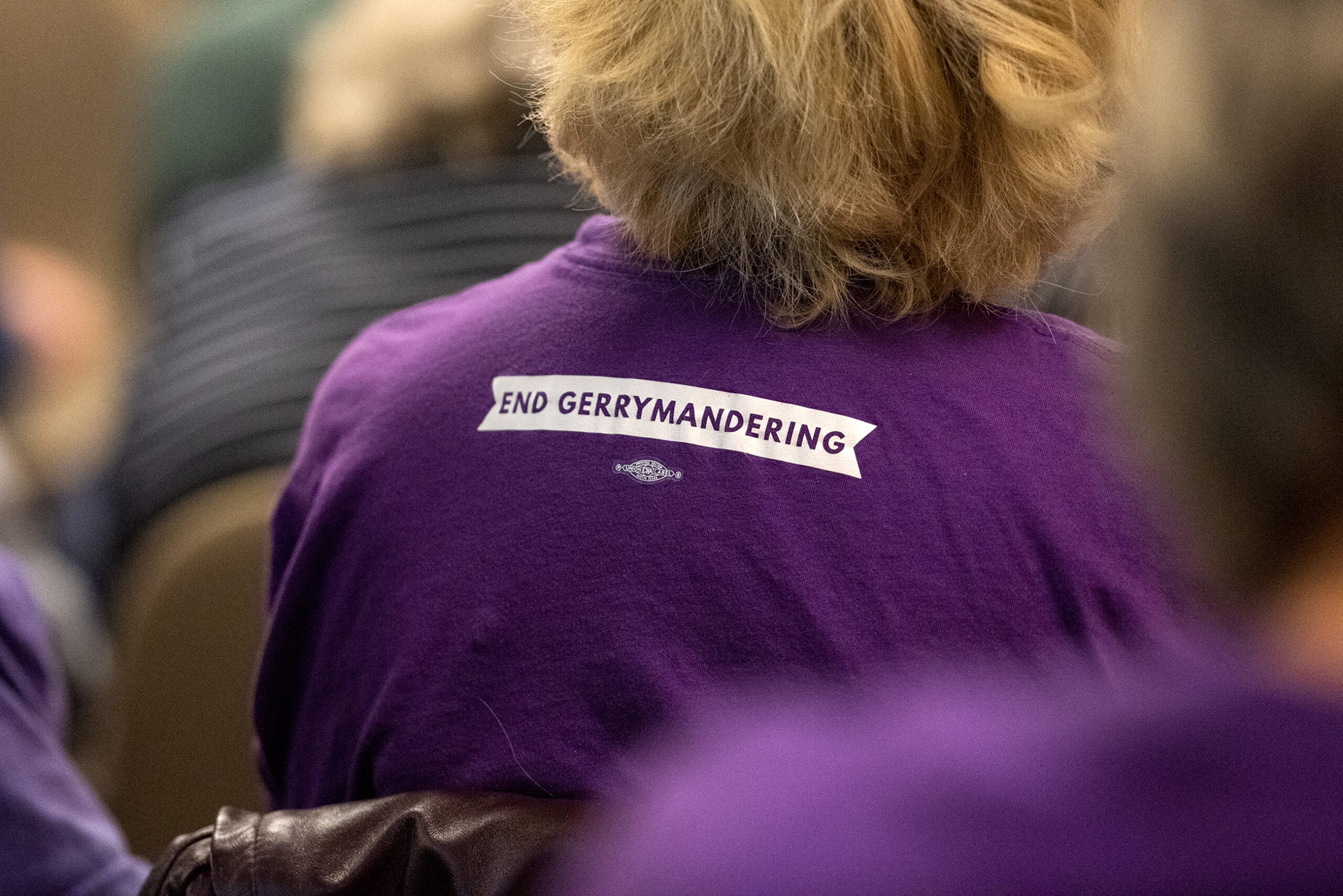
An attendee sits in the crowd and listens as state legislators discuss redistricting during a hearing Thursday, Oct. 28, 2021, in at the Wisconsin State Capitol in Madison, Wis. Angela Major/WPR
A three-judge panel has rejected another lawsuit attempting to throw out Wisconsin’s congressional map.
The order issued Tuesday is the second in the past month dismissing challenges to the state’s congressional districts, which currently give Republicans a 6-2 edge.
The case was brought by the liberal firm Law Forward on behalf of a group called Wisconsin Business Leaders for Democracy. It argues Wisconsin’s congressional map is an “anti-competitive gerrymander,” designed to entrench incumbent candidates at the expense of voters.
In a 13-page ruling, Dane County Judge David Conway, Marathon County Judge Michael Moran and Portage County Judge Patricia Baker wrote that only the Wisconsin Supreme Court could decide to overturn a map on the grounds that it was too partisan.
“While plaintiffs have constructed a detailed theory to support their claims, this panel does not write on a blank slate when it comes to the use of partisan considerations in redistricting,” the judges wrote. “Until the Supreme Court says otherwise, Plaintiffs’ claims are non-justiciable and non-cognizable under Wisconsin law.”
In a statement after the decision, Law Forward attorney Doug Poland promised to appeal to the state Supreme Court.
“This is the first anti-competitive gerrymandering case ever filed in Wisconsin courts, and it deserves to be heard,” Poland said. “We believe that the circuit court was wrong in concluding that anti-competitive gerrymandering is ‘functionally equivalent’ to partisan gerrymandering. They are different claims, based on different evidence, that target different ways of manipulating representation to the detriment of voters.”
Push to redraw Wisconsin maps comes amid national redistricting battle
Fights over congressional gerrymandering have made national news since President Donald Trump began insisting that red states redraw district boundaries to favor Republicans, and blue states began responding in kind.
But this particular case, and a related case, took an unusual path to the court, following a process that’s never been used before in Wisconsin.
For reasons they’ve never articulated in any written opinions, the four justices who make up the court’s current liberal majority have been reluctant to hear new challenges to the state’s congressional map. Last June, they rejected two petitions asking the Supreme Court to hear congressional redistricting lawsuits directly.

From left, Wisconsin Supreme Court Justices Rebecca Dallet, Janet Protasiewicz, Susan Crawford, and former Justice Ann Walsh Bradley, right, celebrate Judge Chris Taylor’s win Tuesday, April 7, 2026, at the Madison Concourse Hotel in Madison, Wis. Angela Major/WPR
Opponents of the maps adjusted their tactics, and last July, Law Forward and Elias Law Group, a national firm that represents Democrats, filed new lawsuits. The latest iterations invoked a 2011 law, written by Republicans, that requires the court to establish three-judge panels to hear redistricting claims.
In November, justices created the panels, saying little about why they took the step other than it was required by law.
But on March 31, the panel in the Elias lawsuit dismissed the case, saying it had no authority to supersede a Wisconsin Supreme Court decision. And Tuesday, the panel in the Law Forward case issued a similar ruling.
Cases hinge on a 2022 ruling from when conservatives ran the Wisconsin Supreme Court
Both judicial panels pointed to a 2022 ruling by the Wisconsin Supreme Court that resulted in the congressional map that’s in place to this day.
That court, which had a 4-3 conservative majority, ruled that any new maps must take a “least change” approach to redistricting, adjusting the lines as little as possible to comply with shifting populations. That resulted in district lines, drawn by Democratic Gov. Tony Evers, that bore strong resemblance to the map drawn by Republicans a decade earlier.
As part of that case, conservative justices ruled that partisan gerrymandering lawsuits can’t be brought in state court, mirroring a federal court policy established in 2019 by the U.S. Supreme Court.
Rick Esenberg, president and general counsel for the conservative Wisconsin Institute for Law and Liberty, said following that precedent was correct.
“The Wisconsin Supreme Court has ruled in the past that claims of partisan gerrymandering are non-justiciable,” Esenberg told WPR. “This claim of anti-competitive gerrymandering is just making the same claim. It just dresses it up with a different name. The court properly recognized that.”
Poland, the Law Forward attorney, disputed that. He told WPR that a partisan gerrymander is designed to protect a party, while an anti-competitive gerrymander is drawn to protect incumbents, whether Republican or Democrat. He said the 2011 map, which closely resembles the current map, has consistently protected incumbents from both parties, robbing voters of meaningful choices in most districts.
In an interview Tuesday afternoon, Poland said he hoped the Supreme Court would hear Law Forward’s appeal. If justices let the decision stand, he said it would send a dangerous message.
“The signal would essentially be to the Legislature, go ahead and do whatever you want,” Poland said. “Gerrymander as badly as you want. Disfavor political parties or favor them, as much as you want. Dilute or deny the right to vote of the voters as much as you want. There’s not a thing anybody’s going to do about it.”
Tuesday’s decision did not affect the landscape for the 2026 election. Law Forward had previously agreed on a trial date that would have taken place next year, after the midterms are over.
But should the Supreme Court decline to hear the appeal, it could put the maps back in the state Legislature’s hands at a time when power there is up for grabs. Republicans still hold majorities in both the Assembly and Senate, but more competitive state legislative maps, drawn under pressure by the court in 2024, have put both chambers in play this November.
To learn more about the history of redistricting efforts in Wisconsin, listen to “WPR Reports: Mapped Out.” The limited-run podcast explores the 2011 fight over legislative maps in Wisconsin — how it was supposed to go, how it really happened and how those decisions impact Wisconsinites today.
Second judicial panel rejects challenge to Wisconsin congressional map was originally published by Wisconsin Public Radio.
If you think stories like this are important, become a member of Urban Milwaukee and help support real, independent journalism. Plus you get some cool added benefits.























The mere fact that Republicans have had a chokehold on the state legislature is more than enough evidence.