

Live Nation Must End Deals with Summerfest?
It would cede control over concerts at two major amphitheaters under anti-trust deal.
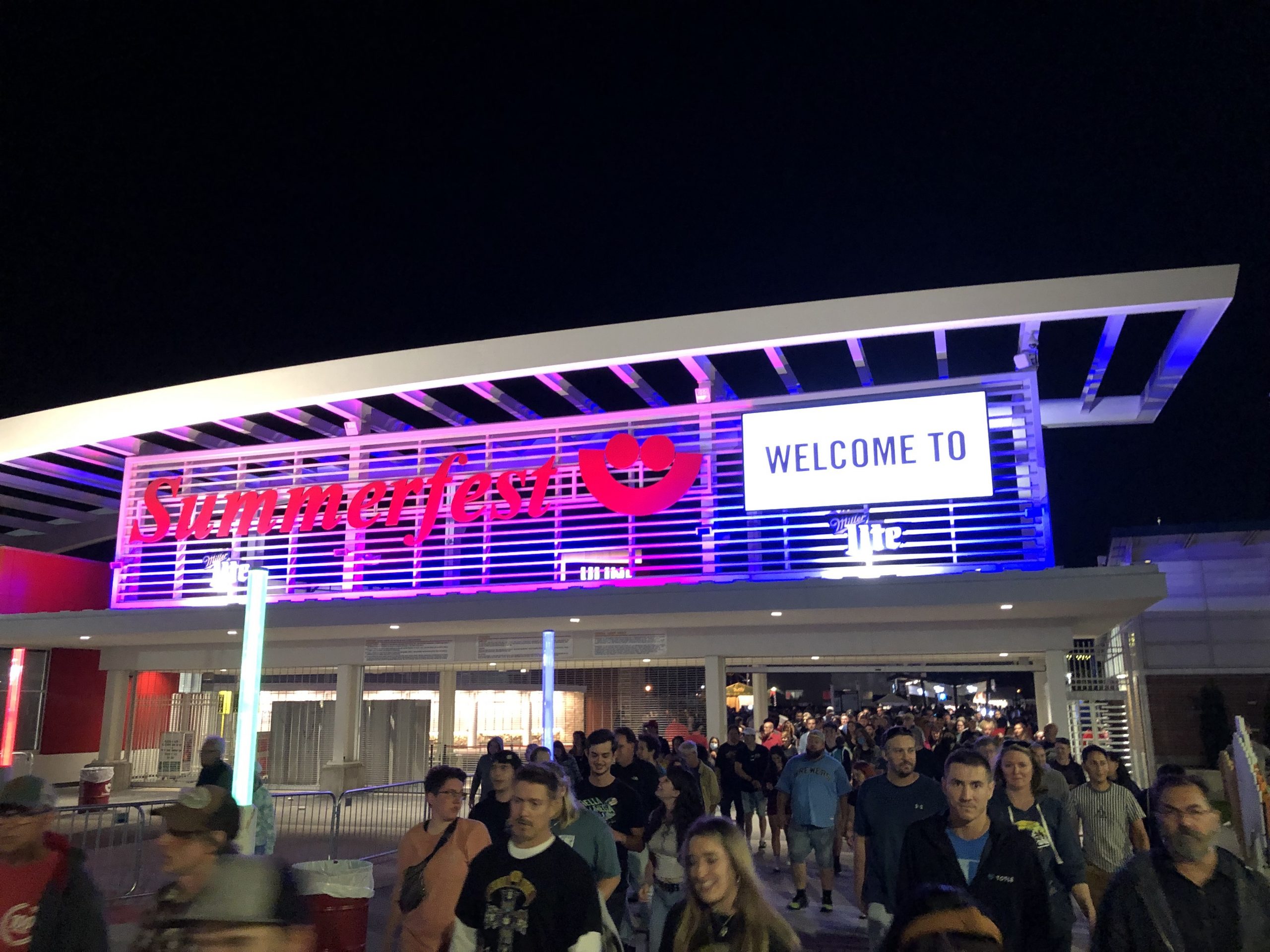
People file out of Summerfest on the last night of the 2021 festival. Photo by Jeramey Jannene.
A much-criticized settlement of the federal antitrust case against the alleged concert monopoly Live Nation could have a major impact on Milwaukee’s Summerfest and its two major concert venues.
The term sheet for the deal called for Live Nation “to divest ownership or control of 13 amphitheaters,” including venues in Milwaukee, Cincinnati, Syracuse, New York, and Austin, Texas.
Two of the 13 amphitheaters were at Summerfest: the 23,000-capacity American Family Insurance Amphitheater and the 7,000-capacity BMO Pavilion. Madison’s Frank Productions, which is owned by Live Nation, has an exclusive contract to manage all non-Summerfest concerts at these two concert venues. The most obvious beneficiary of an end to this arrangement would be the Pabst Theater Group, run by Gary Witt, which has been blocked from booking any shows at the two venues. Potentially, the national music producer AEG might try to compete as well to book shows at these venues.
Live Nation, which also owns Ticketmaster, has used that combined power to monopolize booking and especially ticket prices for concerts across the nation, critics have charged. According to an AP story, the terms of settlement call for Live Nation to allow a certain portion of tickets for concert venues to be sold by entities other than Ticketmaster and also let up to 50% of all tickets be sold through any ticketing marketplace at amphitheaters that Live Nation operates or controls. The term sheet also called for Ticketmaster to cap its service fees at those amphitheaters at 15%.
Both Live Nation and a federal Department of Justice (DOJ) official praised the settlement, but others blasted it. Manhattan Judge Arun Subramanian called it “entirely unacceptable” that nobody told him what was going on until late Sunday, days after the term sheet was signed the previous Thursday. North Carolina Attorney General Jeff Jackson slammed the agreement as “a terrible deal” that was hidden from the states until the last minute. New York Attorney General Letitia James charged that the pact “fails to address the monopoly at the center of this case.”
New York was among 39 states that joined the DOJ on this case, and 27 states have announced their dissatisfaction with the deal.
“My attorney general colleagues and I have a strong case against Live Nation, and we will continue our lawsuit,” James said. The states that have rejected the settlement include Arizona, California, Colorado, Connecticut, Illinois, Kansas, Maryland, Massachusetts, Michigan, Minnesota, Nevada, New Hampshire, New Jersey, New Mexico, North Carolina, Ohio, Pennsylvania, Rhode Island, Tennessee, Utah, Vermont, Virginia, Washington, Wisconsin, Wyoming and the District of Columbia.
“Wisconsin is part of a group of states that will be continuing this important litigation against Live Nation,” said Wisconsin Attorney General Josh Kaul in a statement on Monday.
Judge Subramanian has declared that the settlement must be redone, and the parties have until the end of the week to come up with a settlement that satisfies the 27 states or the case could go back to trial, as NBC reported.
Those states have hired attorney Jeffrey Kessler, considered one of the world’s leading antitrust lawyers, to represent them in the case. Kessler successfully sued the National Collegiate Athletics Association for antitrust violations over its rules barring student athletes from accepting compensation in a case that ultimately went before the U.S. Supreme Court.
If Live Nation were found guilty of antitrust violations, a potential remedy would be to split Live Nation and Ticketmaster into two separate companies. In short, the company has a strong motivation to sign a settlement that is stronger than the one released this week and avoid a decision that declares it a monopoly.
Odds are the proposed settlement’s provision that Live Nation end all control over ventures in those 13 states, including the two run by Summerfest, will be retained in any revised settlement. That’s because those 13 venues are not owned by Live Nation and are “its least profitable venues,” according to a knowledgeable music industry source.
Summerfest’s exclusive deal with Frank Productions has drawn criticism from the Wisconsin Transparency Project and its attorney Tom Kamenick, who last year sued Milwaukee World Festival, the parent organization of Summerfest, as Urban Milwaukee reported. Kamenick is demanding the festival reveal the details of the contract. He argues that it is a quasi-governmental organization created by the city of Milwaukee that must be transparent.
“Is this a sweetheart deal, is this something no one else can get?” Kamenick asked. “The public has a right to ask these questions.”
Urban Milwaukee asked Pabst Theater Group for comment and Witt said he was awaiting a revised settlement or possible trial: “Until that negotiation is done there is no official settlement.” Summerfest did not respond to requests for comment.
If you think stories like this are important, become a member of Urban Milwaukee and help support real, independent journalism. Plus you get some cool added benefits.


Back in the News
-
Trump Obsessed With Milwaukee Shoes
 Mar 10th, 2026 by Bruce Murphy
-
Children’s Museum Looks to Double Its Space
 Feb 26th, 2026 by Jeramey Jannene
-
Art Museum Director’s Salary Rose to $589,000
 Feb 12th, 2026 by Bruce Murphy



















Live Nation/Ticketmaster is a one of the most obvious monopolies, despised by everyone in the country, and yet the corrupt Trump administration couldn’t bring itself to even try to score a PR win on this slam dunk. Who are the people who still think these nutjobs care at all about regular people?!
And boycott that mf-ing Landmark Credit Union Live!
Years ago, after reviewing the fee pricing by Live-Nation /Ticketmaster I’ve work extremely hard to not patronize their events / acts. I look for alternatives ( local box office ) or simply don’t buy the tickets..VOTE with your wallet..
I don’t understand how the Justice Dept. can do this in the middle of a jury trial and not even tell the Judge! How infuriating. Not sure if breaking up the monopoly is a better deal for us, or some MAJOR concessions, but this settlement is ridiculous.
I’ve been opposed to Live Nation in Milwaukee when it was proposed. I’m boycotting it. It undermines the local culture of the Club scene.
The Sports Industrial Complex continues robbing Milwaukee taxpayers with the support of State Legislatute’s Republican majority.
Meanwhile, the City & Country are cutting services.
Live Nation is more of the same.
I’ve been attending SUMMERFEST since its inception in 1968.
The City &/it County must block Live Nation from SUMMERFEST.
Ticketmaster has been a lot Monopoly since its inception. I refer to it as Ticket Mafia. It should’ve been broken up decades ago.