

Supervisors Alarmed About Transit’s Future
County board members grasp for options as financial future grows darker for MCTS.
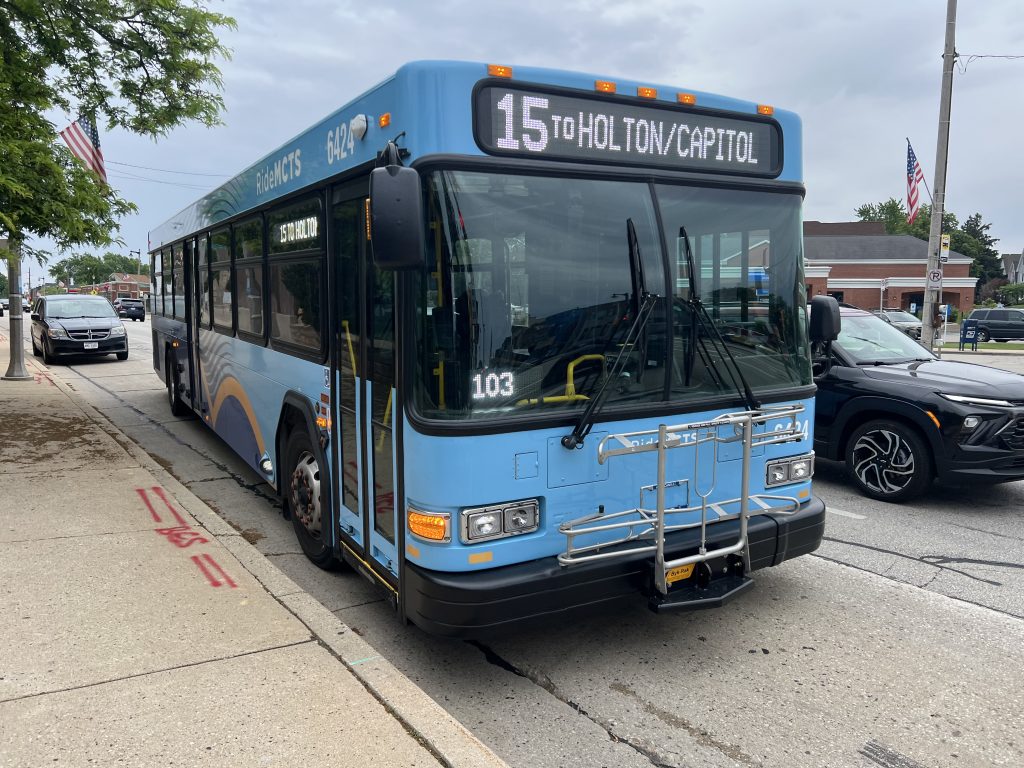
6400 series Milwaukee County Transit System (MCTS) bus. Photo by Jeramey Jannene.
With significant budget cuts kicking in across Milwaukee County, supervisors are grasping for solutions to the Milwaukee County Transit System (MCTS) funding crisis.
The transit system is preparing to launch a new planning project to redesign the entire bus network by mid-2027, as Urban Milwaukee previously reported. The initiative comes as the system implements approximately $9 million in budget cuts this year and projects a budget deficit at least twice as large in 2027.
Supervisors are concerned. During a meeting Wednesday of the Milwaukee County Board’s Committee on Transportation and Transit, they pleaded for routes to be restored and asked whether the transit system could sue the state for more funding.
“We are preparing for the 2027 budget, and right now it’s going to be significant because we are forecasting a deficit of approximately $17 million to $20 million based on the known funding levels that will be available to us in 2027,” Sandra Kellner, MCTS director of operations, told the supervisors on the Committee on Transportation and Transit on Wednesday.
“Estimated deficit of $17 to $20 million next year; that is just, it takes one’s breath away,” said Sup. Steven Shea, who chairs the committee.
Over the next year and a half, MCTS and a planning consultant will work with local stakeholders to answer the question, “What does our system look like that we can actually afford?” Kellner said.
Joe Lamers, the new director of the Milwaukee County Department of Transportation (MCDOT), told Urban Milwaukee, “We want to study the most efficient routes possible, whether that funding challenge goes forward or not. So we’ll look at variable options: growth network, status quo network, reduction if necessary.”
Transportation officials and the county’s government affairs office are gearing up to advocate for greater transit funding in the next state biennial budget, Lamers said. They are also gathering data to communicate the importance of public transit.
Sup. Kathleen Vincent announced during the meeting that she is drafting a resolution to restore funding for transit cuts she voted for in December. The appropriation would restore service along Routes 11, 22, 24, 80 and 88. MCTS is cutting service along segments to close the 2026 budget gap. The cut to Route 24 will stop bus service from running to Historic Downtown Greendale in Vincent’s district.
“These service reductions affect multiple districts and thousands of residents across Milwaukee County,” Vincent said.
Sup. Jack Eckblad asked whether the county was working to build a statewide coalition for increased transit funding. Lamers agreed that Milwaukee is not the only community that relies on transit funding. He said transportation officials are working with the Wisconsin Public Transportation Association and other communities to push the issue.
MCTS’ primary funding challenge is state aid, Lamers said. It is the largest source of revenue for the system and has been flat since 2010, while the cost of operating the transit system has risen annually, he said. If state aid had kept pace with inflation, MCTS would have approximately $34 million more in its annual budget, Lamers said.
“So I think that’s our biggest problem, and challenge, is that we don’t have a dedicated funding source for transit that grows with inflation,” Lamers said.
Sup. Justin Bielinski asked if the county has considered suing the state of Wisconsin over transit funding. “There’s a $2.5 billion surplus, and I’ve seen public schools sue the state for adequate funding,” Bielinski said, adding that he wants to see the transit system “fighting” for itself more. Sup. Juan Miguel Martinez echoed Bielinski’s question.
Lamers said it wasn’t immediately clear what the transit system’s case would be, but said he would follow up with the county’s attorneys.
Tom Stawicki, legislative director for Amalgamated Transit Union Local 998 (ATU), called dedicated funding for transit a “tough nut to crack.” ATU, which represents the county’s transit workers, will continue advocating for transit funding at the state level, he said. “But, just to let you know, it is really going to be an uphill battle to get money.”
If you think stories like this are important, become a member of Urban Milwaukee and help support real, independent journalism. Plus you get some cool added benefits.


Transportation
-
Bus Fare Evasion Declining
 Mar 15th, 2026 by Graham Kilmer
-
Committee Approves Towing Reckless Drivers, With Objections
 Mar 12th, 2026 by Graham Kilmer
-
$14.1 Million Plan Targets Safer Streets In Walker’s Point, Valley, Westown
 Mar 12th, 2026 by Jeramey Jannene


















The system needs more people to ride the bus (and pay the fares). Every change they make results in less people riding the bus and moving further down the spiral. Begging for more money isn’t a strategy and doesn’t fix the root cause. It’s desperation.
Reduce stops per mile to increase average speed. Enforce conduct rules on the buses. Then people won’t choose to drive 3 miles to downtown and pay to park.
And don’t pay a consulting firm tens of millions of dollars for a study when you could hire a few urban planners and data scientists for years for less money.
Do you mean Hire urban planners who do not undermine public transportation?
Consultants BerryDunn and Kairo teamed up with Milwaukee County (M-Co) are currently drafting recommendations for a strategic plan that addresses among other things, to “determine what, where, and how we deliver services based on the resolution of health disparities.” Reimagining how to develop M-Co’s services and organizational structure toward advancing this goal in the most efficient and effective way possible [according to their literature.]
The report’s DRAFT recommendation #11: Milwaukee’s bus system has dedicated and reliable funding, and a regional transit authority serves the transit needs of M-Co municipalities and residents. https://county.milwaukee.gov/County—Office-of-Strategy-Budget-and-Performance1/FSP/2026.02.27-Handout—Milwaukee-County-Future-State-Draft-Recommendations.pdf
Of course, the community is being asked for comment, and here’s a link to their survey, results of which along with several community wide in-person listening sessions (very low attendance in three sessions I attended this week!): https://engageberrydunn.mysocialpinpoint.com/milwaukee-county-future-state-project-advisor/FSP-recommendations-survey
So-ooo, one silo of information (above report) forecasts as much as ANOTHER $20M shortfall for 2027; and another silo of information proposes a regional transit authority that incidentaly was not widely supported a few years ago when proposed elsewhere.
The silos are not talking to one another! Community engagement is low based on the attendance of 3 public listening sessions already hosted (Franklin and Brown Deer Public Libraries, and Kosciuszko Community Center); and three more next week: Monday, March 9th, 6-7:30 pm at Washington Park Senior Center; Wednesday, March 11, 2-3:30 pm at 5 Points Neighborhood Assn. at Grace Fellowship Church; and Thursday, March 12 5:30-7 pm at Thrive on King. PLEASE ATTEND, and if you cannot, please complete the survey (question 3 allows you to write down your thoughts & ideas, rather than just marking multiple choice.
IMO, the first thing they have to do is come up with an effective fare evasion policy. Don’t let folks on the bus unless they can pay. MCTS brought these issues upon themselves, by hiding the deficit from the powers that be and by coming up with a policy that actually encourages fare evasion. Who has the power to force the current inept MCTS management out and bring a reliable management team in?
Unfortunately, unless the powers that be realize how important a reliable transit system is to a growing, thriving community, or become dependent on public transit themselves, nothing will change anytime soon.
So disappointed in everyone who has the ability to change this but doesn’t because it doesn’t affect them.
Has there been a feasibility study of having different levels of fares that included how paying fares would be enforced? Madison just adopted a fare scheme similar to what Milwaukee has and is encountering some of the same issues. This is ominous and suggests that new fare systems were installed before they were well-thought out.
mpbehar: Thank you for the information. I was unaware of the sessions. I am unable to attend, but will fill out the survey and give them my thoughts on how they could generate more funds–a lodging tax. Let all the tourists who hop on the Connect 1 to the Brewers game without paying fare help close the gap with an additional fare to their hotel room.