WI Senate Debates Competing Data Center Bills
Non-disclosure agreements, consumer costs, renewable energy key issues.
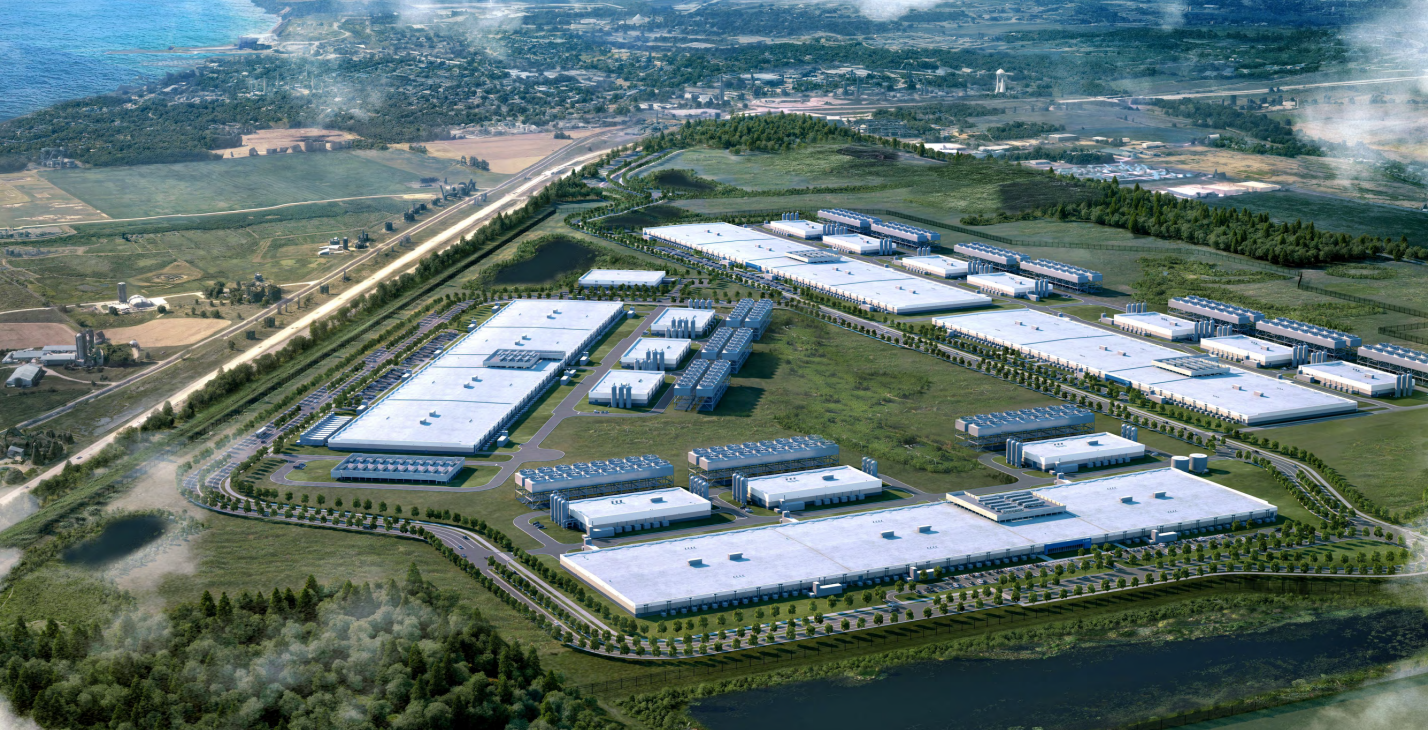
Rendering of the planned data center campus in Port Washington. Photo courtesy of the City of Port Washington.
Data centers and local communities would be barred from working in secret under legislation that received a public hearing before a state Senate committee Tuesday.
The Senate Committee on Utilities, Technology and Tourism also heard testimony on a pair of competing bills, both pitched as ensuring that data centers pay their own way for the electric power they use and controlling how they use water resources.
SB 969 would impose a blanket ban on non-disclosure agreements between data center companies and the municipalities where they’re planning projects.
“Unfortunately, we have witnessed a troubling pattern in Wisconsin and throughout our country — community leaders are signing secrecy deals with big tech companies and their agents to conceal material facts about the development of billion-dollar data centers from the public,” said Sen. Andre Jacque (R-New Franken), the bill’s author, in his testimony on the measure. “These same entities seek to hide vital information about the scope and impacts of their intended developments from the local officials charged with guarding their citizens’ welfare, undermining sound decision-making and eroding confidence in the process.”
The secrecy surrounding a data center project in Menomonie prompted local opposition that led the community’s city council to pass an ordinance in January stopping a developer from advancing the $1.6 billion project.
“This bill is really about trust,” said state Rep. Clint Moses (R-Menomonie), the author of the bill’s Assembly companion. “It makes sure those conversations happen in the open and not behind closed doors.”
A data center industry lobbyist opposed the measure, asserting that a ban on non-disclosure agreements, or NDAs, could stall Wisconsin’s emergence as a prime data center location.
Brad Tietz, the state policy director for the Data Center Coalition, said the industry group has been working with its member businesses “on model frameworks that ensure early and proactive community engagement and transparency while safeguarding sensitive proprietary and security information.”
Non-disclosure agreements are especially important in the early stages of data center site selection, “where a company may be considering multiple sites and has not yet made a final decision,” Tietz told lawmakers. “But to simply put a blanket opposition on NDAs would put Wisconsin at a competitive disadvantage right when it is primed to do exceptionally well in this industry.”
Data center utility costs
The bulk of Tuesday’s hearing focused on two other pieces of legislation, one authored by Democrats and the other by Republicans. Both measures were written with the intent of ensuring that power-hungry data center developments don’t pass off their electricity costs to the rest of the public.
SB 729 is authored by Sen. Jodi Habush Sinykin (D-Whitefish Bay) and state Rep. Angela Stroud (D-Ashland). The Assembly companion is AB 722.
“Wisconsin must establish a comprehensive and responsible regulatory framework that protects Wisconsin taxpayers, workers, and our natural resources now and into the future,” Habush Sinykin told the committee. “Yet here’s the rub. Currently, Wisconsin has no statewide regulatory standards governing hyperscale data centers. None.”
Habush Sinykin said that the bill was written in consultation with the state Public Service Commission. It would put data centers in a new class of electric power users, “very large customers,” and require utilities serving those users to file a rate case for that class every two years.
“I believe that we all have a shared goal of ensuring that the public does not pay for the energy expenses of data centers,” Stroud told the committee. “According to the Public Service Commission, establishing a very large customer class tariff is the most effective tool currently available to ensure that energy-related costs are borne by data centers rather than shifted on to the general public.”
Utilities would also be required to report quarterly their data center users’ energy consumption and sources and make that information public.
Because data centers are also heavy uses of water, the bill requires water utilities to notify the PSC of individual customers that use 25% of the utility’s water volume.
The Habush Sinykin/Stroud bill includes provisions to encourage renewable energy use and the use of union labor. In order to qualify for a sales and use tax exemption from the Wisconsin Economic Development Corp., the data center must derive at least 70% of its energy from renewables and pay the construction workers the prevailing wage in the region if they aren’t covered by a union contract.
The committee chair, Sen. Julian Bradley (R-New Berlin), questioned those provisions.
“This bill appears to me as though it’s going to say, ‘Well, you can come here. We understand you bring a massive economic impact, but actually we want more,’” Bradley said. “It’s going to drive them away from the state of Wisconsin and then we’re going to lose out.”
But Stroud said data center developers have been enthusiastic about adopting clean energy.
“We are extending tax credits to the richest companies in the world. It is not a small thing to do that,” Stroud said. “We should be getting a huge benefit. And it would change the conversation, I think, in a lot of these communities if they had access to significant benefits.”
Republicans go in a different direction
The alternative bill — AB 840/SB 843, authored by Rep. Shannon Zimmerman (R-River Falls) and Sen. Romaine Quinn (R-Birchwood) — mostly takes different approaches on all of the issues involved. The Assembly version passed that house in January on a mostly party-line vote of 53-44, with two Democrats voting in favor of the legislation and one Republican voting against it.
The bill directs the PSC, in writing its rate-making orders, to ensure that the utility costs of large data centers aren’t passed off to any other customer, but doesn’t offer specific directions on how to do that. It includes language stating that developers must hire Wisconsin workers to the extent possible.
The legislation also would require that any renewable energy facility that primarily serves the load of a large data center be located on the data center property.
“This will improve reliability by reducing dependence on a distant power grid and safeguards our communities from being burdened with large energy projects that exist solely to serve data center facilities elsewhere,” Quinn said.
The bill also requires the water used at a center to be recycled, and includes requirements that data center developers post a bond that can be used to reclaim the property if the project is abandoned before it’s completed.
Earlier, Stroud said the GOP bill’s requirement restricting renewable energy to on-site at data centers would be “a non-starter for many of the companies seeking to locate in our state.”
In his testimony, however, Quinn defended the provision as a safeguard against saddling other customers with the data centers’ energy costs. “I believe we should make it more attractive for data centers to build their own power supply,” he said.
Sen. Melissa Ratcliff (D-Cottage Gove) asked Quinn why he and Zimmerman didn’t work with Sinykin and Stroud on a common piece of legislation. Quinn replied that the provisions the Democrats prioritized wouldn’t pass in the current Legislature, including the prevailing wage provision and the renewable energy provisions.
During her portion of the hearing, Habush Sinykin said the provision for recycling water in the Republican bill was of interest to her. She also emphasized that lawmakers should work together across the aisle on legislation to address the broader concerns about data centers.
“The Senate is here through March, and the Assembly can be called back as well,” Habush Sinykin said. “I believe it makes sense and the conditions warrant a call for a special session or an extraordinary session, because people in Wisconsin do not want to wait another year or more to have regulation filling this vacuum.”
Tom Content, executive director of the Citizens Utility Board, testified that affordability was a top concern for Wisconsin ratepayers.
“Electricity costs are surging at a pace higher than inflation over the past four years,” Content told the committee. “Wisconsin has the second highest electricity rates in the Midwest.”
His organization “recognizes the intent of the authors on both sides to shield customers from higher costs,” Content said. “Our hope and expectation, given that affordability is job one right now, is that lawmakers will work together in the remaining days of the session and across the aisle to take the most workable provisions of both and find common ground on a plan that the governor will sign into law.”
Non-disclosure agreements, energy costs focus of data center hearing was originally published by Wisconsin Examiner.