Defense Rests in Dugan ICE Trial After Brief Case and Character Testimony
Four witnesses, including two judges and former Mayor Tom Barrett, testified as Dugan’s lawyers argued confusion, not obstruction, drove her actions.
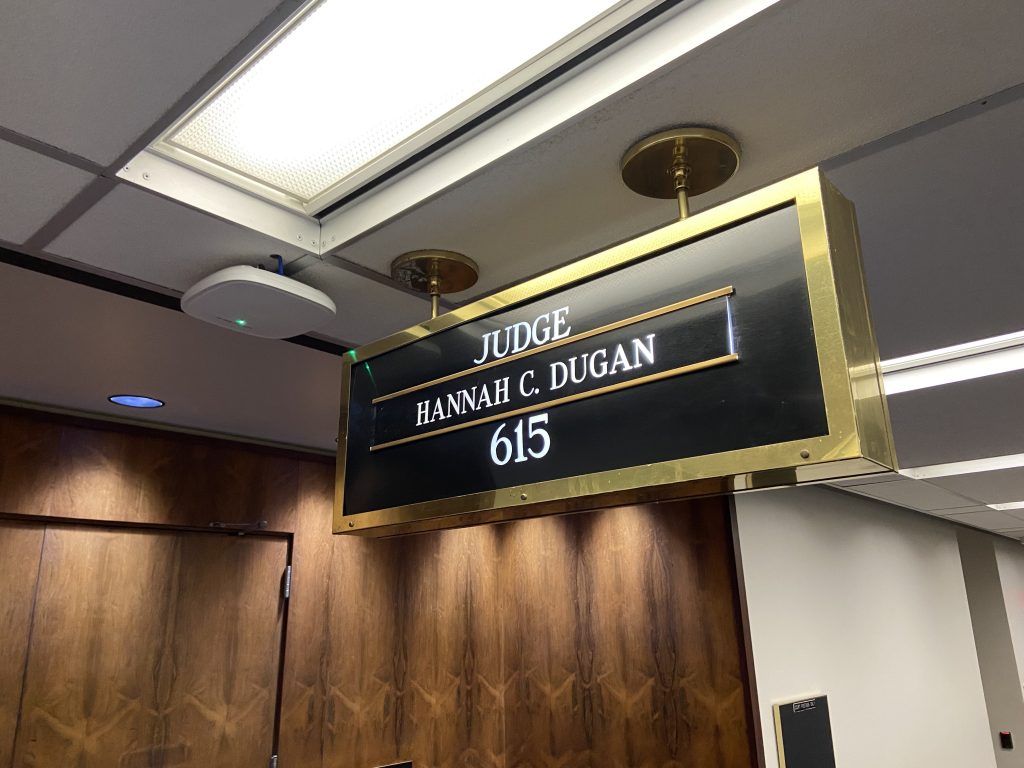
Judge Hannah Dugan’s courtroom on the sixth floor of the Milwaukee County Courthouse. Photo taken by Graham Kilmer.
Milwaukee County Circuit Court Judge Hannah Dugan called four witnesses to testify in her defense Thursday.
In less than an hour, Dugan’s attorneys called Milwaukee County Circuit Court Judges Katie Kegel and Laura Gramling Perez, state public defender Maura Gingerich and former Mayor Tom Barrett.
Since the trial began Monday, the defense has attempted to show jurors that the Milwaukee County Courthouse was in the grips of confusion and paranoia on April 18, the day federal agents showed up to arrest a defendant in Dugan’s courtroom. The defense argued in opening statements that the judge was trying her best to make the right decisions under difficult circumstances.
When she asked federal agents for a warrant and sent them to Chief Judge Carl Ashley‘s office, it was not part of a scheme to knowingly obstruct a U.S. Immigration and Customs Enforcement (ICE) arrest or to conceal a person from arrest, as the federal government alleges. Rather, she was trying to navigate a difficult situation without clear legal guidance.
While questioning Gramling Perez, Dugan’s attorney Steven Biskupic introduced emails showing that Dugan was unable to attend a virtual training on ICE operations at the courthouse hosted by the circuit court. He also produced a document, which Gramling Perez had shared with Dugan from the training, that included a paragraph suggesting ICE arrests should not take place in public areas of the courthouse.
Another email from Gramling Perez, which Dugan received, outlined some of the restrictions federal law places on ICE arrests, including restrictions on arresting victims and witnesses.
Another email, from Judge Jean Kies, shows Kies warning her colleagues that she saw an ICE vehicle outside the courthouse. The defense used it to attempt to illustrate that judges were on heightened alert after two previous ICE arrests at the courthouse.
On cross-examination by Assistant U.S. Attorney Keith Alexander, the federal prosecutor failed to get Gramling Perez to say, with certainty, what the circuit court rules regarding ICE arrests at the courthouse were.
He produced a document saying arrests could be made in public areas of the courthouse. Gramling Perez said she was not familiar with the document. He asked her about the limitations on ICE arrests sent to Dugan. Gramling Perez replied that they were not all-encompassing and that she is not an expert on immigration arrests.
Gramling Perez maintained that there was only a draft policy, not a formal policy from the circuit court, regarding ICE activity at the courthouse. There was also a county policy, she said, adding that she wasn’t sure what that policy stated.
Gingerich, the attorney who photographed federal agents in the hallway, was called next. She testified that she was taking pictures of agents to send to her supervisor in order to seek guidance from the chief judge.
“I think that it was stressful to see what I thought were a number of law enforcement agents on the sixth floor not wearing uniforms,” Gingerich said.
On cross-examination, Deputy U.S. Attorney Richard G. Frohling asked Gingerich about her statement to Judge Kristela Cervera, who testified Tuesday that Gingerich told her about Flores-Ruiz’s arrest and thanked her for “what she was trying to do.” Dugan pulled Cervera out of her courtroom that morning to ask federal agents whether they had a judicial warrant. On the stand, Cervera said Gingerich told her about Flores-Ruiz’s arrest because they knew “what you guys were trying to do.”
During her own testimony Thursday, Gingerich said, “I don’t think I would have phrased it that way.” She also disagreed with the conclusion that this referred to knowingly obstructing an arrest. If anything, she said, it was about the judges confronting federal agents and asking for a warrant.
Finally, the defense called Barrett, the former mayor, who has known Dugan since she was a child. Barrett testified that he was a high school friend of Dugan’s older sister and spent time at the Dugan family home in New Berlin. They kept in touch over the roughly 50 years they’ve known each other, especially as they both became more involved in public life in Milwaukee, he said.
Asked by Biskupic to testify to Dugan’s character, Barrett said, “I think she is extremely honest, and I think that she will tell you exactly how she feels.”
On cross-examination, Frohling asked Barrett to clarify that he was testifying as a character witness and not as a witness to the events on April 18.
“I’m here as someone who’s known her since she was 11 or 12 years old,” Barrett said.
Following Barrett’s testimony, the defense rested its case. The defense has also filed a motion to dismiss, which U.S. District Judge Lynn Adelman will consider. Dugan will not testify in the case. Before handing the case off to the jury, attorneys for both sides will make closing statements.
If you think stories like this are important, become a member of Urban Milwaukee and help support real, independent journalism. Plus you get some cool added benefits.
More about the Courthouse ICE Arrests
- Judge Hannah Dugan Resigns - Sarah Lehr - Jan 4th, 2026
- Hannah Dugan Seeks New Trial - Graham Kilmer - Dec 23rd, 2025
- Op Ed: Making Sense of Judge Dugan’s Conviction - Ruth Conniff - Dec 22nd, 2025
- After Dugan Verdict Comes Politics and Courthouse Uncertainty - Graham Kilmer - Dec 21st, 2025
- Wisconsin Republicans Threaten to Impeach Judge Hannah Dugan - Anya van Wagtendonk - Dec 20th, 2025
- Forward Latino Corrects Misinformation Presented During Judge Hannah Dugan Trial - Forward Latino - Dec 19th, 2025
- United States Thanks Jurors for Their Service and Urges Peaceful Response to Verdict - U.S. Department of Justice - Dec 19th, 2025
- Dugan Must Go - Wisconsin Assembly Speaker Robin Vos - Dec 19th, 2025
- A Dangerous Precedent - Press Release - Dec 19th, 2025
- Verdict Against Judge Dugan Threatens Due Process and Judicial Independence - Voces de la Frontera - Dec 19th, 2025
Read more about Courthouse ICE Arrests here
More about the Judge Hannah Dugan Trial
- Judge Hannah Dugan Resigns - Sarah Lehr - Jan 4th, 2026
- Hannah Dugan Seeks New Trial - Graham Kilmer - Dec 23rd, 2025
- Op Ed: Making Sense of Judge Dugan’s Conviction - Ruth Conniff - Dec 22nd, 2025
- After Dugan Verdict Comes Politics and Courthouse Uncertainty - Graham Kilmer - Dec 21st, 2025
- Wisconsin Republicans Threaten to Impeach Judge Hannah Dugan - Anya van Wagtendonk - Dec 20th, 2025
- Forward Latino Corrects Misinformation Presented During Judge Hannah Dugan Trial - Forward Latino - Dec 19th, 2025
- United States Thanks Jurors for Their Service and Urges Peaceful Response to Verdict - U.S. Department of Justice - Dec 19th, 2025
- Dugan Must Go - Wisconsin Assembly Speaker Robin Vos - Dec 19th, 2025
- A Dangerous Precedent - Press Release - Dec 19th, 2025
- Verdict Against Judge Dugan Threatens Due Process and Judicial Independence - Voces de la Frontera - Dec 19th, 2025
Read more about Judge Hannah Dugan Trial here
Political Contributions Tracker
Displaying political contributions between people mentioned in this story. Learn more.
- September 8, 2018 - Tom Barrett received $25 from Hannah Dugan
- April 11, 2018 - Tom Barrett received $400 from Keith Alexander
- September 11, 2017 - Tom Barrett received $50 from Hannah Dugan
- May 25, 2017 - Tom Barrett received $100 from Jean Kies
- March 8, 2017 - Tom Barrett received $400 from Keith Alexander
- March 29, 2016 - Tom Barrett received $50 from Hannah Dugan
- March 25, 2016 - Tom Barrett received $400 from Keith Alexander
- December 28, 2015 - Tom Barrett received $300 from Keith Alexander
- August 29, 2015 - Tom Barrett received $100 from Jean Kies


MKE County
-
Prosecution Rests Case in Dugan Trial
 Dec 17th, 2025 by Graham Kilmer
-
Chief Judge Questioned About ICE Policy, Texts, Emails in Dugan Trial
Dec 17th, 2025 by Graham Kilmer
-
Fellow Judge Testifies in Dugan Case
Dec 16th, 2025 by Graham Kilmer