

Life Expectancy in Wisconsin vs. Other States
Hawaii is the leader. How high -- or low -- does Wisconsin rank?
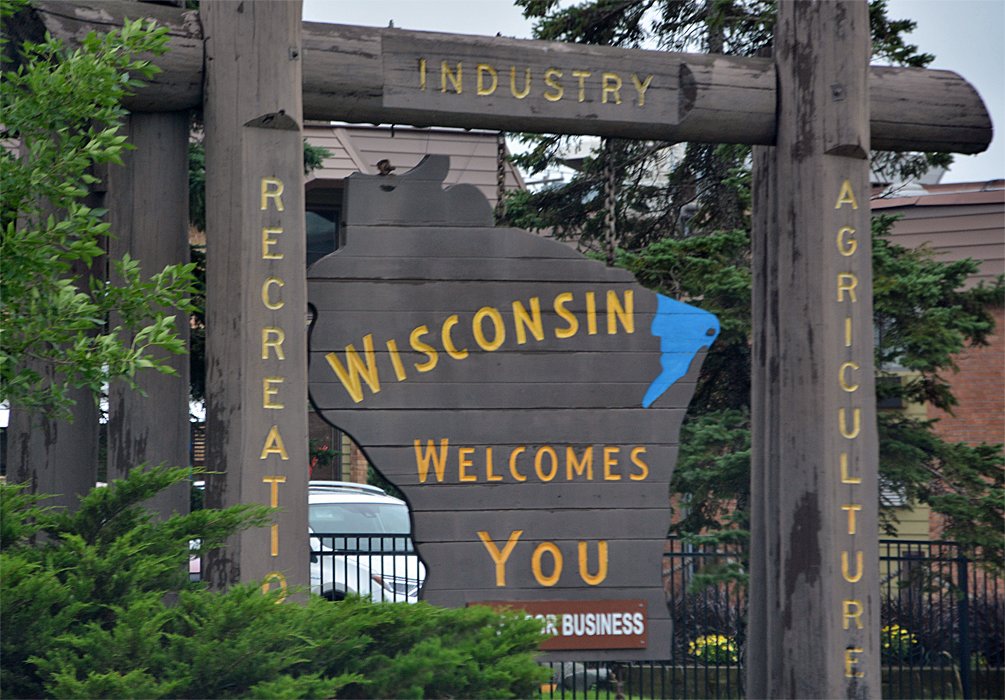
Wisconsin Welcomes You sign. Photo by Andreas Faessler, (CC BY-SA 4.0), via Wikimedia Commons
How long do residents of Wisconsin live compared to other American states? That might be one way of measuring the quality of life in each state.
Average life expectancy, it turns out, varies widely from one state to another, as shown in the graph below. The horizontal axis shows the states’ average life expectancies in 2019. The vertical axis shows the lifespans two years later, in 2021. In this, and subsequent graphs, Wisconsin is shown with a black ring around it.Several generalizations are supported by this graph. One is that the statistic are highly consistent from one year to the next. High performing states like Hawaii, some of the states on the two coasts, and some like Minnesota continue near the top in life expectancy. At the bottom states like Mississippi and West Virginia continue to lag behind.
In 2021, Wisconsin had the 12th longest life expectancy. On average, women in this state lived about five years longer than men.
The gap between the best performing states at the rear is a significant one. On average, people at the front live up to 10 years longer than those with the lowest life expectancy.

Life expectancies in 2021 compared to 2019
Between 2019 and 2021, every state’s life expectancy declined, as shown on the next graph. Most likely this reflects the effect of the COVID-19 pandemic. The decline ranged between six months to about four years.
Although there is considerable scatter in the data, as a whole the decline was greater for states which already lagged behind, suggesting that those states’ performance gap was increasing.
Between the two years, Wisconsin’s life expectancy declined by about a year and a half. This put it at the 11th smallest decline.
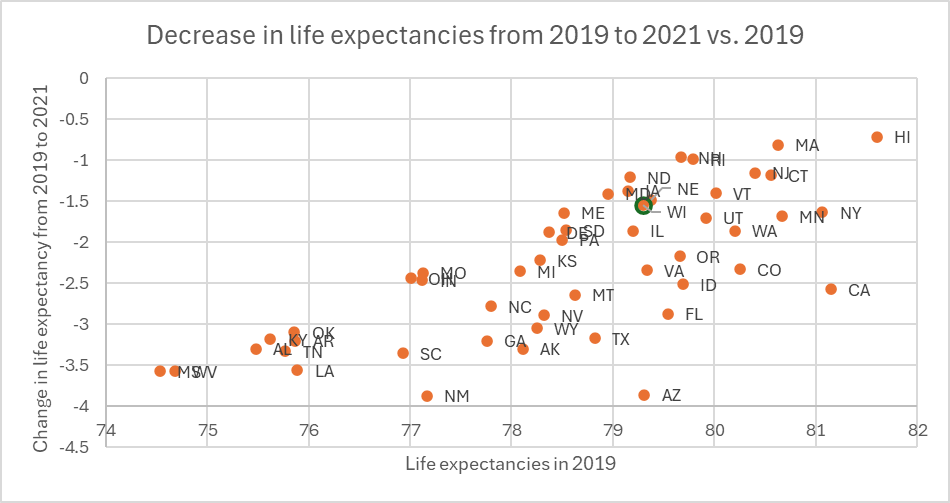
Decrease in life expectancies from 2019 to 2021 vs. 2019
One factor in life expectancy is household income: more well-to-do people tend to live longer. The following graph shows median household income compared to the percentage of Democratic vote in the 2024 presidential election. Although there is considerable scatter in the data, on average pay was higher for those voting Democratic than Republican.
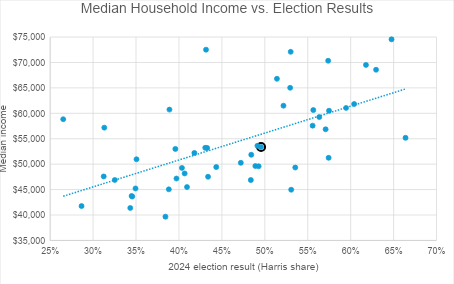
Median Household Income vs. Election Results
The final graph relates voting to the percentage of each state’s population with a bachelor degree.

Bachelor Degrees vs. Election Results
Education is a big factor in life expectancy: on average U.S. college graduates live seven years longer than high school graduates and 11 years longer than those who never finish high school. That, in turn, leads to higher paying jobs, and a higher income is a key factor in longevity. Other factors include—but are not limited to—gender, access to quality health care, each state’s safety net, and personal decisions like diet, nutrition, and exercise. Overall, the highest life expectancies appear in the healthiest states.
Gender is a big factor: In 2021, American men could expect to live 73.5 years on average, while American women can expect to live 79.3 years—a 5.8-year gap. The numbers for Wisconsin are higher: 75.2 for men and 80.5 for women. But the gender gap is slightly smaller: Wisconsin women live 5.3 years longer than men. Why Wisconsin ranks as it does might be a topic for a future column.If you think stories like this are important, become a member of Urban Milwaukee and help support real, independent journalism. Plus you get some cool added benefits.


Data Wonk
-
Who Do You Trust to Conduct Elections Fairly?
 Apr 6th, 2026 by Bruce Thompson
-
Is Non-Citizen Voting a Real Threat to Elections in Wisconsin?
Mar 18th, 2026 by Bruce Thompson
-
How Global Climate Change Affects Milwaukee
 Mar 11th, 2026 by Bruce Thompson




















Paragraph 3 should say West Virginia, not Virginia.