

Justice Ziegler Misquotes US Supreme Court Decision
Conservative falsely claims state courts can’t review congressional maps.
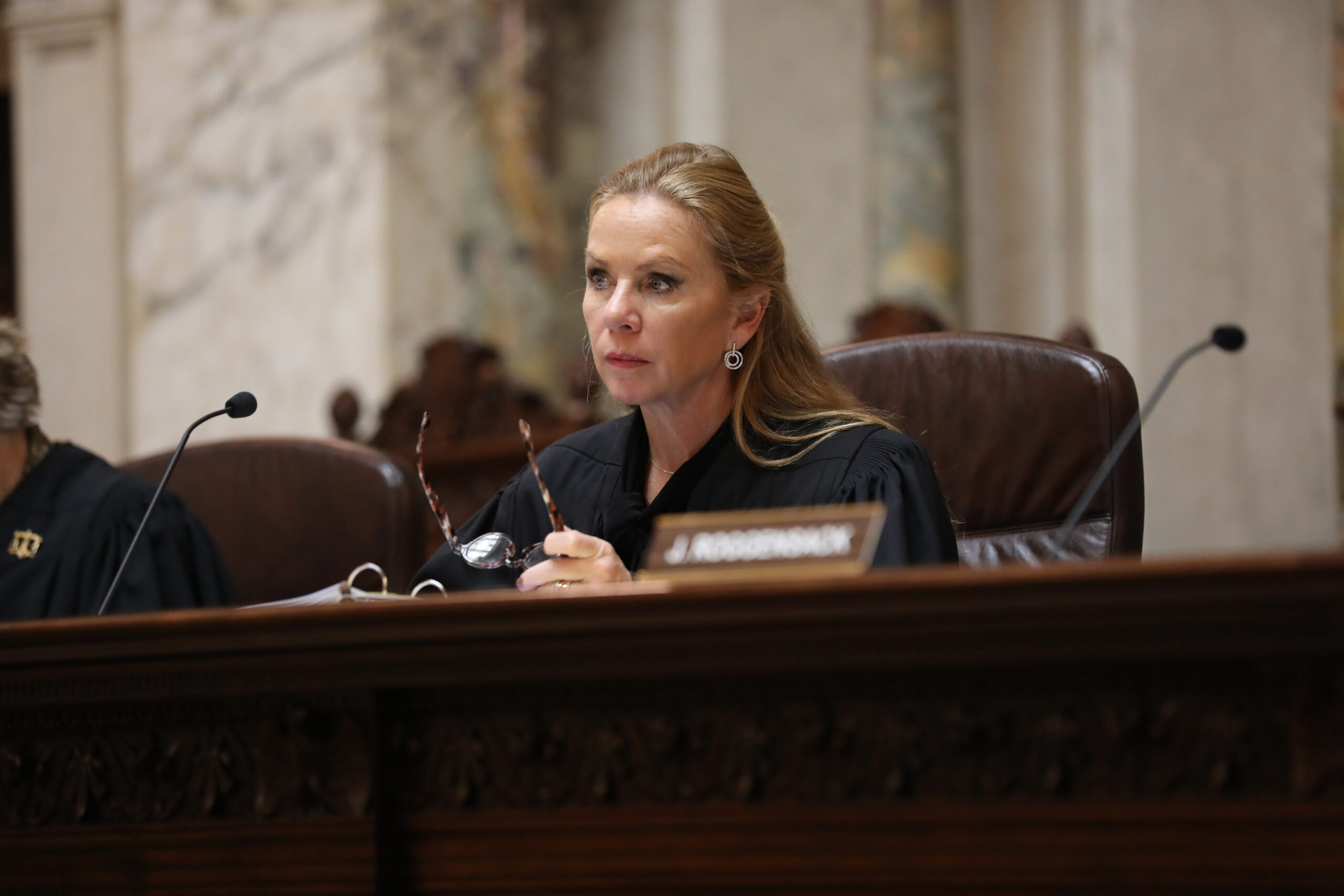
Justice Annette Ziegler. File photo by Coburn Dukehart/Wisconsin Watch.
It’s an embarrassing mistake. Or something worse.
Wisconsin Supreme Court Justice Annette Ziegler was caught turning a U.S. Supreme Court decision on its head to justify her dissent in a key case decided last week. The online publication Slate accused Ziegler of using a “fake quote” to defend “an extreme Republican gerrymander that blatantly discriminates against Democratic voters.”
On Nov. 26, the state Supreme Court voted 5-2 to follow a 2011 state law requiring the court to appoint a panel of three district court judges to consider any challenge to how congressional districts were drawn. Notably, the court’s four liberals were joined by conservative Justice Brian Hagedorn, who agreed that judicial panels must be appointed to review Wisconsin’s congressional maps, but argued the majority should have been more impartial in choosing which judges to appoint.
The court’s two other conservatives objected to the entire decision, with Ziegler charging that it was done “in furtherance of delivering partisan, political advantage to the Democratic Party.”
To bolster her argument that state legislatures have exclusive authority to determine legislative and congressional maps — and that state courts should avoid “meddling” with them — Ziegler cited the U.S. Supreme Court’s 2023 decision in Moore v. Harper. She claimed the ruling declared that the role of state courts in congressional redistricting is “exceedingly limited.”
In fact, as Slate reporter Mark Joseph Stern notes, “That quotation appears nowhere in the ruling.”
I checked, and Stern is correct. Even the word “exceedingly” appears nowhere in the decision.
But this is not just a misquote — it is a complete misrepresentation of the decision. The Moore ruling “held the opposite” of what Ziegler claims, Stern writes, concluding that state courts can play a legitimate, meaningful role in congressional redistricting.
This was a case that received extensive national coverage and commentary from media outlets, legal scholars, good-government groups, the National Association of Attorneys General and the National Association of Counties. None interpreted the case as limiting state courts’ authority. Ziegler could have simply read the Wikipedia summary stating that the Court “rejected the independent state legislature theory,” which asserts that state legislatures have sole authority to establish federal election laws without judicial review by state courts.
Or she could have checked how the conservative Federalist Society described the 6-3 decision: The Court “rejected the ‘independent state legislature’ doctrine, recognizing the North Carolina Supreme Court’s authority to review the legislature’s rules for federal elections.”
By Wednesday morning, the day after the Wisconsin Supreme Court decision was published, the court withdrew the opinion from its website and “replaced it with a partial correction — without publicly acknowledging the mistake,” Stern writes.
The corrected version of the decision retained the phrase “exceedingly limited” but removed the quotation marks, noted Douglas Poland, the attorney for Law Forward, which won the ruling Ziegler opposed. The sentence’s meaning was unchanged, he told Urban Milwaukee.
Ziegler also changed a link to page 34 of the Moore decision, replacing it with a link to page 36. But the phrase “exceedingly limited” appears on neither page, Poland said. He added that Ziegler also ignored Chief Justice John Roberts’ statement on that page that “State courts retain the authority to apply state constitutional restraints when legislatures act under the power conferred upon them by the Elections Clause.”
In short, the corrected version of Ziegler’s dissent “continues to assert that [the U.S. Supreme Court] severely restricted state courts’ oversight of congressional redistricting,” Stern writes, “offering a patently inaccurate summary of Moore’s holding.”
“Mistakes happen,” Stern continued. “But when they do, judges are supposed to fix them, not recast them into a doctrine that doesn’t exist.”
Urban Milwaukee reached out to Justice Ziegler for comment and has not heard back.
If you think stories like this are important, become a member of Urban Milwaukee and help support real, independent journalism. Plus you get some cool added benefits.


Back in the News
-
Will West Milwaukee Do Development Near Brewers Stadium?
 Dec 1st, 2025 by Bruce Murphy
-
Key Streetcar Opponent Opposes Effort to Shut It Down
 Nov 10th, 2025 by Bruce Murphy
-
Ron Johnson’s New Conspiracy Theory
 Nov 6th, 2025 by Bruce Murphy



















Common misreading of the law or interpreting the law in the most favorable light for MAGA needs has also become common at the White House. Is this desire to fumble spreading to state conservatives?
Ziegler complains that the latest WSCOTUS ruling as delivering partisan, political advantage to the Democratic Party. She ignores the fact that the conservative justices’, when they were in the majority, rulings repeatedly delivered partisan, political advantage to the Republican Party. What the current liberal majority is doing is fixing the mess left by the conservatives. Thus, another example of the legal double standard of conservatives today.