

MCTS Avoids Full Route Cuts Under New Plan
MCTS will not eliminate any routes entirely in 2026, but will cut service on 16 routes.
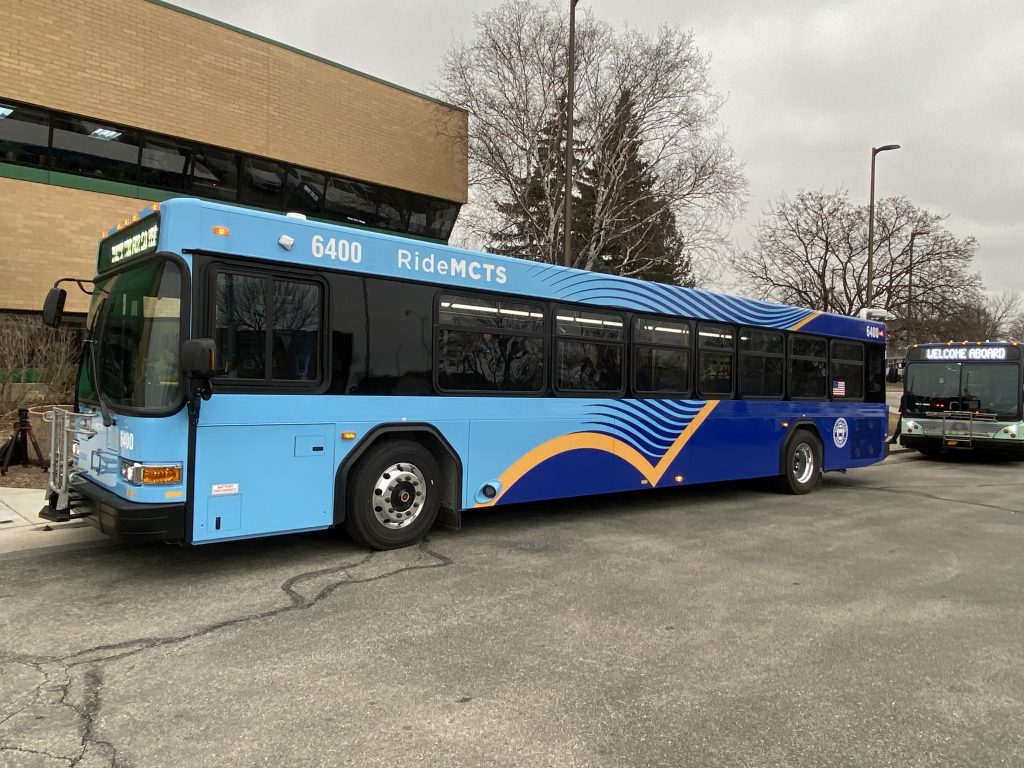
MCTS Gillig bus. Photo by taken March 19, 2025 by Graham Kilmer.
After receiving extra funding in the 2026 budget, the Milwaukee County Transit System (MCTS) has softened service reductions next year.
MCTS was initially planning to eliminate six bus routes in 2026, and reduce service along 21 others, to close a $14 million budget gap. The transit system no longer plans to eliminate any routes next year after receiving an additional $4.7 million in the 2026 budget, according to a Nov. 26 report from MCTS CEO Steve Fuentes.
Instead, MCTS will reduce service to only “peak” travel times on the six routes previously identified for cuts: routes 20, 28, 33, 34, 55 and 58.
“This service will be monitored, and adjustments will be made incrementally throughout the year to meet the appropriate service needs of the community and stakeholders,” the report states. “Peak service hours may vary from route to route, depending on ridership patterns, and will vary from weekdays to weekends.”
MCTS is also planning to eliminate sections of five routes next year, as Urban Milwaukee previously reported. These cuts will be delayed until March 8, allowing riders to prepare for the changes and maintain their current trips through the winter. The impacted routes include routes 11, 22, 24, 80 and 88.
MCTS is still planning to reduce bus frequency on 16 routes across the system next year to reduce expenses and close the budget gap, now projected at approximately $9.3 million.
For years MCTS has had a structural budget gap. The system does not have enough revenue to maintain service at existing levels. Costs rise every year, but the system’s primary source of funding, mass transit aid from the state, has largely remained flat. Since 2020, the system has filled the growing gap with federal stimulus funding released during the COVID-19 pandemic. It has now run out.
The stimulus funds were initially supposed to last until 2027. But in June, MCTS officials announced an unexpected mid-year budget deficit that led officials to spend down stimulus funding faster. The deficit came as a shock to the Milwaukee County Board of Supervisors, who had to learn that the county’s transit system was over budget from media reports.
Emails obtained by Urban Milwaukee showed top MCTS officials were planning to conceal the deficit from supervisors until the budget process began later in the fall. But the magnitude of the budget gap and contract negotiations with the Amalgamated Transit Union Local 998 forced the system to go public.
The additional funding in 2026 softens the blow of service reductions, but it potentially makes the budget deficit bigger in 2027. The amendment, authored by Chairwoman Marcelia Nicholson Bovell, used a mix of increased sales tax revenue and debt, spreading it across various county expenditures and freeing up $4.7 million in property tax revenue. The additional funding does not come from a sustainable source, and if sales tax collections underperform next year it could create a budget deficit for the county.
Nicholson did not consider the move a solution to the transit system’s budget crisis and compared the amendment to applying pressure to a bleeding wound.
Same-Day Paratransit Saved
MCTS will also use funding in the 2026 budget amendment to preserve the same-day paratransit service it launched in 2024. Faced with a large budget deficit, MCTS initially planned to eliminate the service in 2026.
MCTS operates a paratransit service for persons with disabilities called TransitPlus. But riders have to schedule their trip at least a day in advance, and the system has reputation for being unreliable.
The same-day pilot program was created to replace a paratransit taxi service that was shuttered after falling out of compliance with federal regulations. The service allows riders to schedule a ride the same day through a mobile application. It is provided through a contract held by Via, a New York-based transportation company, and uses wheelchair accessible vehicles.
To keep the program going next year, MCTS will use approximately $750,000 to operate the service with limitations on what kind of trips are eligible for rides. The report from Fuentes suggests MCTS is considering limiting rides to medical and work-related trips, and also reducing the number of trips a rider can take per month using the service.
Legislation Link - Urban Milwaukee members see direct links to legislation mentioned in this article. Join today
If you think stories like this are important, become a member of Urban Milwaukee and help support real, independent journalism. Plus you get some cool added benefits.
More about the 2025 MCTS Financial Issues
- Transportation: Bus Fare Evasion Declining - Graham Kilmer - Mar 15th, 2026
- FTA Tells Milwaukee to Crack Down on Fare Evasion — Even Where Fares Don’t Exist - Graham Kilmer - Dec 12th, 2025
- Transportation: County Names New Director of Transportation - Graham Kilmer - Dec 5th, 2025
- Transportation: MCTS Budget Picture Keeps Getting Worse - Graham Kilmer - Dec 4th, 2025
- Transportation: MCTS Avoids Full Route Cuts Under New Plan - Graham Kilmer - Nov 27th, 2025
- Transportation: Supervisor Pushes Fare Evasion Plan, Tangles With Sheriff - Graham Kilmer - Oct 23rd, 2025
- Transportation: Bus Cuts Leave Some Riders Stranded - Graham Kilmer - Oct 21st, 2025
- Transportation: Emails Reveal MCTS Officials Concealed Budget Deficit From Comptroller, County Board - Graham Kilmer - Oct 10th, 2025
- Transportation: 6 Bus Routes That Could Disappear in 2026 - Graham Kilmer - Sep 30th, 2025
- Transportation: MCTS Reaches New Labor Agreement With Union - Graham Kilmer - Sep 27th, 2025
Read more about 2025 MCTS Financial Issues here
More about the 2026 Milwaukee County Budget
- Transportation: MCTS Budget Picture Keeps Getting Worse - Graham Kilmer - Dec 4th, 2025
- Transportation: MCTS Avoids Full Route Cuts Under New Plan - Graham Kilmer - Nov 27th, 2025
- MKE County: Crowley Signs $1.3 Billion Budget Without Vetoes - Graham Kilmer - Nov 11th, 2025
- County Executive Crowley, Chairwoman Nicholson-Bovell Approve 2026 County Budget - David Crowley - Nov 7th, 2025
- MKE County: Board Adopts 2026 Budget, Reduces Size of MCTS Cut - Graham Kilmer - Nov 6th, 2025
- Supervisor Sequanna Taylor Highlights Key Co-Sponsorships in 2026 Milwaukee County Budget - Sequanna Taylor - Nov 6th, 2025
- Supervisor Martin Applauds Board Approval of Cooper Park Repair Amendment - Sup. Felesia Martin - Nov 6th, 2025
- Milwaukee County Board Advances Budget Amendments to Strengthen Transit, Health, Housing, and Family Well-Being While Reducing the Tax Levy - County Board Chairwoman Marcelia Nicholson - Nov 6th, 2025
- Milwaukee County Executive David Crowley Statement on 2026 Amended Budget - David Crowley - Nov 6th, 2025
- Transportation: Supervisors Use Parliamentary Moves To Save MCTS - Graham Kilmer - Oct 31st, 2025
Read more about 2026 Milwaukee County Budget here


Transportation
-
Bus Fare Evasion Declining
 Mar 15th, 2026 by Graham Kilmer
-
Committee Approves Towing Reckless Drivers, With Objections
 Mar 12th, 2026 by Graham Kilmer
-
$14.1 Million Plan Targets Safer Streets In Walker’s Point, Valley, Westown
 Mar 12th, 2026 by Jeramey Jannene
















I fear this is just an exercise in kicking the problem into next spring. The reduction of certain routes to peak hour service has been tried usually doesn’t work.
Of the routes in danger, I personally have experience with the 33 and 28. The 33 and an earlier incarnation of Vliet Street service provided by a different route just haven’t had much business – unlike other East West routes such as the Red Line. Maybe Vliet St. just doesn’t have the residential/commercial mix needed to generate more ridership.
The 28 might have some low numbers, but my observations are that there are regular riders who have places to which they need to go (work, etc.). Peak hour service will not be of much help to people whose business falls outside of those hours.