Kenosha County DA Has Law License Suspended
Xavier Solis's brief tenure has been marked by controversy.
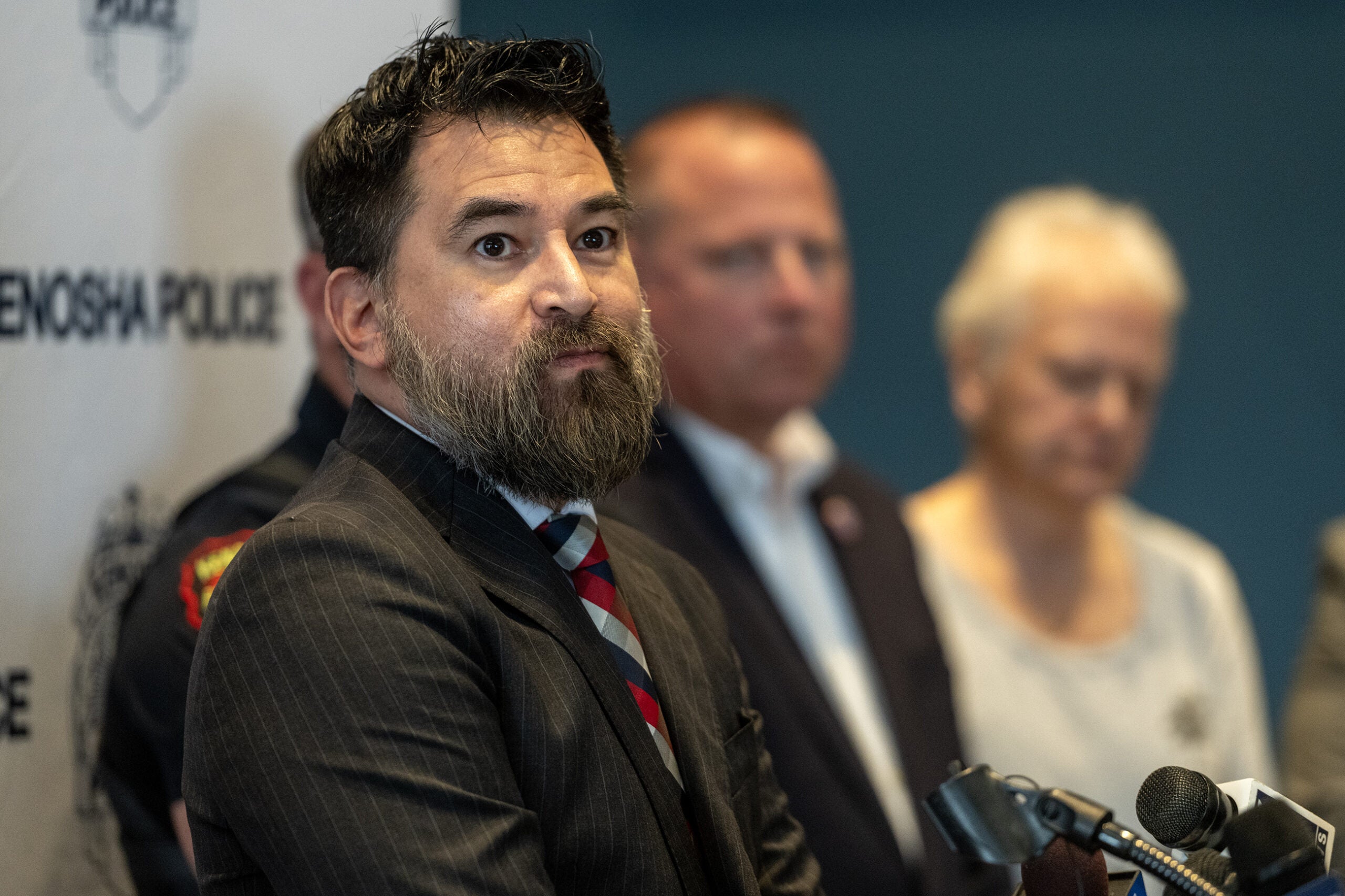
Kenosha County District Attorney Xavier Solis answers questions about a cold case from the 1970’s on Tuesday, March 31, 2026, at the Kenosha Public Museum in Kenosha, Wis. Angela Major/WPR
Kenosha County’s top prosecutor is now barred from practicing law in Wisconsin.
A memo released Monday by Wisconsin’s Office of Lawyer Regulation states that Xavier Solis’ Wisconsin law license has been suspended effective immediately for “willfully failing to cooperate with one or more OLR investigations into alleged misconduct.”
The memo does not give details about what that alleged misconduct was.
Solis has been working as Kenosha County’s top prosecutor since January 2025.
He was elected in November 2024 after running as a Republican against Carli McNeill, a Democrat who previously worked as the No. 2 person in the Kenosha County district attorney’s office.
At the time of the election, Solis had been working in private practice, but he did not have any experience as a prosecutor.
Since Solis took office, the Kenosha County district attorney’s office has struggled with vacancies and with resignations from experienced prosecutors.
Solis did not immediately respond to an emailed list of questions from WPR. Wisconsin law says that a district attorney must be licensed to practice law in the state.
The notice about Solis’ suspension references a section of the state’s Supreme Court rules. Those rules say that a lawyer’s license can be suspended for failing to cooperate with an OLR investigation in a number of ways. That could include failing to “fully and fairly to disclose all facts and circumstances,” failing to turn over evidence or failing to meet deadlines imposed by the OLR.
It could be possible for Solis to regain his law license. The rules say that a lawyer’s license will be reinstated automatically if — within 18 months of the suspension — the OLR determines that lawyer has since cooperated with the investigation.
In the meantime, Kenosha County’s Deputy DA Rosa Delgado says she will serve as acting DA until Solis’ “license to practice law is reinstated or until further direction is received from the Governor’s Office,” WGTD reported. Typically, Wisconsin’s governor appoints lawyers to fill district attorney positions that are vacant mid-term.
Solis was previously sanctioned for his use of AI
In February, Kenosha County Judge David Hughes sanctioned Solis after Solis used artificial intelligence to file court documents that included false case citations.
Under a Kenosha County Circuit Court policy, people have to disclose if they use AI to help write or prepare documents submitted to that court, and Solis did not make that disclosure.
The policy also says it’s the responsibility of the person filing the document to make sure that the information they submit is accurate.
After a defense attorney flagged issues with Solis’ court filing, Solis told a judge in February that he sometimes uses AI for “research” purposes.
Solis turned in the AI-assisted filing when responding to the defense’s request to have a felony burglary case thrown out.
Hughes ended up dismissing all of the charges in that case , as well as all of the charges against another man who was charged as a co-defendant. Hughes said prosecutors hadn’t brought forth enough evidence to establish probable cause that a crime had been committed.
Hughes’ sanction against Solis did not carry monetary penalties. Instead, Hughes penalized the district attorney by striking the AI-assisted motions.
In another case, Solis missed a deadline to turn over evidence
In April, another Kenosha County Judge, Jodi Meier, said in court that she would consider issuing sanctions against Solis in a separate case. There is nothing in online court records from that case, however, to indicate that she ever issued that type of public reprimand.
Meier made that statement after defense requested monetary sanctions against Solis.
That was after Solis blew a court-imposed deadline for handing over criminal background check reports related to multiple witnesses in a homicide case. Solis also submitted a trove of digital evidence later in the day on April 14 — hours after the first day of the trial had already started, online court records show.
That trial concluded when jurors found 42-year-old Justin Tercek of Kenosha guilty of multiple charges including first-degree intentional homicide, burglary and criminal damage to property.
Tercek was accused of breaking into a home and stabbing a Kenosha man and his dog to death, according to a criminal complaint.
Under law and the U.S. Constitution, prosecutors are required to turn over certain evidence to defense attorneys. That includes anything deemed “exculpatory,” meaning that it could cast doubt on a defendant’s guilt.
John Gross, a criminal law professor at the University of Wisconsin, says those requirements are intended to help trials run efficiently — and to make sure that people get due process.
“What you want is you want a full and fair disclosure of what each side is going to present during trial,” Gross said in an interview with WPR earlier this year. “And you want that … for fundamental fairness, to allow each side to prepare and not be surprised by witnesses.”
State law also explicitly states that a district attorney has to turn over information about the criminal history of witnesses that will be called by the prosecution.
According to online court records, Meier set a deadline for Solis to provide criminal histories of witnesses by April 10. But, when the trial started April 14, defense attorneys raised concerns that those histories — which are available to prosecutors through a database from the National Crime Information Center — had not been provided for at least three planned witnesses.
Defense attorneys also told the judge they received more than 150 items of digital evidence late in the morning on day one of the trial. And they said they didn’t receive a disk with new autopsy photos until that afternoon.
On the first day of the trial, Meier called the DA’s late submissions “extremely unacceptable,” online court records show. She ended up sending jurors home early, so that evidence issues could be sorted out before proceedings resumed the next morning.
Gross said late evidence can be “very frustrating” for judges.
“There’s nothing judges dislike more than having to impanel a jury (of a) bunch of citizens — who we’re asking them to spend their time adjudicating this case, away from their family, away from their jobs,” he said. “And then to have somebody, one of the parties, do something that requires the judge to hit the brakes.”
How often do Wisconsin attorneys have their licenses suspended?
State records show that Solis was first admitted to the bar in 2013. However, he’s now listed publicly as having a suspended law license for disciplinary reasons.
According to Wisconsin’s Supreme Court rules, “any person” can file a grievance about an attorney’s conduct with the Office of Lawyer Regulation.
Depending on the substance of that complaint, the office may choose to launch an investigation.
In 2025, a total of 123 matters — or 6 percent of the grievances received —were referred for an investigation, according to the office’s annual report.
Some of the matters before the OLR resulted in reprimands, most of which were private, before the matter was referred to an investigation.
Last year, Wisconsin’s Supreme Court ended up suspending the licenses of six lawyers. Two of those people had their licenses suspended for six months or less, another two had their licenses completely revoked and two entered into agreements to give up their licenses, the annual report says.
Kenosha County DA has law license suspended was originally published by Wisconsin Public Radio.
If you think stories like this are important, become a member of Urban Milwaukee and help support real, independent journalism. Plus you get some cool added benefits.