Crowley Unveils Anti-Corruption Plan
Democratic candidate for governor targets stock trades, prediction markets and email deletions by legislators.
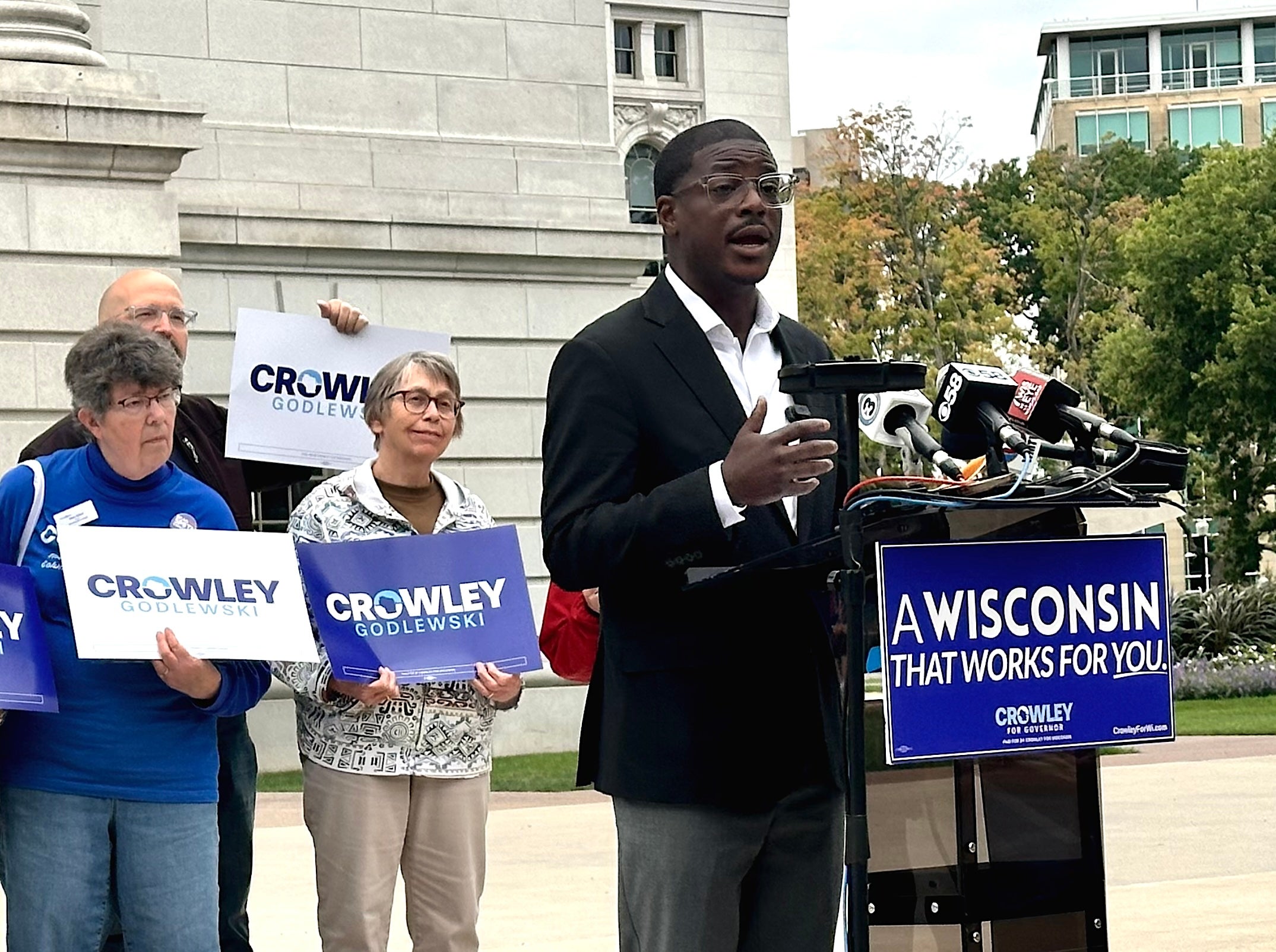
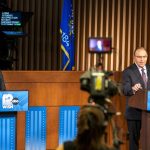
Milwaukee County Executive David Crowley, who is running for governor as a Democrat, speaks at a press conference outside the Wisconsin State Capitol in Madison, Wis., on Sept. 14, 2026. Anya van Wagtendonk/WPR
David Crowley, the Democratic candidate for governor, says he’ll push for changes to state law that would limit elected officials’ ability to profit off their offices and access.
In a press conference Monday, Crowley framed his proposals as a push for government accountability at a time of rising costs.
“Wisconsinites, the people who pay their public officials’ salaries, they deserve transparency. They deserve accountability for how their money is being spent,” he said. “They see politicians across the state and in Washington doing better than them. They’re doing fine, and in many cases, they’re thriving. And how can that be when diesel right here in the state of Wisconsin is nearly $6 a gallon?”
The proposals include banning elected state officials from participating in prediction markets. They’d also be banned from trading stocks, and would instead have to place investments in diversified funds or blind trusts.
Energy companies would also be prohibited from hiring former industry regulators within two years of the regulator leaving office.
And Crowley said he’d end a little-known caveat to Wisconsin’s open record laws. Whereas government agencies must retain records, individual lawmakers don’t have to. They can, for example, delete emails sent to their offices.
“We have seen lawmakers try to hide how they spend taxpayer dollars on things that absolutely, in no shape or form, serve the public,” said Crowley.
Crowley said that he’d include the proposals in his first state budget if elected. To become law, they’d ultimately need the Legislature’s approval.
In a statement, Republican candidate Tom Tiffany said he shares Crowley’s goals, but “would go even further.”
Tiffany said he wanted to make it easier for Wisconsinites to search through how government agencies spend money, and called for a modernization of the existing OpenBook program, which tracks government expenditures. He also called for tighter rules barring legislators from subcontracting with lobbyists.
And he said he’d initiate a full audit of state government “to uncover waste, fraud, and corruption and make sure taxpayers are getting the results they deserve.”
Bipartisan efforts to rein in trading, prediction markets
Any budget proposal from a governor would need legislative approval. Whether that happens could hinge on who wins control of the Assembly and Senate in November.
But Crowley’s proposals echo other efforts in Washington and in Madison — some of which had bipartisan support.
One bipartisan effort to halt congressional stock trading has not advanced for a vote, but a narrower bill, authored by U.S. Rep. Bryan Steil, R-Janesville, recently passed the House with some Democratic support. That bill would place limits on buying new stocks, but it doesn’t require a change to existing portfolios.
Congress is likewise grappling with how to regulate lawmakers’ use of prediction markets, with concerns that politicians could use insider information to place bets. Earlier this year, the Senate passed a resolution prohibiting its members from participating in prediction markets, like Kalshi and Polymarket.
States are also imposing their own regulations on these services. According to the National Conference of State Legislatures, no state has yet enacted a complete ban on statewide elected officials using these markets, but Ohio has such a proposal pending.
Crowley’s proposal to impose a two-year waiting period between regulating a utility working for one is similar a bipartisan bill that Republicans proposed earlier this year, which died in committee. It would have made any former commissioner of the Public Service Commission wait for three years before working for a public utility or transmission company.
Since 2023, two former PSC commissioners — one appointed by Democratic Gov. Tony Evers and one appointed by Republican Gov. Scott Walker — have taken executive roles at utilities. Backers, including Crowley, have said restricting such moves would be aimed at keeping energy rates fair.
David Crowley proposes plans to tackle government corruption was originally published by Wisconsin Public Radio.
Political Contributions Tracker
Displaying political contributions between people mentioned in this story. Learn more.