Federal Transit Cuts Threaten County Bus System
Congress could slash federal transit funding, a further blow to financially struggling MCTS.
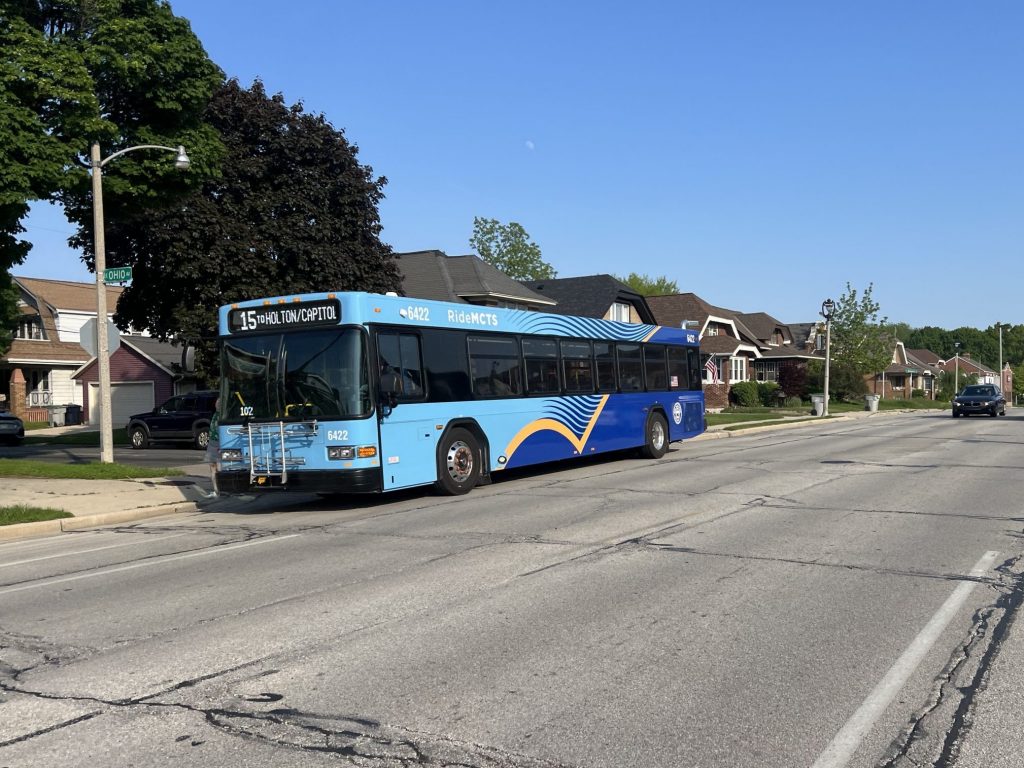
MCTS Bus. Photo by Jeramey Jannene.
Congress is proposing cuts to federal transit funding, complicating the efforts of Milwaukee County transportation officials to stabilize the declining Milwaukee County Transit System (MCTS).
Congress is considering cutting federal transit funding by between 14% and 20% over the next five years. In the House of Representatives, the Build America 250 Act would reduce federal support for transit by $16.5 billion between 2027 and 2031, according to the American Public Transit Association. In the Senate, a continuing resolution to keep the government funded is proposing a 20% cut in transit funding.
“Although state and local funding impacts are still being evaluated, a
In either case, MCTS stands to lose millions annually in federal funds, just as county transportation officials attempt to steer the system out of fiscal crisis.
MCTS cut service in 2026 to close a $9.3 million budget gap. The system faces another $15.7 million budget gap in 2027 and is on track for a $37 million shortfall by 2031 if nothing changes. While the system has lost ridership, the primary challenge to solvency is state aid falling behind inflation. If state mass transit aid — the single largest source of revenue for MCTS — had kept pace with inflation since 2010, the system would be receiving an additional $35.5 million from the state this year.
MCTS President and CEO Steve Fuentes is proposing to stabilize the system with a 25% cut in 2027, reducing operations to a level that can be sustained without the infusion of new funds. MCTS is already working with a transit consultant to redesign the bus network for long-term stability and re-expansion, if additional funding ever materializes.
“If we reduce the service by 25% over the next three years, we can afford to put out the same level of service for a three-year period without any one-time appropriations, which means we’re not threatening, or we’re not saying, that we need to cut routes,” Fuentes previously said.
But now even that might not be enough, with Congress planning anywhere from 14% to 20% in cuts. The bill in the House is a reauthorization of funding for existing programs. It cuts baseline spending last established by the Infrastructure Investment and Jobs Act, the bill passed under former President Joe Biden commonly referred to as the Bipartisan Infrastructure Law.
“Because we are already working to maintain service at current funding levels, which have remained flat for years in spite of rising costs, these challenges would be exacerbated, systemwide, if federal funding is reduced,” Lamers told Urban Milwaukee.
Lamers has recently begun enlisting the support of local advocacy groups, asking them to write to their representatives in opposition to the Build America Act. Beyond baseline cuts to federal formula funding, Congress is also considering reducing funding available through competitive grant programs.
Wisconsin’s 4th Congressional District — represented by U.S. Rep. Gwen Moore and including most of Milwaukee County — stands to lose approximately $17.7 million in federal transit funding under the proposal, according to an analysis by the Urban Institute, a nonpartisan think tank in Washington, D.C.
MCTS does not have any cushion in its budget to absorb federal funding cuts. The system has, for years, been repurposing federal funding intended for infrastructure to operate bus routes. A loss in federal funding is likely to have a direct impact on service levels for MCTS and the paratransit system, Transit Plus.
“This reduction would have a devastating impact on all riders, but especially those who rely on mobility services for their day-to-day needs,” Lamers wrote in a letter to local organizations. “We are already fighting to preserve current paratransit and mobility programs, but this potential loss of federal funding would make it challenging to maintain service for those who need it most.”
If you think stories like this are important, become a member of Urban Milwaukee and help support real, independent journalism. Plus you get some cool added benefits.


Transportation
-
Downtown Boulevard for I-794, Completing MARK Rail Plan Will Build City
 Sep 1st, 2026 by Larry Witzling
-
Federal Grant Will Upgrade Bike-Pedestrian Crossings and Bridges
 Aug 30th, 2026 by Graham Kilmer
-
The Hop Changes Tracks To Two-Route Configuration
 Aug 28th, 2026 by Jeramey Jannene