

Supreme Court Order on Mail-In Voting Won’t Affect Wisconsin Ballots
But election officials warn the back-and-forth over election rules could confuse voters.
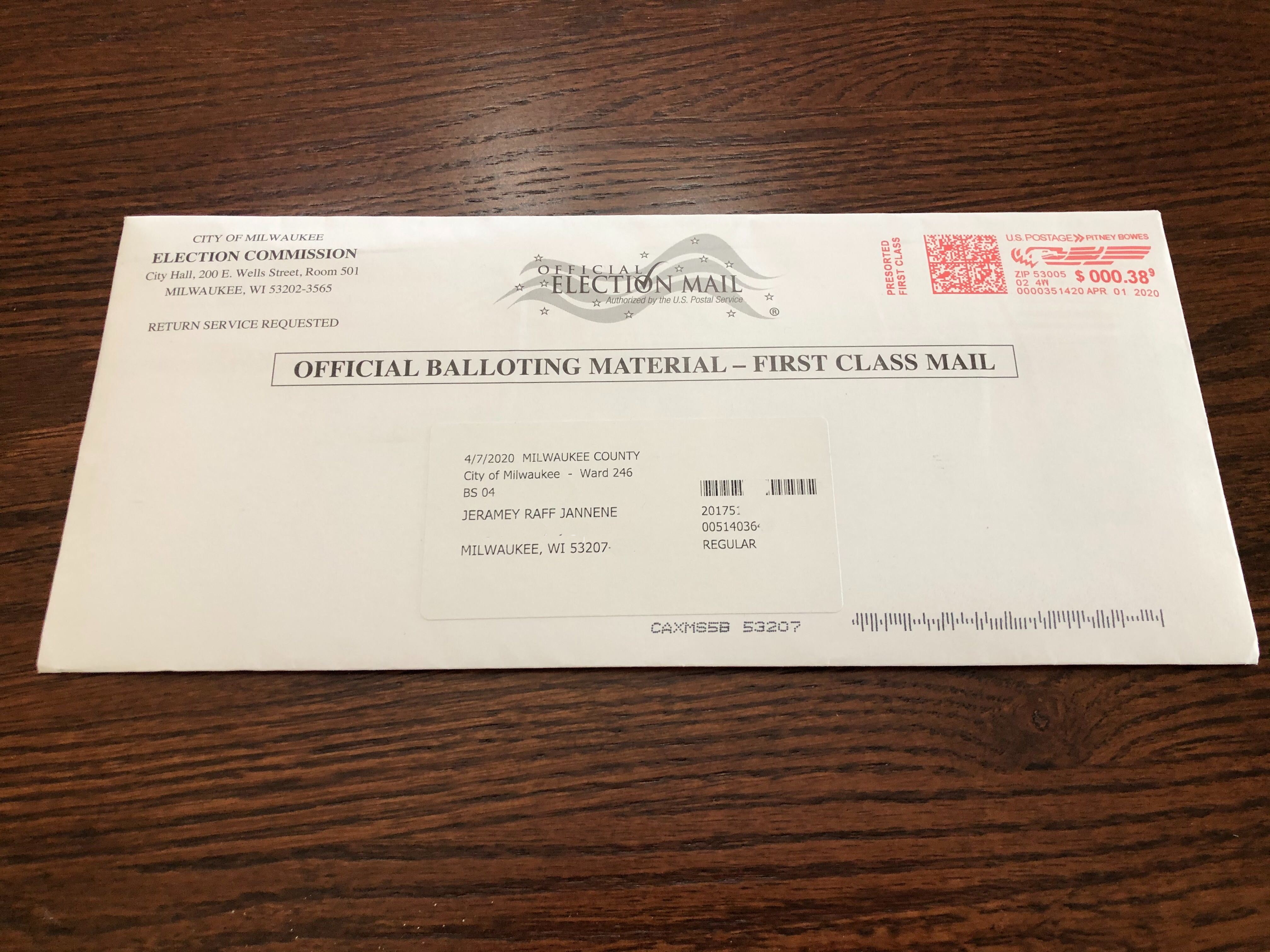
An absentee ballot. Photo by Jeramey Jannene.
A U.S. Supreme Court decision allowing President Donald Trump to advance his plan to restrict voting by mail won’t be the final word ahead of Wisconsin’s November election, Wisconsin election officials say.
But they warn the back-and-forth over election rules — 10 weeks out from consequential midterm elections — and the open question of whether more changes are forthcoming before then sows confusion.
“I think that the real concern is that the clock is ticking,” said Derek Clinger, with the State Democracy Research Initiative at the University of Wisconsin-Madison Law School. “Really, any last minute change to mail voting procedures this close to the election could create a lot of chaos and confusion for election administrators and for voters.”
A Monday emergency opinion from the high court paused a lower court ruling that blocked parts of Trump’s March executive order directing the U.S. Department of Homeland Security to create state lists of U.S. citizens eligible to vote. The order also directs the U.S. Postal Service to prevent mail-in ballots from going to anyone not on those lists.
The unsigned decision didn’t get into the legality of Trump’s order and focused instead on the timing of the challenge brought by 23 states, including Wisconsin. Justices said the states couldn’t show they’ve been harmed because the president’s voting rules haven’t yet taken effect.
The Supreme Court’s three liberal members dissented, with Justice Ketanji Brown Jackson saying the order “needlessly injects chaos and uncertainty into the upcoming midterm elections.”Wisconsin Elections Commission member Ann Jacobs, a Democrat, told WPR it is possible, but unlikely, that Trump’s order restricting voting by mail would go into effect before the November midterm election.
“We are going to see, I think, litigation,” said Jacobs. “But hopefully it’ll become clear to the voters that this is a situation where the courts are going to stay it and the election will move forward as it has in the past.”
Democratic Wisconsin Attorney General Josh Kaul said the Supreme Court “has kicked the can down the road” by not deciding the legality of Trump’s order. He said another federal district court order blocking the president’s directive in another case still stands and will likely be amended soon.
“I remain very confident that this executive order is not ultimately going to impact the way that absentee voting works in Wisconsin for the upcoming election,” said Kaul. “That’s going to depend on what happens in court and what actions the Trump administration takes. But I do remain very confident about that.”Kaul said it’s disappointing to see Supreme Court justices acting on cases like this so near an election, when they’ve previously avoided making changes on such tight timelines.
Dane County Clerk Scott McDonell told WPR the court is telling states like Wisconsin that they can’t challenge the Trump order because they haven’t been ordered to do anything yet. On Friday, the U.S Postal Service published its final rule on which voters can receive mail-in ballots, if the high court rules in favor of Trump’s executive order.“I mean, I don’t know how else you read that,” said McDonell.He said the lack of clarity surrounding voting by mail has left him unsure what to tell voters.“What I’m hoping for is that the Supreme Court moves quickly on this and has a decision within the next week or so because we’re designing the ballot as we speak,” he said. “It’s going to go to the printer … and then there’s deadlines coming up to mail them out.”
“So yeah, this timeline is very tight,” he added.
Clinger, the democracy researcher, said he expects the Massachusetts district court, which originally blocked parts of the Trump order, to rule on the merits of the finalized USPS rule. Even that, he added, won’t answer the question.
“That (lower) court has already said that the rule would be unconstitutional,” he said. “But whichever way it goes, that matter’s almost certainly headed back to the Supreme Court very soon, and it’s that kind of coming litigation that will be the most important step.”
McDonell noted his office is currently designing and printing ballots that must be sent early to voters who are in the military or overseas. Federal law dictates that those must be mailed 45 days out from an election, which is Sept. 19 this year.
Supreme Court order on mail-in voting won’t immediately affect Wisconsin ballots was originally published by Wisconsin Public Radio.
If you think stories like this are important, become a member of Urban Milwaukee and help support real, independent journalism. Plus you get some cool added benefits.



















I say screw the Supreme Court. Proceed with the election. Create a rule that allows any person who voted by mail to come in person and cast a provisional ballot.
Then if their mail-in ballot doesn’t arrive before the deadline, use the provisional.