Can Wisconsin’s Stressed Oak Trees Be Saved?
Arborists say early signs of off-color leaves and thinning canopies are a critical window to act before trees die back further.
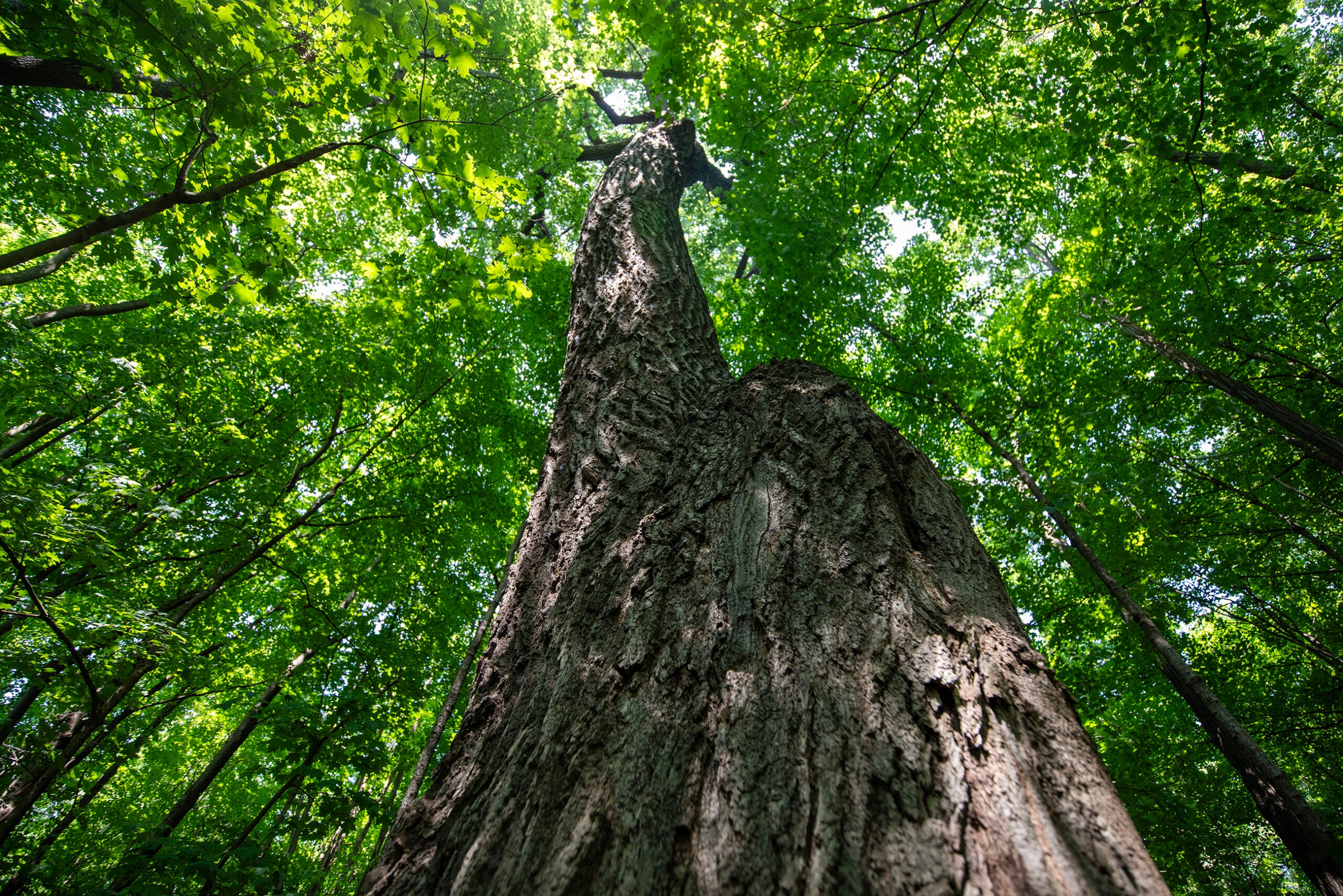
The largest red oak tree in the state stands tall Monday, July 21, 2025, near the Mendota Mental Health Institute in Madison, Wis. Angela Major/WPR
Invasive insects, drought and disease are killing some of Wisconsin’s oak trees.
Many of the state’s oak trees are declining or dying as they face spongy moth infestations and drought conditions. And the tornadoes and strong storms that have hit Wisconsin this year have damaged the branches on thousands of trees, which could make those trees more vulnerable to deadly oak wilt.
Wisconsin Department of Natural Resources forest and pest coordinator Michael Hillstrom said many factors are also hurting the health of the state’s oaks: vulnerability due to old age or being planted too close to other trees, stress events often caused by invasive species and drought.
“Tree mortality is not linked to a single issue,” he said. “It’s not just oak wilt that’s killing the trees, or it’s not just an insect.”
One main culprit is the spongy moth, an invasive insect that was rampant in the state from 2022 through 2024. These insects chew through the trees’ leaves, making it harder for the trees to produce the food they need to grow.
Hillstrom said the spongy moth population is not as large this year, but the trees are still actively recovering from the previous outbreak.
“We had this three-year buildup of stress, then in year four (2025), we started seeing more of that decline in mortality. We’re seeing a little bit more of it this year,” Hillstrom said.
Additionally, parts of Wisconsin have seen several years of drought. Droughts create conditions that make it hard for the trees to replace the leaves they have lost.
The spongy moth population grew during the drought years according to Hillstrom. He said a fungus that kills them can only thrive in wet soil.
“When you get three springs in a row where it’s really dry and you don’t have that (fungi) activity, that really allows that (spongy moth) population to boom pretty quickly,” he said. “We generally have not seen an outbreak this severe.”
Hillstrom said that when trees are already vulnerable, stress events like spongy moth defoliation can be what ultimately kills trees. He said these “stacked stressors” make it hard for experts to trace what is causing a specific decline in different areas.
And in some parts of the state, recent storms could be adding a new stressor. Broken branches can make trees vulnerable to oak wilt. That means places hit by strong storms this year such as central Wisconsin and the Fox Valley could see further tree loss.
Rachel Lilla, a certified arborist based in Waukesha County said oak wilt is a fungal disease that can be spread through beetle transmission or root systems.
“We get worried when we have these intense storms because when branches break, trees release chemicals that attract these beetles,” she said. “The beetles have the infection or the fungal spores or masses on their little feet.”
Catching decline early can keep trees healthy
Oak wilt happens quickly and can kill red oak trees within a month. White oaks with wilt can last years with the disease.
But most of the other issues oak trees face take longer to kill the tree. This means there is time for the trees to be saved.
“If you’re paying attention to your trees, you can catch (decline) really early,” said Lilla. “As soon as you start to see that off-color, you’re not seeing that lush green foliage anymore; that’s your number one sign to get it checked out.”
She said if there are still leaves on the canopy of the tree, then there is hope that it can be saved. Lilla said notifying an arborist if there are signs of decline is important, and that they have tools to treat struggling trees.
“We start by first addressing symptoms, and then we can work to get to the root cause,” Lilla said. “Typically we’re trying to control insect feeding because that’s one of the low hanging fruits to address.”
Arborists can also relieve the root stress of trees by vertical mulching, she said. This prevents the soil from compacting and creates a fluffier compost for root systems to grow.
Hillstrom said cutting down older trees can allow for healthier trees to absorb more resources and watering trees during droughts are ways to keep trees healthier upfront. He also said sometimes letting nature run its course is the best.
“Maybe the tree doesn’t look great right now, but over the course of two, three, four, five, years, it grows out some new branches and puts out some new leaves,” Hillstrom said. “Sometimes having patience is really the best thing we can do.”
‘Stacked stressors’ are causing oak tree decline in Wisconsin was originally published by Wisconsin Public Radio.
If you think stories like this are important, become a member of Urban Milwaukee and help support real, independent journalism. Plus you get some cool added benefits.