Trump Administration Cutting Federal Loans for Low-Paying Degrees
Social workers, artists, early childhood education teachers in Wisconsin will be affected.
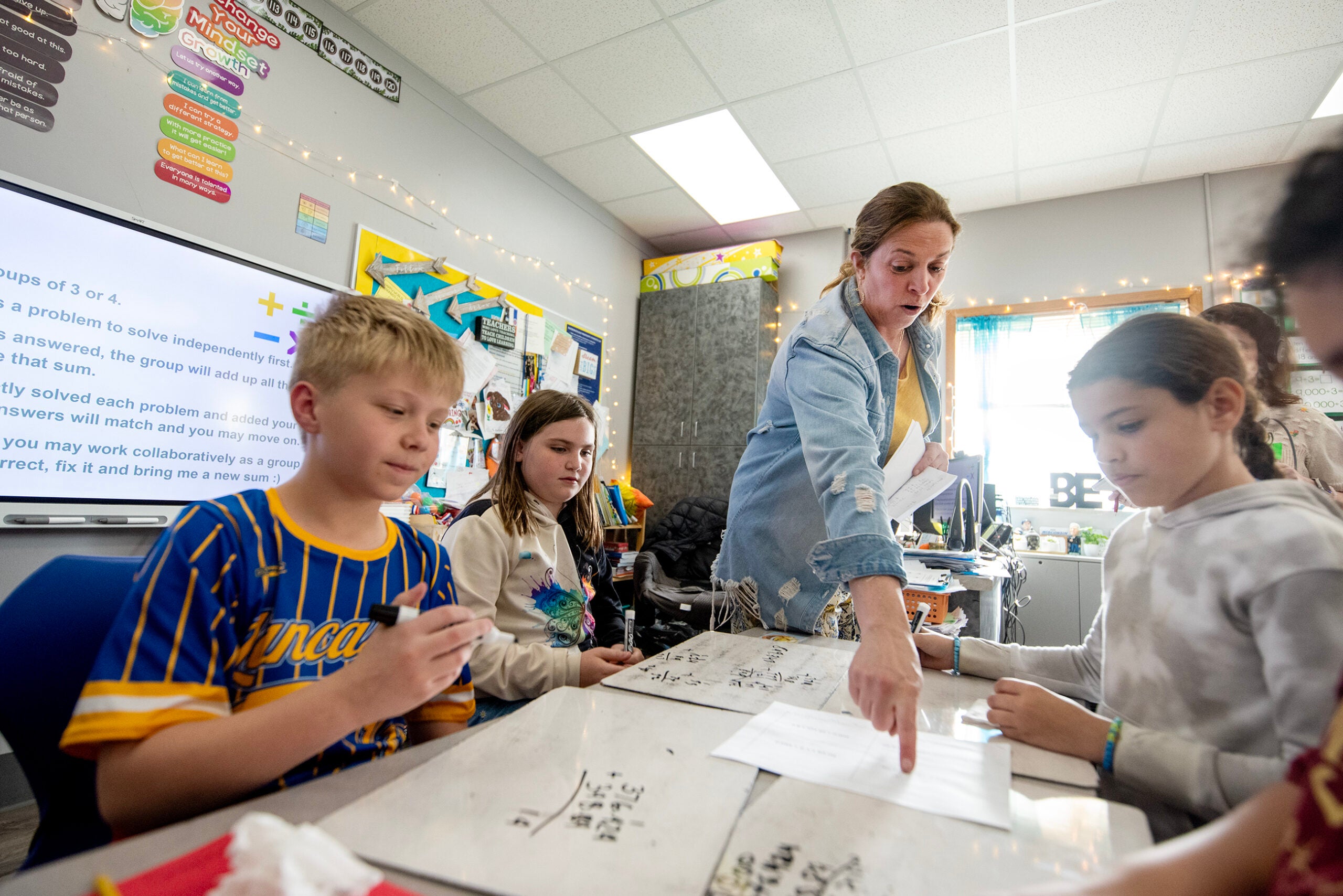
Fifth grade math teacher Missy Sperle helps her students during class Tuesday, April 29, 2025, at Winskill Elementary School in Lancaster, Wis. Angela Major/WPR
A new Department of Education rule will cut off federal student loans for college programs whose graduates consistently earn low incomes.
Under the Student Tuition and Transparency System, or STATS, and Earnings Accountability rule, undergraduate programs will be required to demonstrate that their graduates earn more than the typical high school diploma holder, and graduate programs will be required to demonstrate that their graduates earn more than the typical bachelor’s degree holder.
The Education Department will compare the earnings of graduates four years after completion to the median earnings of working adults ages 25 to 34 in the state where the college is located.
That means people who want to become social workers, early childhood teachers, cosmetologists and artists might no longer be able to borrow money to pay for their schooling.
The Trump administration says it is hitting a “reset button” on higher education to drive down the cost and hold institutions accountable.
“If a program cannot show that it leaves its graduates financially better off than if they had never enrolled, it should not be underwritten by federal taxpayers,” Under Secretary of Education Nicholas Kent said in a statement.
The median annual income for a high school graduate aged 25 to 34 in 2022, according to the most recent data available, was $41,800.
According to the federal government’s College Scorecard, graduates of Wisconsin schools exceed that salary.
If a program fails to show at least this modest financial return on investment for its graduates in two out of three consecutive award years, it will lose eligibility to participate in the federal Direct Loan program.
After three years of consistently failing the earnings premium measure, the Department of Education could also terminate eligibility for Title IV of the Higher Education Act, including Pell Grant eligibility, for all of an institution’s low-earning outcome programs.
The median income for people aged 25-34 holding a bachelor’s degree in 2022, according to the most recent data available, was $66,600. But that median varies widely based on the field of study.
The changes are expected to go into effect in 2027.
Milwaukee Institute of Art and Design President Jeffrey Morin says limiting who gets loans based on their future earning potential says something about the type of country we want to become and our future quality of life.
Similar rules existed under the Biden administration, but applied only to certificate programs at nonprofit schools and degrees at for-profit schools.
“I think that one of the original intentions of this was to go after predatory practices,” Morin said. “But now, because it is being so broadly applied, it really does start to impact things that are really important in our communities.
“Things like counseling and mental health services, social work, early childhood education and the arts,” Morin continued.
“Usually, community good causes people to go into a vocation that is not known for high salaries,” Morin said.
Victoria Folse, president of Ripon College, says many times a person’s full earning potential isn’t realized until several years after graduation.
As of today, Ripon College, a private liberal arts school that has about 800 students, is not on the Trump administration’s radar, Folse said.
Graduates from Ripon are typically making more than $50,000 a year, she said.
Ripon College recently announced it will add new majors in accounting and criminal justice and sunset programs in anthropology and French.
Folse says that is based on student and workforce demand, not the federal government.
“When we think about a traditional liberal arts and science education, we’re preparing students for lifelong learning, not just their first job,” Folse said. “I am concerned about some government interference with the decision making of students and their families.”
The new rule coincides with changes in student loan borrowing unless the program is considered “professional.”
Since July 1, students in graduate programs are limited to borrowing $20,500 annually and a $100,000 lifetime limit. This includes social work, education, nursing and public health.
“If you haven’t checked tuition lately, $20,000 is not exactly what a graduate-level tuition is,” said Joel Rubin, executive director of the National Association of Social Workers Wisconsin Chapter.
“What this means is, social workers across the country will be at significant and needless risk of losing access to adequate federal student loans and pretty much won’t have the possibility to finance their schooling,” Rubin continued. “And frankly, this is happening in a time period when we have significant mental health shortages. This is not good news.”
A survey conducted in Marchby the American Art Therapy Association, a program also having to follow the new borrowing limits, found three-fourths of students took out more than $20,500 a year in federal student loans to complete their schooling in the past 10 years.
Students enrolled in “professional” programs would qualify for up to $50,000 in federal loans per year, with a $200,000 aggregate limit. These degrees include pharmacy, dentistry, veterinary medicine and occupational therapy.
These new federal rules come in the midst of a national crisis in student loan defaults and as part of a larger effort by the federal government to ensure a college degree serves as an avenue for economic advancement, not debt.
According to federal data, more than 108,000 people in Wisconsin haven’t made payments on their student loans in more than a year.
Trump administration cutting federal loans for low-paying degrees was originally published by Wisconsin Public Radio.
If you think stories like this are important, become a member of Urban Milwaukee and help support real, independent journalism. Plus you get some cool added benefits.