

Oracle’s Credit Rating Cut Amid Data Center Legal Battle with WI Regulators
BBB- rating just about junk status. Trying to build $15B data center in Port Washington.
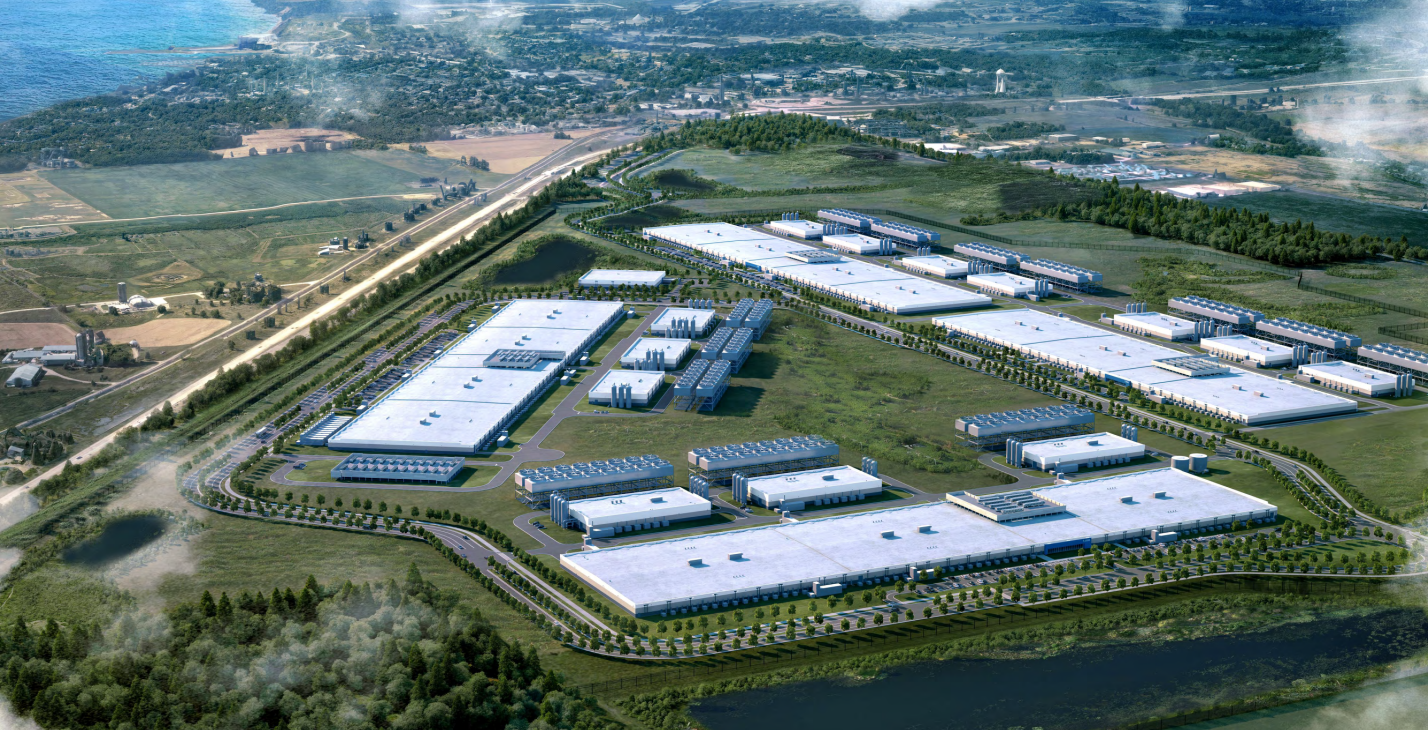
This is an aerial rendering of what the planned data center campus in Port Washington could look like. Source: City of Port Washington
Tech giant Oracle Corp. took a hit to its credit rating amid massive spending in the race to build out artificial intelligence as it battles with Wisconsin regulators in court over financial requirements for data center customers.
On July 9, S&P Global Ratings, a national credit rating agency, cut the company’s credit rating to BBB- as it spends money faster than it can generate revenue. The tech giant’s credit rating is still investment-grade, but it’s now just one step above junk status.
“We now recognize that we underestimated the scale of the investments required to expand the AI business and its impact on our overall view of Oracle’s creditworthiness,” the S&P analysts wrote.
Even so, the S&P analysts expected the company to show improvement in its profitability, as well as raise additional capital in the next few years to fund its growth.
Oracle is one of three developers partnering to build the $15 billion Lighthouse data center campus in Port Washington. In a statement, an Oracle spokesperson said the company remains committed to maintaining its investment-grade credit rating as a top priority for raising and spending funds.
“We remain confident in and focused on executing our business plan over the next months and years tied to the unprecedented opportunities for growth and strong returns on capital tied to cloud infrastructure,” an Oracle spokesperson said.
The downgrade comes as Oracle has sued the Public Service Commission of Wisconsin over financial support requirements for data center customers. In April, utility regulators approved a “very large customer” rate for We Energies that required data center developers in its territory to maintain a credit rating of A- or A3.
Without the higher rating, the PSC requires companies to post cash or a letter of credit to protect ratepayers from data center costs, putting Oracle in a bind. Oracle has said the requirements impose “substantial and unreasonable” costs that could exceed more than $100 million annually for the tech giant.
In a July 9 court filing, attorneys for the PSC said the company was trying to avoid oversight and reinstate financial requirements proposed by We Energies, which the utility could waive.
“(T)he Commission determined that a number of modifications and conditions were required to ensure the resulting rates were just and reasonable and did not subject non-participating customers or shareholders of (We Energies) to harm or increased risk,” the filing states.
The Citizens Utility Board defended the PSC’s requirements. In its court filing, the ratepayer advocate said We Energies and ratepayers could be left “holding the bag” for $7 billion of investments in power plants and other infrastructure being built solely to serve its data centers.
“If any data center tech company has financial problems and the size of the data center ends up being a fraction of what was intended, then there’ll be all these extra power plants that could end up not being needed. I’ve been around long enough to know that ratepayers could get stuck with that bill,” said Tom Content, CUB’s executive director.
Clean Wisconsin attorney Brett Korte said the downgrade in Oracle’s credit rating shows massive investments by utilities to serve data centers “need to be backed by the right kinds of collateral.”
In a separate petition to reconsider financial requirements, attorneys for We Energies and others argued “tens of billions of dollars in Oracle’s value would need to be destroyed” before the utility or its customers could face losses. The PSC didn’t act on their request.
To maintain an investment-grade rating, Bloomberg reported that Oracle may have to cut back on capital expenditures or issue more equity, meaning sell new shares of stock to raise capital. S&P analysts say the company’s competitors have “greater flexibility to outspend Oracle” and warned the industry’s rapid expansion is a growing risk.
According to the New York Times, Morgan Stanley found five companies plan to invest more than $1.2 trillion in AI next year, highlighting that’s more than the U.S. spends on national defense. Those tech companies include Microsoft, Alphabet, Amazon, Meta and Oracle.
For Oracle, S&P estimated its free cash flow deficit to widen to $42 billion in fiscal year 2027, meaning it would spend more on operations and capital expenditures than it generates.
At the same time, Oracle and OpenAI have partnered on a $500 billion push to expand AI under the Stargate project, which includes the Port Washington data center campus. S&P said OpenAI remains a “key credit risk.” If OpenAI can’t meet its obligations, Oracle would be at risk of being saddled with massive data center leases that it may be unable to exit.
Oracle’s credit rating cut amid data center legal battle with Wisconsin regulators was originally published by Wisconsin Public Radio.
If you think stories like this are important, become a member of Urban Milwaukee and help support real, independent journalism. Plus you get some cool added benefits.























“If any data center tech company has financial problems and the size of the data center ends up being a fraction of what was intended, then there’ll be all these extra power plants that could end up not being needed. I’ve been around long enough to know that ratepayers could get stuck with that bill,” said Tom Content, CUB’s executive director.
This right here. When the bubble pops, Oracle will just walk away and install lawyers to cover its retreat. Residential ratepayers will see their bills skyrocket. The PSC must stand firm on its thoroughly reasonable standard.
There has been some reporting of “Enron” style accounting with these tech companies. Nikkea Asia calculates that Alphabet, Microsoft, Amazon, Meta, and Oracle are hiding $1.65 trillion in debt that doesn’t appear on their balance sheets but in “legally distinct subsidiaries”. Oracle’s reported debt is almost $200B and their share of the “hidden debt” is over $270B. That’s nearly half a trillion in debt and they are still have beaucoup CAPEX spending planned for their AI build out.
And for the second time there has been news that China has developed cheap AI models (Kimi K3) that rivals expensive US ones from OpenAI and Anthropic.
(from CNBC) “Chinese AI models are already gaining traction among Western companies as they close the performance gap with U.S. rivals and remain cheaper to use than the most advanced offerings from American labs. U.S. lawmakers are considering how to curb the growing adoption of Chinese AI models by homegrown companies”.
My guess is that with the Ellison family so well connected with the current administration and with so much of the US speculative economy based on the AI “hail mary” there will be another financial bailout happening.