

Wisconsin Supreme Court Backs Kaul on Control of Settlement Funds
Liberal majority says the attorney general can direct multistate lawsuit money within the state’s general fund.
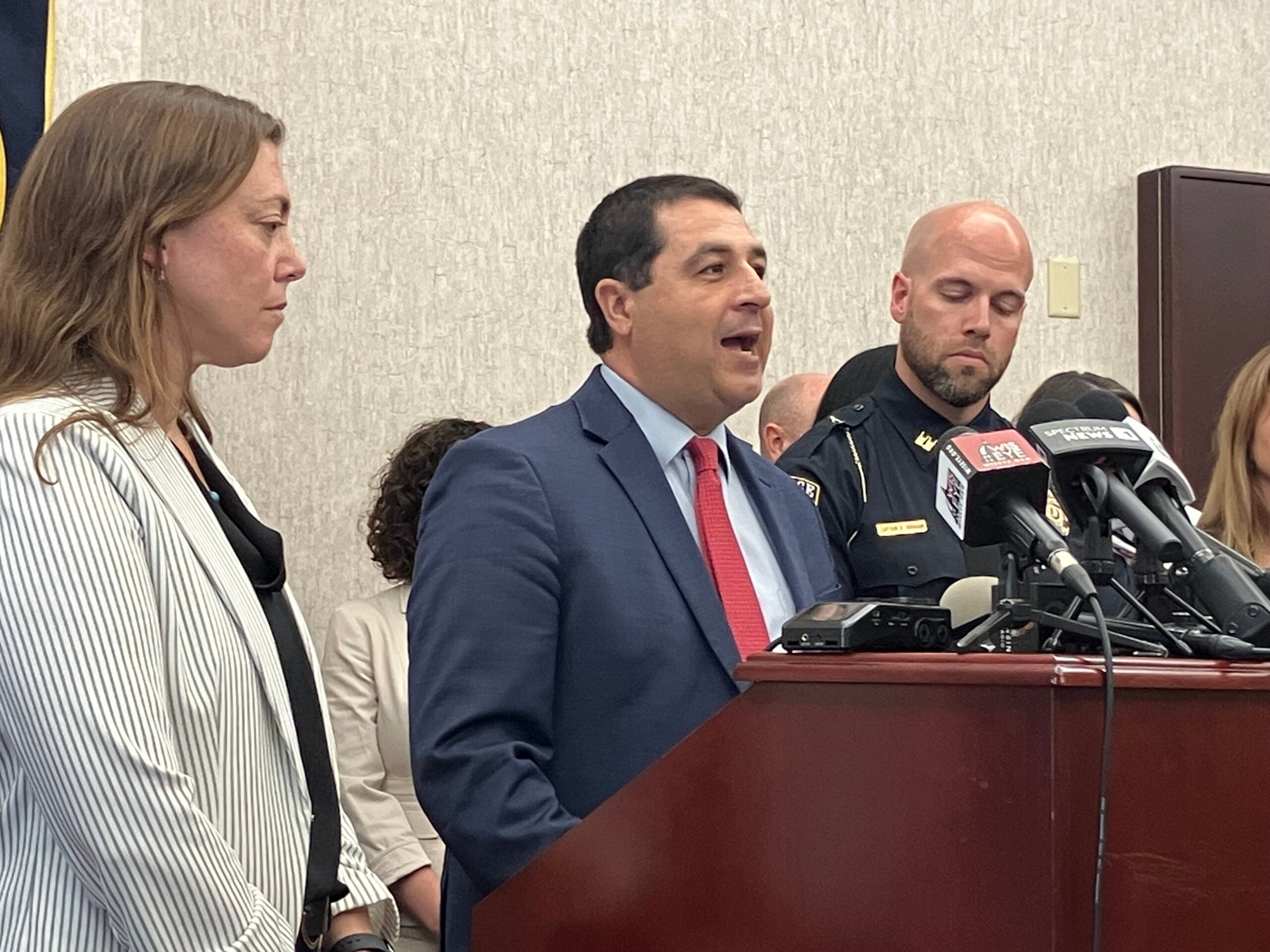
Wisconsin Attorney General Josh Kaul during a news conference in Madison, Wis. on Monday, June 30, 2025. (Sarah Lehr/ WPR)
The Wisconsin attorney general gets to control money from multistate lawsuits, the Wisconsin Supreme Court ruled Friday.
The decision by the court’s liberal majority in favor of Democratic Attorney General Josh Kaul is just the latest chapter in a long-winding separation of powers saga dating back nearly eight years. It effectively secures the authority of the state Department of Justice to decide what to do with settlement money in lawsuits the state wins.
The clashes between Kaul and the Republican-controlled Legislature date back to 2018, and a series of lame duck laws approved right before Kaul, alongside Democratic Gov. Tony Evers, took office. Those laws limited power in the executive branch and in the attorney general’s office, which Democrats had just flipped away from Republican control.
One of the laws’ provisions required any money coming to Wisconsin from multi-state lawsuits to be deposited in the state’s general fund. In 2021, the Legislature sued Kaul, arguing he was illegally depositing settlement money into an account he controls. It argued that this essentially allowed the agency to receive funds outside of the biennial budget process — and thus away from legislative and public oversight.
In briefings before the court and during oral arguments, Kaul’s office argued the DOJ was complying with the law, which it said allowed the DOJ to deposit settlement funds into the state treasury and credit them to various programs.
Writing for the court’s majority Thursday, Justice Rebecca Dallet agreed that Kaul had the authority to direct funds to specific programs, as long as they fell within the state’s general fund, which is effectively its main checking account.
“We conclude that the attorney general complies with (the law) when, in accordance with the straightforward language of the statute, he deposits settlement funds into the general fund,” Dallet wrote. “That is true even if the attorney general also credits those deposited settlement funds to one or more program appropriations contained within the general fund.”
In a dissent, conservative Justice Rebecca Bradley wrote that the liberal majority had sided with Kaul based not on the law but on their shared politics.
“This is not the first time justice has taken a back seat to political interests,” Bradley wrote. “The members of the majority extend the Democrats’ almost unbroken winning streak in litigation against the Republican legislature since the progressives took control.”
Joining Bradley in the dissent was conservative Justice Annette Ziegler.
Conservative Justice Brian Hagedorn wrote separately, concurring with part of the majority opinion but chiding the court’s liberals for leaving unanswered a more specific question about the scope of the DOJ’s powers to redirect funds.
“It is declining to decide an issue—one that was briefed, argued, opined on by the court of appeals, and central to the dispute between the parties,” Hagedorn wrote. “Prior to this, I am unaware of this court dismissing an issue as improvidently granted.”
Challenging the lame duck laws
Friday’s decision ends one five-year legal journey, but there have been multiple challenges to the lame duck laws over the years.
And it’s not to be confused with a similar case, resolved last year in a unanimous decision in the attorney general’s favor. In that case, the Supreme Court determined that the attorney general’s office could resolve some lawsuits without requiring legislative approval.
Kaul brought that lawsuit against the Legislature, saying that allowing the Joint Finance Committee to give final approval over civil settlements was a violation of the separation of powers. The Department of Justice successfully argued that the DOJ, not a legislative committee, should have control over cases having to do with “executive authority,” like consumer protection and environmental laws.
Editor’s note: This story will be updated.
Wisconsin Supreme Court sides with Josh Kaul in latest lame duck decision was originally published by Wisconsin Public Radio.
If you think stories like this are important, become a member of Urban Milwaukee and help support real, independent journalism. Plus you get some cool added benefits.























Becky has to be Becky, all anger & no insight. I would like Bradley to cite one case in which she voted against her political beliefs. One.