
Milwaukee’s Push to Restore Swimmable Rivers
City joins international movement aiming to buoy safety, stewardship and recreation for local waterways.
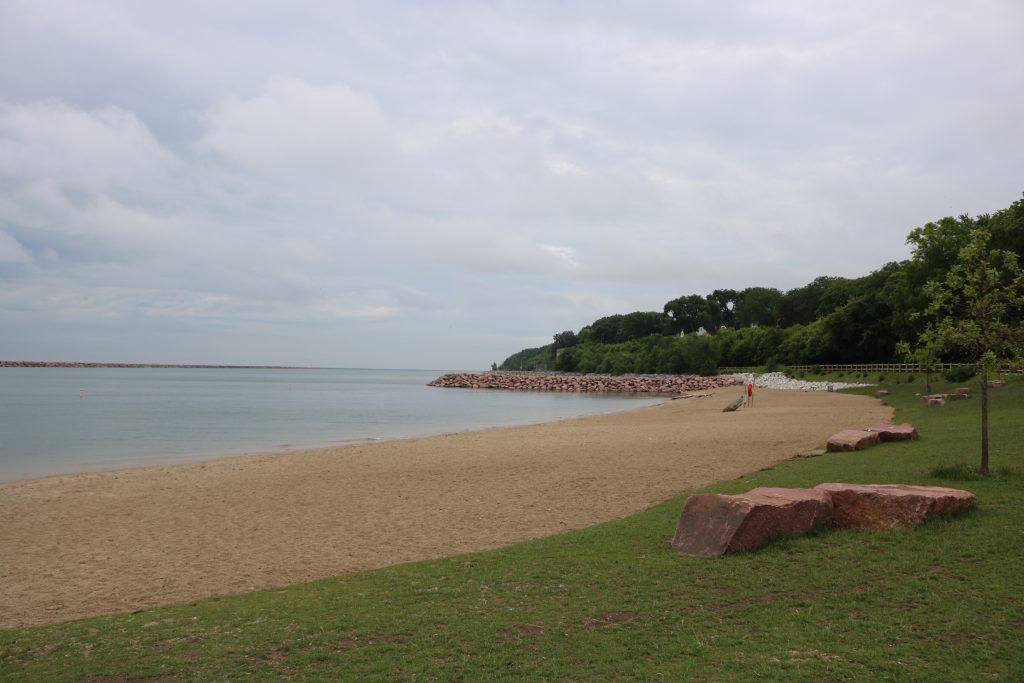
Reconstructed South Shore Beach. Photo taken June 24, 2026 by Sophie Bolich.
It’s been nearly a century since pollution pushed swimmers out of the Milwaukee River Basin. Now, the city is joining a global effort to make its urban waterways swimmable again.
Local leaders and environmental advocacy groups gathered at South Shore Park on Wednesday to announce Milwaukee’s entry into the Swimmable Cities Alliance.
The designation builds on years of local efforts to improve water quality, including the 2025 relocation of South Shore Beach and a multiyear dredging project in the Milwaukee Estuary Area of Concern.
“Water plays a key role in our history, identity and economy; however, due to pollutants, rivers have not been clean enough for people to swim in,” said Mayor Cavalier Johnson, who signed the Swimmable Cities charter in 2025. “There’s still a long way to go, but we’re making a lot of progress.”
Swimmable Cities began as a grassroots movement in 2023 before officially launching ahead of the 2024 Paris Olympics, when athletes were preparing to enter the River Seine for the first time in more than 100 years.
The coalition now includes more than 230 organizations and experts focused on environmental, public health and community issues, all advocating for cleaner urban waterways that are safe for swimming.
Its 10 guiding principles complement those of Milwaukee’s “Water Centric City” initiative, which centers on green infrastructure, applied water research and water technology.
It also aligns with Milwaukee County Parks‘ pursuit of improving outdoor access, said Executive Director Guy Smith. “South Shore Beach is a perfect place to welcome Milwaukee into the Swimmable Cities Alliance because it demonstrates that water quality challenges can be addressed through collaboration, innovation and long-term commitment.”
Alderman Peter Burgelis, who advocated for Milwaukee to join the movement, views the network as an asset for local action. “We can learn from their successes, and we can also share our own innovations,” he said. “Clean water is more than an environmental goal. It’s a public health goal, an economic development goal and a quality of life goal.”
“Our hope is that by joining the Swimmable Cities Alliance, we build on past and current efforts to improve water quality … and work to create an actionable plan for the future,” said Cheryl Nenn of Milwaukee Riverkeeper. “Providing safe and protected swimming areas in our urban rivers is an achievable and realistic goal, especially if we plan for it.”
Milwaukee is the third Great Lakes city to join the coalition, after Sheboygan and Ottawa, Ontario. Although not a member, Chicago has pursued similar efforts. In September 2025, it hosted its first sanctioned open-water river swim in 98 years. The event is scheduled to return later this summer.
Nenn said Milwaukee must continue efforts to improve sewage treatment and stormwater management, especially as climate change brings increasingly volatile weather events to the area. She also stressed the importance of nature cleanups and reducing single-use plastic.
The city plans to work with partners at Milwaukee Riverkeeper, WaterSAFE MKE, Plastic Free MKE and Milwaukee Beach Ambassadors as it works toward a goal of making the river system swimmable by 2030.
Photos

If you think stories like this are important, become a member of Urban Milwaukee and help support real, independent journalism. Plus you get some cool added benefits.
Political Contributions Tracker
Displaying political contributions between people mentioned in this story. Learn more.