

We Energies, Oracle Want Looser Financial Protections for Data Centers
Companies ask state regulators to require less collateral for new projects.
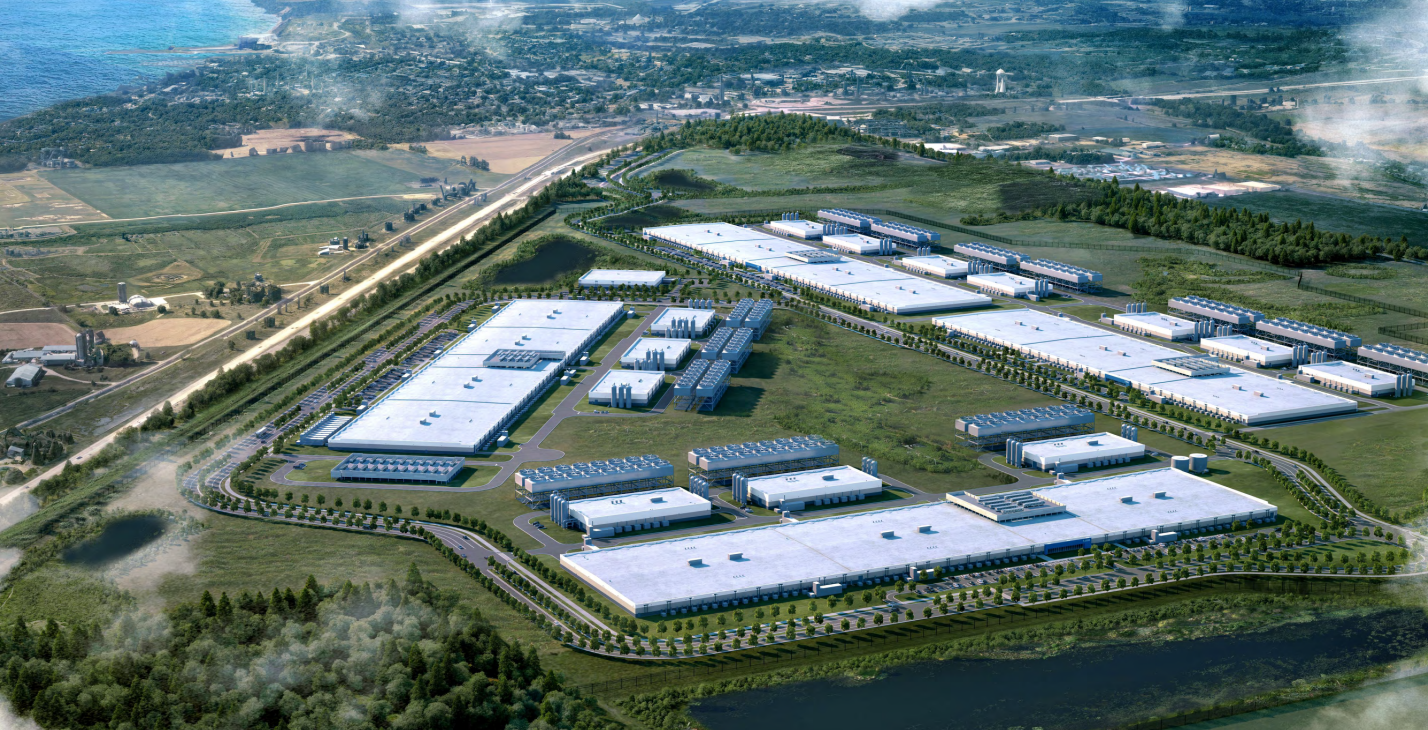
This is an aerial rendering of what the planned data center campus in Port Washington could look like. Source: City of Port Washington
We Energies and a pair of data center developers are asking state regulators to loosen financial protections included in a new special rate structure for data centers.
In a petition filed Wednesday, We Energies, Vantage Data Centers and Cloverleaf Infrastructure requested the state Public Service Commission amend part of its recent data center rate decision related to how large energy users provide financial backing for projects.
They want to lower the amount of money Oracle — and future data center operators — would need to put up for collateral for new projects if they don’t meet the highest credit rating thresholds.
The move has drawn criticism from environmental groups and ratepayer advocates, who say loosening the protections could leave families and small businesses shouldering financial risks of artificial intelligence data centers.
“Most Wisconsinites are very familiar with having to pass a credit check, (and) having to pay fees if they’re not able to do so,” said Cassie Steiner, senior campaign coordinator for the Sierra Club’s Wisconsin Chapter. “It makes sense to ask billionaire tech companies to do the same.”
This spring, the Public Service Commission approved a special rate plan for data center-scale customers in We Energies’ service territory. At the April meeting, commissioners made changes to the utility’s proposal they said were aimed at protecting ratepayers.
We Energies and the data center companies are asking regulators to look at part of that decision related to “financial support requirements.” The filing argues the PSC’s financial requirements could “significantly narrow the pool of investors” willing to develop large projects.
Under the PSC’s requirements, large energy users must meet strict credit rating thresholds and financial tests, or provide collateral — often through cash deposits or letters of credit — to cover the cost of infrastructure built to serve them.
In a statement, We Energies spokesperson Brendan Conway said the utility is asking the PSC to revisit a “narrow part” of its recent data center rate decision, arguing the change would protect customers while supporting economic growth.
“The recent changes to these requirements add significant cost and remove flexibility, which could make it harder for companies to invest in Wisconsin,” Conway stated. “We understand concerns about very large customers, which is why this rate is designed so data centers pay the full cost of the infrastructure needed to serve them.”
Specifically, the petition from the utility says the PSC’s decision has the potential to “impose significantly increased costs” on Oracle’s massive $15 billion Lighthouse data center campus in Port Washington.

Cranes are seen inside the data center construction site in Port Washington in mid-March. Joe Schulz/WPR
Oracle warns PSC rules could require $7B in financial guarantees
In an affidavit filed with the PSC, Julia Robin, vice president of infrastructure capacity and sourcing for Oracle, said the company would not qualify for an exemption from the PSC’s financial requirements despite having an investment-grade credit rating.
She said the financial requirements could “force significant development and investment outside of Wisconsin” because the cost of posting the required collateral would be “a deterrent at best or prohibitive at worst for many firms.”
“We anticipate that, under the current mandated requirements, we will ultimately be required to post financial security, likely in the form of a letter of credit in an amount exceeding $7 billion, at an annual cost that could exceed $100 million,” the affidavit reads.
We Energies and the data center companies asked regulators to allow the utility to waive and modify the financial requirements with PSC approval and reduce financial requirements for “highly creditworthy” companies that do not meet the highest credit rating thresholds.
They also asked the Commission to modify the financial requirements for the Port Washington data center project to allow Oracle to satisfy 10 percent of its required security through a letter of credit.
That would bring Oracle’s security commitment down to approximately $700 million, according to Robin’s affidavit.
“It establishes financial security requirements that will provide meaningful protection for (We Energies) and its existing customers, while ensuring Wisconsin remains competitive in attracting new and beneficial investment to the state,” Robin’s filing reads.

A van leaves the data center construction site in Port Washington in mid-March. Joe Schulz/WPR
Consumer and environmental groups defend PSC protections
But Maria Chavez, an energy analyst with the Union of Concerned Scientists, said We Energies and Oracle were essentially asking the PSC for a “discount.”
“It really erodes the idea that the utility has the public’s best interests in mind,” she said. “It really feels like they are concentrating their resources into their wealthiest clients and investing in what’s best for them rather than regular ratepayers.”
Tom Content, executive director of the Citizens Utility Board of Wisconsin, said his organization fought hard during the PSC’s data center rate case for the financial support requirements We Energies and the data center companies want to revisit.
He said the rules make sure tech companies can either put up the money for energy infrastructure, or they have a strong enough credit rating that they’ll be able to come up with the money if things go south.
“With the risks of an AI investment bubble, or the winners and losers in a massive AI technology race, we think a conservative, protect the customers approach is important,” he said.
Oracle downplayed risks in its PSC filing. But Content said Oracle has been “under the microscope” in the financial press lately because of concerns the company is overextending itself.
In the 2026 fiscal year, Oracle raised $43 billion in debt financing — meaning the company borrowed or arranged to borrow that money — alongside $5 billion in equity financing. It plans to raise another $40 billion through a combination of debt and equity in 2027.
Last month, progressive business publication Fast Company reported Oracle’s debt-to-equity ratio hovered around 415 percent, while none of the other hyperscale data center companies topped 80 percent.
“To me, that is exactly the sort of concerning news that makes these financial security terms absolutely necessary,” said Chavez with the Union of Concerned Scientists. “The trajectory right now of these hyperscale data centers is uncertain. It’s volatile.”
We Energies, Oracle ask state regulators to loosen financial protections for data centers was originally published by Wisconsin Public Radio.
If you think stories like this are important, become a member of Urban Milwaukee and help support real, independent journalism. Plus you get some cool added benefits.






















Is there a plan for these giant buildings ten or so years from now when technology changes and they are obsolete?
“Oracle Warns the Public Service Commission”.
Their “filing argues the PSC’s financial requirements could sgnificantly narrow the pool of investors” willing to develop large projects.”
Talk about ‘the tail wagging the dog’! Wisconsin has too many AI centers. Oracle and their investors are undesirable to say the least
WE Energies Spokesperson, Brandon Conway, supports yet another AI deal. WE Energies mission is to their Shareholders not the public. Residential customers have been hit with significant increases every year.
AI developers rushed in to modest communities for access to Lake Michigan’s water and corporate welfare from WE Energies.
We need a Public Utility. See State Statute Chapter 197.
The Milwaukee Common Council recently passed a resolution to suppot development of a Public Utility.
Absolutely not, Data Centers & unrestrained utilities! Time for a new PSC to enforce the public in public utilities. Our unique place surrounding the Great Lakes means there is too much at stake! And our wallets are also not an unlimited resource.
Because corporations can be trusted. No.