

Evers Says School Leaders ‘Beside Themselves’ at Failure of Funding Deal
Governor said he was assured of Republican support, which Tiffany helped peel away.

Gov. Tony Evers takes questions from eighth-graders Monday, May 11, 2026, in Barneveld, Wis. Angela Major/WPR
Democratic Gov. Tony Evers says school leaders are “beside themselves” after the Legislature rejected a deal he negotiated that would have boosted education funding in exchange for tax cuts.
In an interview with WISN-TV in Milwaukee, Evers blamed the impasse on “politics,” but focused his criticism on Democratic state senators and U.S. Rep. Tom Tiffany, the Republican candidate for governor.
The $1.8 billion deal the state Senate rejected Wednesday would have spent $315 million on special education. It also would have spent another $300 million on general school aid, which would have the effect of driving down property taxes under Wisconsin’s school funding formula.
“I am a school person,” said Evers, who was state superintendent of public instruction before becoming governor. “Seeing that go down was … I mean, it was hard to believe that we couldn’t get this done.”
The bulk of the package Evers negotiated with GOP leaders would have gone toward tax cuts, including $870 million for direct payments to income taxpayers. Those payments, which would have been $300 per individual and $600 per married couple among those who qualified, were a top priority of Senate Republicans, according to the governor’s office.
Democrats who voted against the plan said they were frustrated that it would have spent down the state’s financial reserves without their input, and in ways they didn’t support. During a speech on the Senate floor Wednesday night, Democratic Minority Leader Dianne Hesselbein called the plan “reckless” and a “backroom deal.”
Critics questioned whether the income tax payments and property tax provisions would have given residents meaningful relief from costs, noting that among people who file their taxes as individuals, about 30 percent would have received no payment from the state.
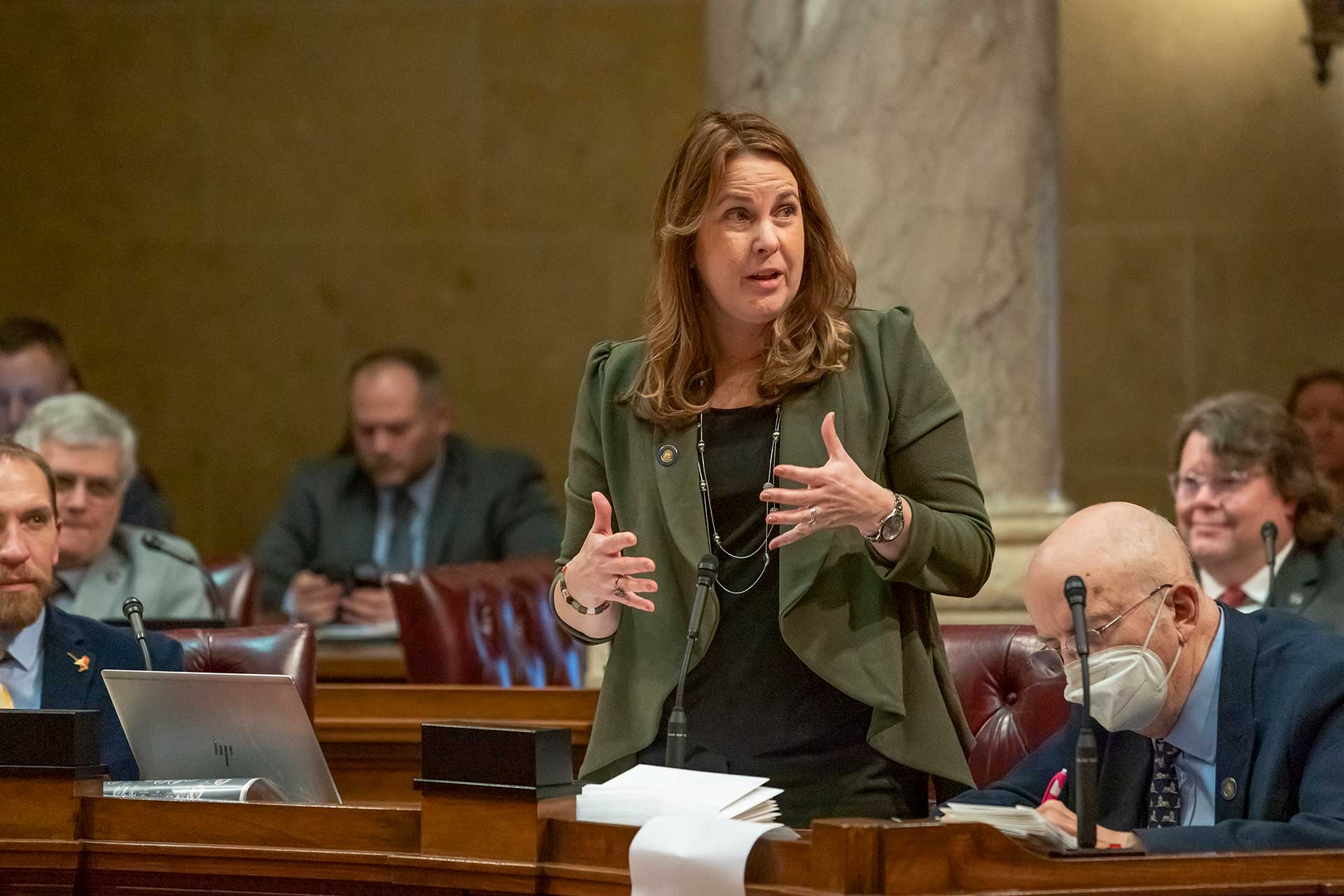
Sen. Dianne Hesselbein (D-Middleton) speaking on the Senate floor. Hesselbein was named Senate minority leader in December of 2023 and was reelected to that position in November of 2024. Photo courtesy of Sen. Dianne Hesselbein’s office
Evers said he did not secure any Democratic votes ahead of the deal’s failure
Evers was asked whether he secured any Democratic votes before he released his deal with Republicans.
“No, I mean there was no need,” Evers said, telling WISN that he had been assured that Republicans in the Senate had the votes to pass the deal without Democratic support.
“And then by the time we realized that the Democrats aren’t going to be moving in the same direction that we anticipated … it was over,” Evers said.
Evers blamed Tiffany for peeling off some GOP support for the deal in the Senate, where three Republican lawmakers joined all Democrats in rejecting the deal. Ahead of the vote, Tiffany reportedly told at least one Republican senator about his concerns with the bill, and after it failed, he celebrated its defeat.
But relying on Republicans only put Evers in a tenuous position. Republicans hold an 18-15 majority in the Senate, meaning they can only afford to lose one vote if they want to pass legislation themselves.
Two of the Republican “no” votes on this deal were Sen. Steve Nass, R-Whitewater, and Sen. Chris Kapenga, R-Brookfield, who both have an extensive history of bucking party leadership on high-profile legislation.
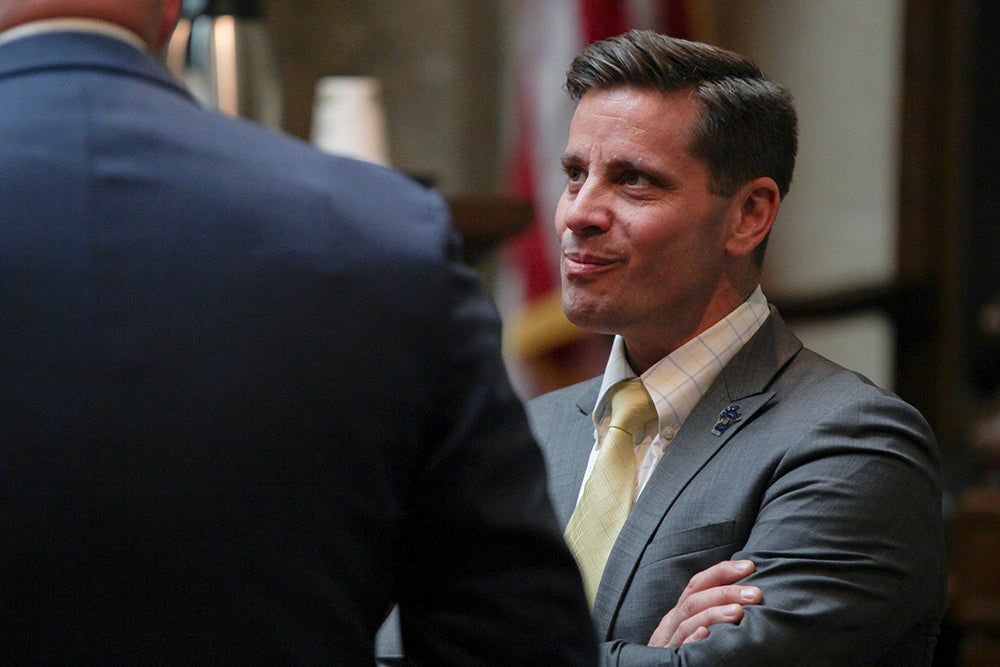
Wisconsin Senate President Chris Kapenga, R-Delafield, during a state Senate session on June 7, 2023, in the Wisconsin State Capitol.. Drake White-Bergey / Wisconsin Watch
Some Democrats did not take kindly to Evers blaming them for the impasse, and one ex-lawmaker criticized the governor on social media.
Winnebago County Executive Gordon Hintz, a former Democratic representative who previously served as the Assembly’s minority under Evers, said on X that the governor seemed on a mission to “torch” his entire legacy “and attempt to take Dems down with him in the fall.”
“The total lack of leadership demonstrated in working out a deal with Democratic leadership is what created this mess,” Hintz wrote. “Don’t be a d— and say Democratic legislators who have carried your water the past 8 years don’t believe ‘people struggling financially’ is an issue.”
Bill’s failure leaves big issues unaddressed
Had the bill passed, it would have increased the state’s reimbursement of special education costs to 50 percent, which would have been a high-water mark.
When Evers signed the most recent state budget last summer, it boosted special education funding by about $500 million. But because district costs also went up, that may only cover roughly 35 percent of special education expenses.
“I hear it from superintendents already, I mean they are absolutely beside themselves,” Evers said.
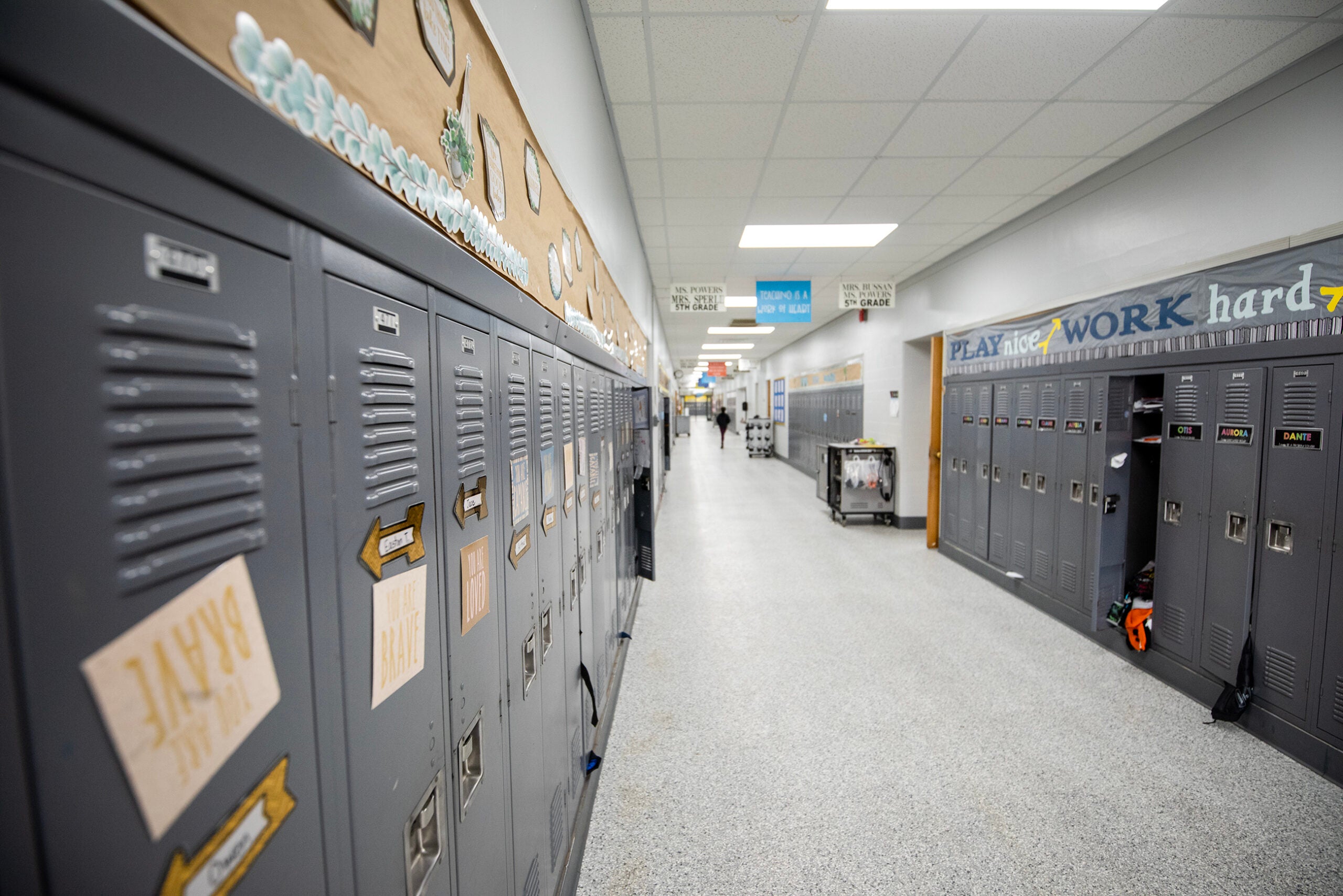
Winskill Elementary School on Tuesday, April 29, 2025, in Lancaster, Wis. Angela Major/WPR
The increase in general school aid was aimed at addressing a recent spike in property taxes. A report by the Wisconsin Policy Forum found K-12 school property taxes rose at an average of 7.8 percent last December, their largest increase in three decades. Those increases are due to a variety of factors, including the underfunding of schools over time, the lack of any general school aid increase in the current budget and Evers’ 400-year veto that increased school revenue limits.
By not passing anything, the state’s projected $2.5 billion surplus remains intact, though there’s always a chance challenging economic conditions could deplete those funds. Evers’ administration has said early numbers suggest tax collections could exceed expectations.
In any case, it seems unlikely leaders will come together to cut a new deal before Evers’ term ends.
“It’s not that I’m leaving office thinking this has just been … the worst thing ever, but it damn near is when people say that they don’t have the willingness to get some money to schools,” Evers said. “That’s a bad, bad, bad place to be.”
Tony Evers says school leaders ‘beside themselves’ following failure of education and tax deal was originally published by Wisconsin Public Radio.
If you think stories like this are important, become a member of Urban Milwaukee and help support real, independent journalism. Plus you get some cool added benefits.












A good example of folks not being included and if one story was right creating a budget problem for the next budget that might be a Dem budget. At least both sides defeated it. Who speaks for the kids????? Tony was and is who he is. No therapy for those in prison No therapy for kids who are suspended BUT THEN AGAIN what press is calling for these most basic needs. Anytime someone at Urban Milwaukee wants to address these most basic human needs and the reasons why they are not being addressed call me 414 403 1341
Never count on Republicans. Evers’ failed to make the deal stick.
The Governor was trying to do something that could address funding/tax concerns that was not totally what some Democrats say they wanted. It was at least an attempt to deal with a problem and go past gridlock. I would think that some voters would wonder why there was not at least an attempt to deal with higher property taxes and school funding. Gridlock is the norm since the Scott Walker days.
This was a failure all around. Why did Evers not at least let the Democrats know what was in the bill? We know why Republican leadership in the legislature failed to include Democrats in the negotiations, they believe they have a strangle hold and don’t need Democrats. Republicans hold a 18-15 majority in the Senate. Excluding democratic legislators is pure hubris on the part of Vos and company. With Vos retiring, maybe Wisconsin voters can elect legislators who actually believe in governance.
Why didn’t Evers work with the DPW caucus and a couple of GOPers to craft a bill that would have put the “surplus” where it belongs- in our starved public schools? Whining now that your scheme didn’t fly doesn’t bring any tears to my eyes, Tony. Stop screwing Milwaukee!
Well, this will be something Dems can run on in the fall: property tax relief in the way of more state aid to schools.