
Maine Went All-In on PFAS Problem; What Can Wisconsin Learn?
New book traces how and why Maine launched $200 million response to 'forever chemicals.'
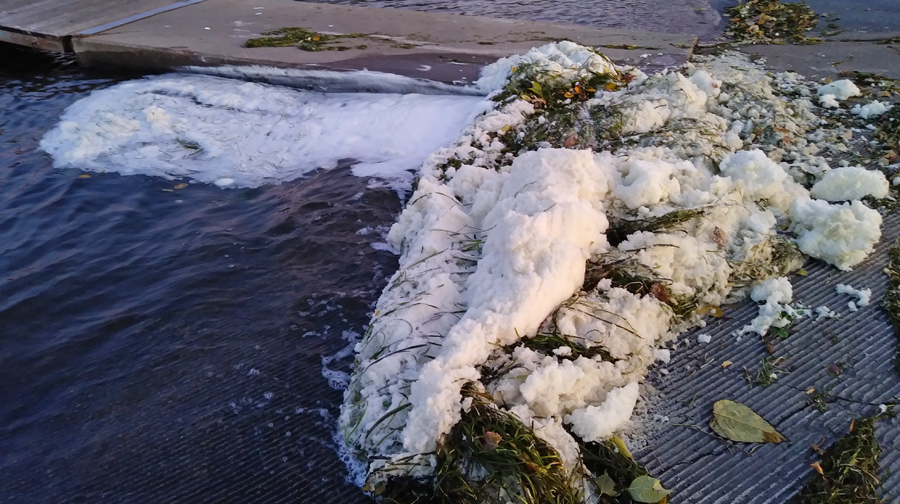
Foam present in Starkweather Creek in October 2019 shows elevated levels of PFOS and PFOA (PFAS chemicals). Photo from courtesy of the DNR.
After years of back-and-forth over how to spend funding to address PFAS contamination, the state recently released $133 million to help communities in Wisconsin deal with widespread pollution of these “forever chemicals.”
The funding will help with PFAS testing and remediation efforts around the state, including money for new wells and a provision to protect “innocent landowners” who have pollution on their property through no fault of their own.
The state of Maine has been down this path. In 2021, lawmakers there passed a suite of legislation aimed at fixing the state’s own PFAS crisis — spurred in part by wastewater sludge spread on farm fields — and invested more than $200 million into the effort.
Where does Maine’s PFAS problem stand now, five years later? That’s the topic of “Inescapable: Facing Up to Forever Chemicals,” a new book from environmental journalist Marina Schauffler.
“One of the challenges of PFAS is it is so persistent, and it’s a long recovery,” Schauffler told WPR’s “Wisconsin Today.” “And it’s not a full recovery, because these chemicals so permeate our environment, and the health threat is going to linger through generations.”
Schauffler spoke with “Wisconsin Today” about Maine’s PFAS story and lessons for Wisconsin as the state enacts policies and allocates funds toward PFAS cleanup.
The following interview has been edited for brevity and clarity.
Kate Archer Kent: Your book starts with the story of Fred Stone, a third-generation dairy farmer who discovered high PFAS levels in his milk. Can you talk about the chain of events that set off?
Marina Schauffler: When he heard that there were these chemicals in his well water, and then his milk tested for them as well, he was blindsided initially, really not understanding the source. The state did a lot of testing on the site, and it gradually became clear.
The state had encouraged farmers in previous decades to spread sludge, both municipal and industrial sludge, on their land, and the high PFAS levels (Stone) found tied directly back to the sludge applications. At first, the state wasn’t eager to acknowledge that this might be a more widespread problem, so he had to speak repeatedly and push for the (Maine) Legislature to do further testing. And when the state did further testing of both dairy farms and other farms where sludge had been permitted in the past, they found recurrent problems.
KAK: So he was licensed to spread this wastewater sludge on his fields, not knowing he was also spreading PFAS. And then he has to kill off most of his cows to contain the spread. Their business is ruined. Did Maine public agencies help?
MS: In the first few years, there wasn’t much support for Fred and Laura Stone, and it was devastating for them. They were already starting to struggle with health problems. Their business was decimated. The value of the farm that was their primary asset was diminished. It was very challenging, and he finally came forward publicly to put more pressure on the state and get some more support for the farming community.
Having farmers advocate before the Legislature was pivotal in getting policy change and much more state support for the farming community and others affected by past sludge-spreading.
KAK: Maine was an early leader among states to start to address PFAS contamination — to put money toward it and figure out policies. How did Maine get people to care about invisible “forever chemicals” that are persistently lurking in the waters and in soil and elsewhere?
MS: A lot of people in Maine are deeply attached to the place and value the health and well-being of our natural environment. The way that PFAS had undermined that was crushing for a lot of people, and the way it was affecting rural communities made it a unifying issue in the Legislature. The initial support was very bipartisan, and it felt like an affront to the people of the state to have this kind of ubiquitous and persistent contamination in a place that we want to be healthy.
KAK: One physician you interviewed called PFAS contamination “a slow-moving environmental disaster” that’s “uprooting people’s lives.” There’s this psychological toll alongside the health risks of PFAS exposure. What did you hear from people dealing with PFAS contamination on their property?
MS: That is a good description, because it just festers for people. They have this uncertainty around future health concerns, and there are a wide array of potential health impacts. One farmer described it as sort of like a ticking time bomb with faulty wiring — just knowing that there would likely be impacts, and having to wait and watch because there’s not too much that can be done.
Then there’s the diminishment of their property values and not being able to pursue a lot of passions — people couldn’t hunt or fish where they had traditionally done that. People who had gardens couldn’t eat their own produce anymore. They weren’t sure about, locally, what was safe to buy … because there’s so little testing on PFAS. It introduced a huge amount of uncertainty and stress in people’s lives.
KAK: What steps has Maine taken to address this issue of the sludge on farm fields?
MS: Maine was the first state to ban the application of sludge to farm fields and the use of compost-containing sludge, because some sludge was also going into composting facilities and then getting redistributed out to gardens and athletic playing fields and a whole range of settings as well. That was instrumental in stopping the distribution of PFAS into food-growing settings, but pretty quickly, the Legislature realized it needed to move upstream and turn off the tap, so Maine was among the first states to start putting bans on various categories of consumer products.
(The state) went very ambitious initially with that product ban and discovered pretty quickly that it was really difficult for people to trace the supply chain back and figure out where PFAS was in their products. And Maine is a small state — it’s 1.3 million people — so it made it challenging in terms of having enough influence on changes in industry practice.
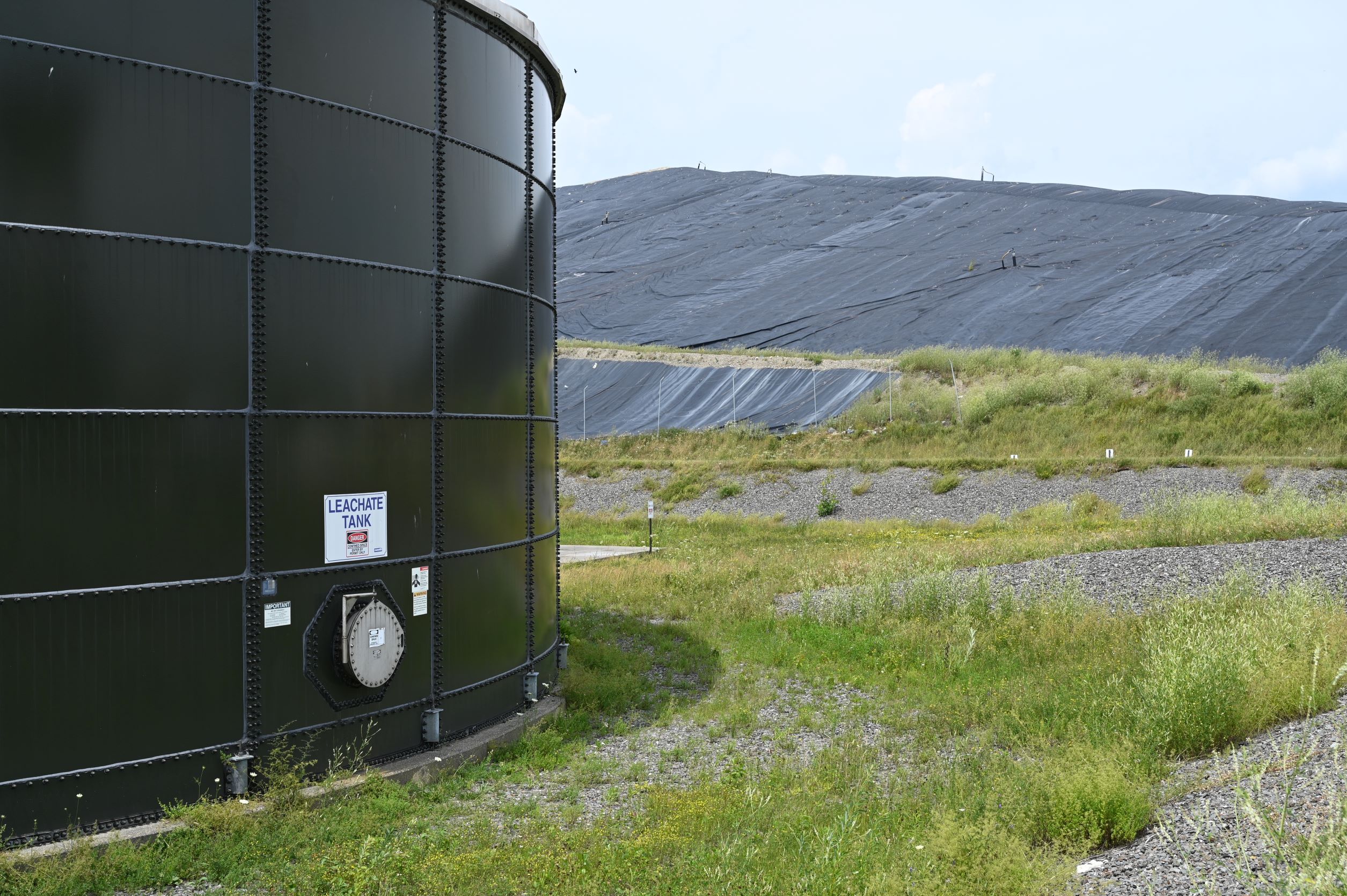
A leachate storage tank at Juniper Ridge Landfill in Maine. High levels of PFAS have been found in Maine’s landfill leachate. Photo courtesy of Marina Schauffler
KAK: PFAS was once this bridge-building topic for lawmakers and communities in Maine — something people could agree on and work together across political divides. You say that’s not so much the case anymore. What has changed?
MS: Some important PFAS legislation went through in this last legislative session here with bipartisan support. But I think where the tensions became evident was when the PFAS regulations and laws bumped up against industry practice, and it was very challenging for a lot of the industries here. They can’t necessarily adapt quickly to remove PFAS from the production of products, particularly those that aren’t manufactured here. And, of course, the waste industry valued having a low-cost means of sludge disposal.
This is a problem going back to the Clean Water Act, where they tried ocean-dumping initially and realized that wasn’t a good idea. Then they went to land-spreading, and now that the toxic effects of that are evident … currently, it’s going to landfills here, which is not an optimal solution. And because the PFAS persists, it’s leaching out from the landfills, and then that … landfill leachate has to be treated as well.
The really insidious thing about PFAS is it’s just so prone to keep cycling through the system. It underscores the importance of getting it out at the front end.
KAK: There is this theme that runs through your book about the regulatory void at the federal level, resulting in states creating this patchwork of their own policies and regulations on PFAS. Based on Maine’s experience, do you think PFAS is something that can be resolved at the state level?
MS: Absolutely not. We need federal leadership. We really need international leadership, because this is a global problem now, and it is so ubiquitous: It’s cycling through the atmosphere. It’s coming down in the rain. So it really needs leadership at a much larger scale.
“Inescapable: Facing Up to Forever Chemicals” details how Maine has been dealing with PFAS contamination at the state level. Image courtesy of Marina Schauffler
Maine went all-in on the state’s PFAS problem 5 years ago. What can Wisconsin learn? was originally published by Wisconsin Public Radio.
If you think stories like this are important, become a member of Urban Milwaukee and help support real, independent journalism. Plus you get some cool added benefits.