80 Years of the Fine Arts Quartet
Spring festival of 6 quartets played by group with a 55-year history at UWM.
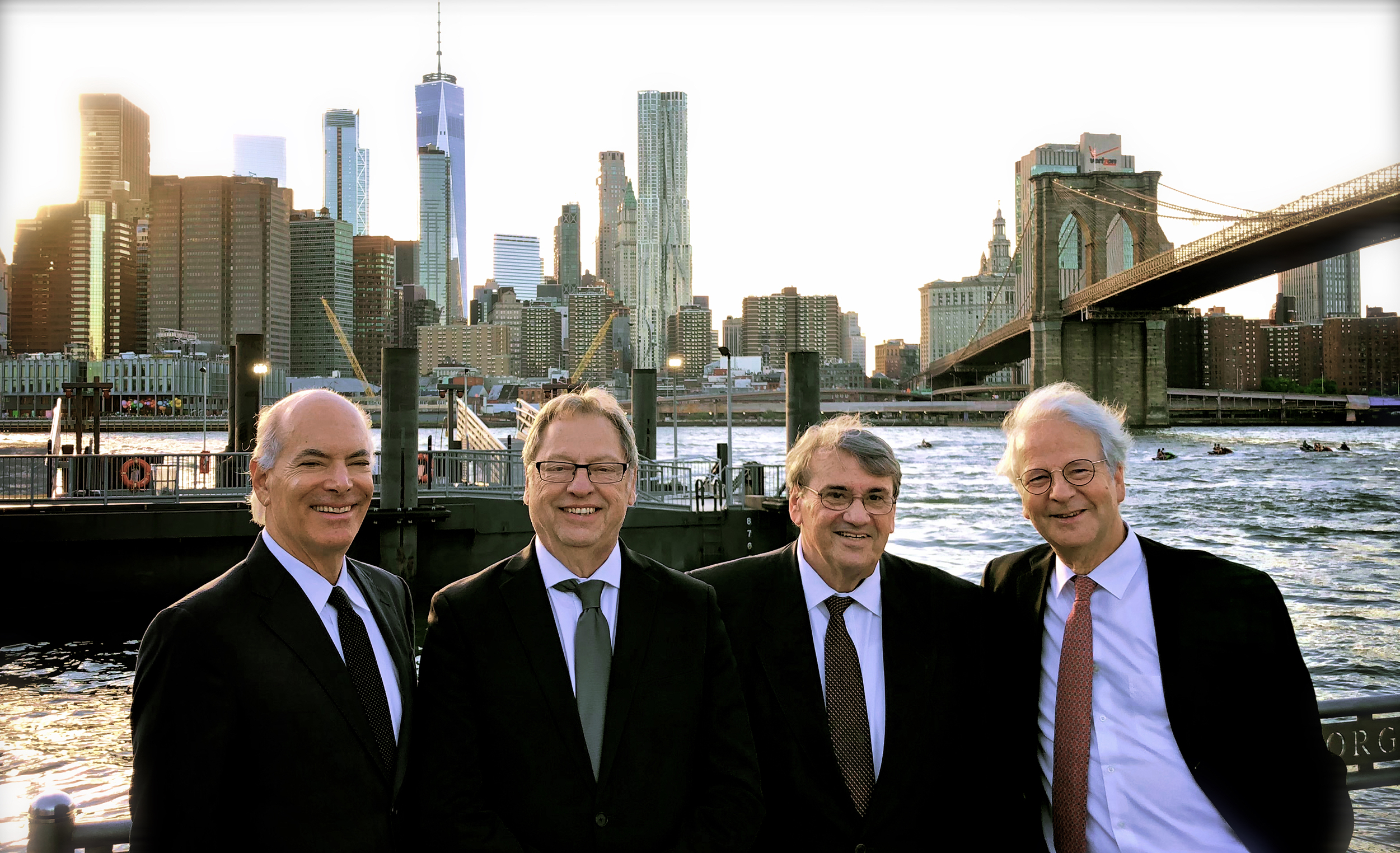
Photo courtesy of the Fine Arts Quartet.
During a 55-year residency at UW-Milwaukee, the internationally renowned Fine Arts Quartet built a loyal local fan base. Although budget cuts ended the FAQ/UWM relationship in 2017, the quartet has regularly returned to Milwaukee for a chamber festival organized by Friends of the Fine Arts Quartet.
2026 marks the 80th anniversary of the quartet’s founding. Honoring that milestone, this year’s Milwaukee festival will be the most ambitious yet, presenting six free public concerts between May 17 and May 31. Three will be played at the quartet’s regular venue during its UWM residency, the university’s recital hall. Performing are Ralph Evans and Efim Boico, violins; Gil Sharon, viola, and Niklas Schmidt, cello.
Each concert will pair one of Wolfgang Amadeus Mozart’s (1756-1791) six profoundly emotional, autobiographical string quintets with one of Ludwig van Beethoven’s (1770-1827) six early quartets, showcasing a revolutionary composer finding his voice. Guest violists Harmut Rohde and Razan Popovici will each appear at three concerts, playing the second viola part in the Mozart quintets.
Michael Barndt, who is managing the local festival, will provide pre-concert talks, sharing his program research and playing musical excerpts to illustrate what he has discovered. He calls the repertoire “bread-and-butter masterpieces” that demonstrate the FAQ’s expertise in works from the Classical period, when the string quartet form was established.
Under the pen of Franz Joseph Haydn (1732-1809), the “father of the string quartet,” the form evolved from light entertainment to musically complex and emotionally expressive chamber music. The works on the festival programs reveal how both Mozart and Beethoven paid homage to Haydn’s legacy while establishing their own musical identities.
At the age of 17, after Mozart had composed six string quartets, he wrote his first string quintet, adding a second viola. He set the form aside for 14 years, during which he wrote a set of six quartets dedicated to Haydn. In 1787, he returned to the viola quintet, writing five more in the next two years, including an adaptation of his Serenade for Winds.
“The addition of a second viola to the string quartet enables the composer to expand and enrich his musical resources in several directions,” writes musicologist Peter Holman. “In particular, it offers him a surprising number of extra textures: the instruments can be grouped and regrouped into a number of contrasted twos and threes, a cello solo can be supported comfortably on a cushion of violas, and, most attractive to Mozart, first violin and first viola can sing an operatic duet accompanied by full harmony.”
Beethoven, who moved from Bonn to quartet-crazy Vienna in 1792, wrote six string quartets identified as Opus 18 between 1798 and 1800. Barndt characterizes the set as “almost a résumé,” with each piece demonstrating a different type of exploration, “playing to his strengths, one strength at a time.” These works push and pull against the norms for string quartets established by Haydn and Mozart. Barndt cites particularly the final movement of Op. 18, No. 6, marked La Malinconia. As the movement begins, he said, “Each chord is sadder than the last. But Beethoven then introduces a bright, fast section, and the two motifs play against each other.”
The Fine Arts Quartet will perform on May 17, 19, 21, 26, 28 and 31; details about each program and venue are found here. All concerts are free, and no tickets are required. FAQ fans also should mark their calendars for July 10 and July 12, when the quartet will return for summer performances.
If you think stories like this are important, become a member of Urban Milwaukee and help support real, independent journalism. Plus you get some cool added benefits.


Preview
-
National Organists Competition Winner Comes to Town
 May 5th, 2026 by Martha Brown
-
The Family That Plays Together
 Apr 17th, 2026 by Michael Barndt
-
Present Music Celebrates Hindu Festival
 Mar 16th, 2026 by Michael Barndt