
Severe Storms Push Milwaukee To Change Leaf And Street Sweeping Rules
Climate change, clogged drains and angry residents are driving DPW changes.
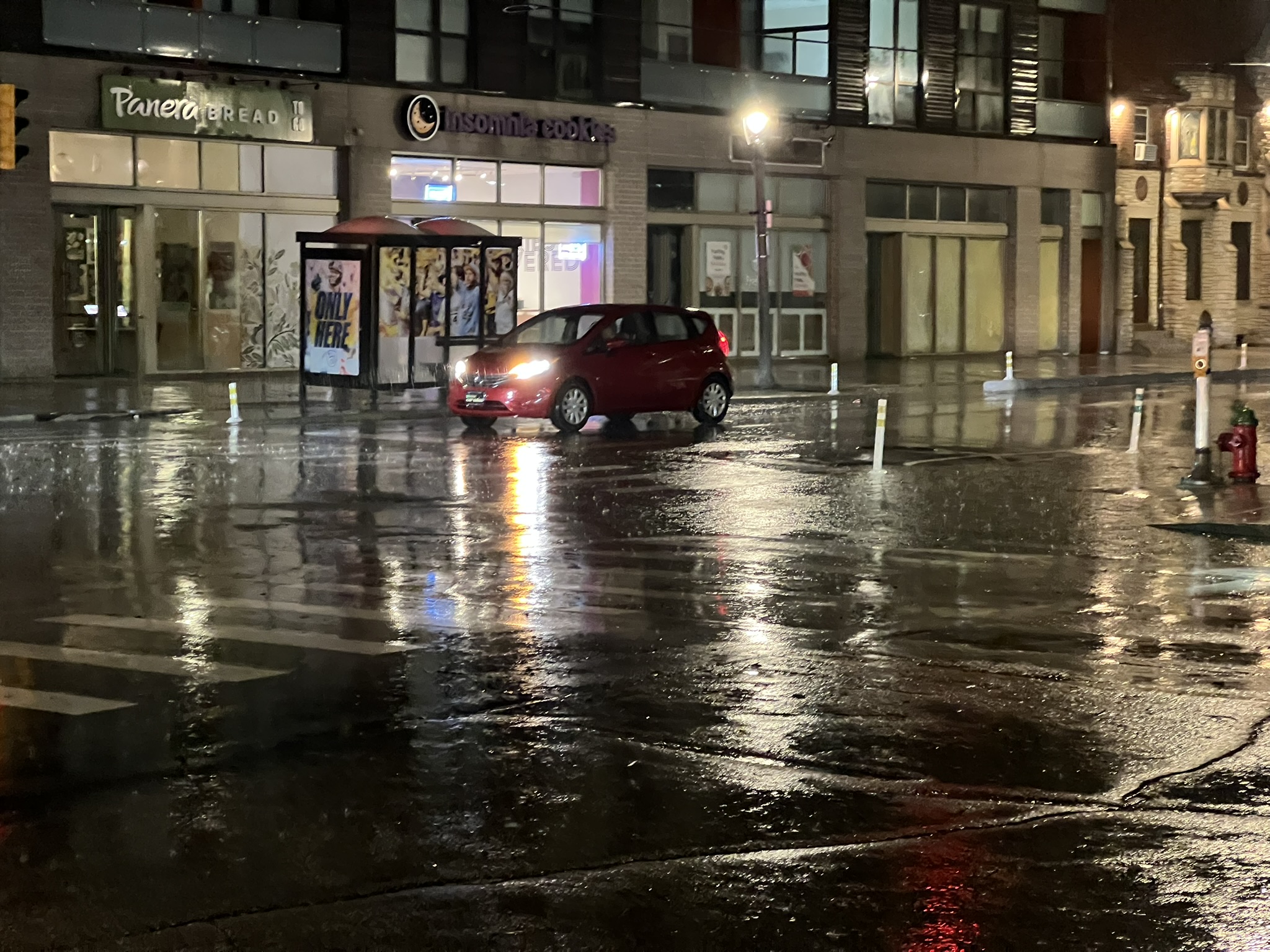
Flooding on E. North Avenue pushed a manhole cover down the street. Photo by Jeramey Jannene.
Climate change is forcing changes at the Department of Public Works.
Commissioner Jerrel Kruschke announced Wednesday that DPW will make two major changes to its operations because of leaves falling later in the season and heavy rains.
Instead of allowing residents to rake leaves into the street, DPW will require residents to bag leaves and leave them on the terrace.
The department will also move to scheduled street sweeping days in areas where parking is allowed overnight on both sides of the street, which encompass up to 30% of the city.
The moves are intended to reduce the amount of surface flooding that occurs during heavy rainstorms.
“We have to pivot,” Kruschke told the Public Works Committee. “We have been poking around all across the nation to learn what’s the best way.”
The city was deluged by a 1,000-year storm event last August, but the one-two punch of lingering leaves and a 25-year storm event two weeks ago has made it clear the city is likely dealing with more than a one-off occurrence.
Last fall, leaves continued their recent trend of falling later, forcing DPW to extend its cleanup window. But before everything could be picked up, a Black Friday snowstorm buried what remained.
As the snow melted this spring, DPW hoped to clean up what remained. But then the rain started. When the rain peaked, several areas of Milwaukee experienced surface flooding, caused in part by leaves clogging drains.
On April 15, Kruschke said leaves weren’t the issue. But that drew a sharp rebuke in a press release from Ald. Robert Bauman and from several people on social media.
On Wednesday, Kruschke softened his opposition. “The majority of what we’ve seen in most parts of our neighborhoods is a lot of litter,” he said. Kruschke said leaves were an issue in areas where parking is allowed overnight on both sides. “A lot of the other things we’ve seen in the localized flooding was the capacity of the sewer system,” he said. “There’s a lot of litter and I’ll reiterate that there is a lot of litter that’s out there.” He said litter, including plastic cups and car parts, mixed with landscaping material “that might look like leaves.”
The goal now is to get whatever is sitting on the street off of it. “The least amount of material we can have between the curb lines is a win,” said Kruschke.
The cons
The changes won’t come without downsides.
Regularly scheduled street sweeping will require motorists to pay attention to redesigned permanent parking signs that will include messages like “No parking — street sweeping third Wednesday.”
“We are going to end up towing a lot of vehicles,” said Kruschke. He said the intention would be to relocate the vehicles to nearby streets instead of moving them to the tow lot, but it would result in a citation and tow fee.
The new signs will take up to three years to install, the commissioner said. The city, he said, had piloted the effort in portions of the East Side and Concordia neighborhood.
Scheduled street sweeping in areas with overnight parking on both sides will replace a tiered approach, where the city attempts to sweep Downtown weekly, the combined sewer area every few weeks and the outlying areas once a month.
There is also the issue of compliance with the bagging requirement.
“I expect massive noncompliance, especially in neighborhoods dominated by renters,” said Bauman. He asked if the city was prepared to fine residents.
“Do I want to penalize our residents? That’s a potential … I’m not sure we want to get into penalizing folks,” he said. “I think that’s something we have to really think about. I mean we’re not here to penalize our folks.” He said the city would make a substantial commitment to proactive communication.
The city will still sweep leaves that fall into the street, but Kruschke said he expects the volume to be reduced by 75%.
The fiscal impact of the two changes is expected to be limited, but residents will need to pay for paper bags at an estimated cost of $2 each if they choose not to mulch their leaves. Ald. Peter Burgelis said he is already working with Ald. Russell W. Stamper II on a bag giveaway.
Other investments
While the city changes its policies, it’s also trying to change its infrastructure.
“We have not been just sitting around waiting for events to get larger and larger,” said City Engineer Kevin Muhs. Under Mayor Cavalier Johnson‘s direction, Muhs said the city is accelerating green infrastructure projects designed to capture and retain stormwater.
Kevin Shafer, Milwaukee Metropolitan Sewerage District executive director, said his agency is also accelerating four large projects designed to hold tens of millions of gallons of stormwater. Included in the acceleration are the West Basin project in Century City, projects in Jackson Park and Wilson Park, and a basin near S. 6th St. and W. Bolivar Ave.
“These are like $40 to $50 million projects. These are not cheap,” said Shafer. Construction bidding will open this year on the West Basin project, followed by Jackson Park next year.
Working smarter?
The multi-hour discussion also touched on the efficiency of DPW’s existing operations.
Bauman suggested that DPW was street sweeping overnight in his district, when the streets were filled with parked vehicles, instead of during the day when people have driven to work. The result was less effective sweeping.
“Yes, you’re working, but you’re not working smart,” he said.
“We can look at it and it is not incorrect,” Kruschke told Urban Milwaukee after the meeting. He stressed that every neighborhood is different and not everyone drives to work at the same time.
Last year, Bauman, over DPW and the mayor’s opposition, led the council in removing the alternate-side parking requirement in his entire district. He said restrictions weren’t being enforced.
But one council member is questioning the wisdom of the street sweeping change. Council President José G. Pérez, who represents a district that has long had streets not subject to alternate-side parking, said a map of flooding doesn’t match a map of where the street sweeping change would be made.
“I want to be clear that when you look at a map, it’s not areas with two sided parking that have an issue,” said Perez.
DPW officials said they are responding to concerns and attempting to prevent flooding.
Problem spots
Ald. Andrea Pratt was the first of several council members to ask what the city and MMSD are doing about recurring flooding in certain areas. She cited several intersections along W. Capitol Drive, but other council members added their own problem spots.
Ticking off a list of intersections, she said if there is heavy rain, she knows she will find the same problem spots flooded.
The issue isn’t limited to just surface flooding on streets. Other areas have regular basement flooding.
“I am feeling the pain of my constituents, and it’s really rough,” said Ald. Marina Dimitrijevic. She said many constituents with flooded basements recently learned they can’t submit two similar home insurance claims in the same year and are now out thousands of dollars.
Shafer said the flooding doesn’t appear to be from overflowing waterways, but instead from stormwater drainage.
Kruschke said DPW maintains a list of “hot spots” where it clears grates in advance of storms, but council members made it clear that they don’t feel enough is being done and they’re the ones taking the blame.
“What can be done today?” asked Dimitrijevic.
“Today is a real challenge,” said Muhs, who acknowledged the financial and emotional impacts, but said it will take time to improve infrastructure.
The sewer system in the combined sewer area is built to handle a 10-year storm event. The separated sewer system was previously built for a five-year event, but is being rebuilt incrementally to a 10-year standard.
Kurt Sprangers, DPW engineer in charge of the sewer section, said sewer backflow prevention devices are “strongly recommended,” but are not cheap to install. The implementation can cost thousands of dollars. Bauman suggested it was a possible remedy for areas where flooding recurs.
Dimitrijevic requested that a council member be added to a newly-formed MMSD-city-county-suburbs technical task force.
Ald. Alex Brower suggested DPW make a public map of hot spots and include a report on what it believes causes the flooding and what can be done. “At least the public then knows,” he said.
If you think stories like this are important, become a member of Urban Milwaukee and help support real, independent journalism. Plus you get some cool added benefits.
More about the Leaf raking controversy
- Mayor Rakes Back Leaf Bagging Plan - Jeramey Jannene - May 12th, 2026
- Council Members Threaten to Bag New Leaf Collection Policy - Jeramey Jannene - Apr 30th, 2026
- Bag the New Leaf Pickup Policy - Ald. Scott Spiker - Apr 30th, 2026
- DPW Announced Leaf Collection Change – that Doesn’t Mean it’s Happening - Ald. Lamont Westmoreland - Apr 30th, 2026
- Severe Storms Push Milwaukee To Change Leaf And Street Sweeping Rules - Jeramey Jannene - Apr 29th, 2026
- Leaf Backup Apparent in Clogged Catch Basins - Ald. Bob Bauman - Apr 20th, 2026
- DPW Leaf Collection Failure Exacerbates Recent Flooding - Ald. Bob Bauman - Apr 17th, 2026
- Milwaukee Again Cleaning Up From ‘Overwhelming Force of Nature’ - Jeramey Jannene - Apr 16th, 2026
- 2025 Fall Leaf Rake-Out Deadline Extended - City of Milwaukee Deptartment of Public Works - Nov 12th, 2025
Read more about Leaf raking controversy here
Political Contributions Tracker
Displaying political contributions between people mentioned in this story. Learn more.
- February 20, 2016 - Cavalier Johnson received $250 from Robert Bauman
- May 5, 2015 - José G. Pérez received $10 from Cavalier Johnson