

Food Truck Operators Rally at City Hall
Demonstration aims to put the brakes on new late-night restrictions.
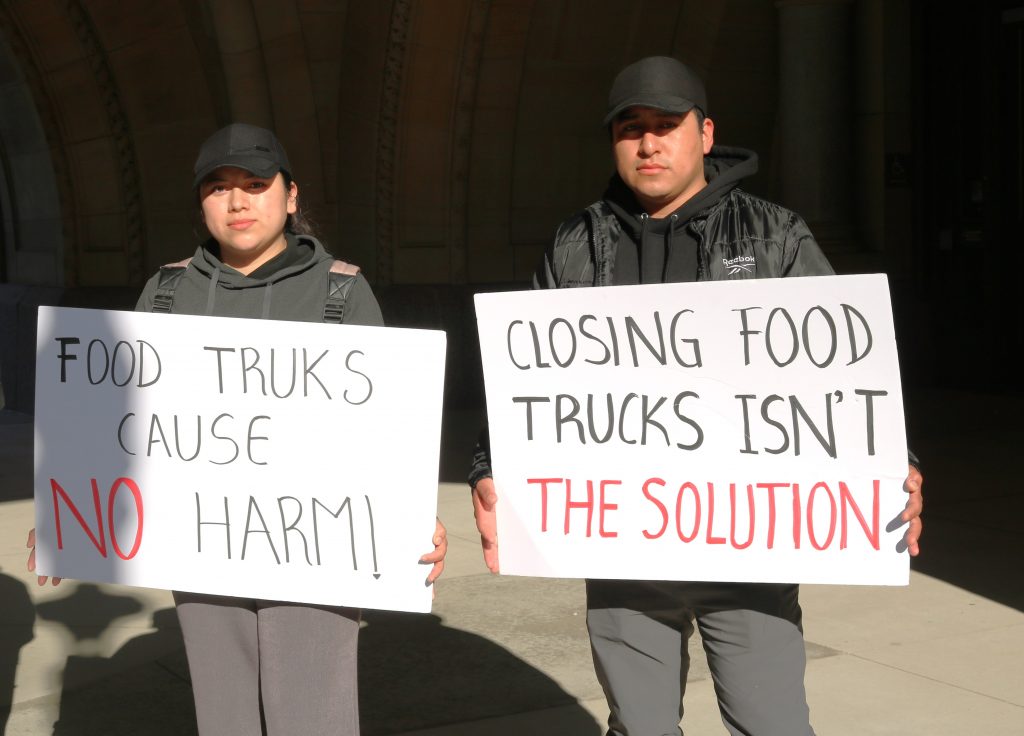
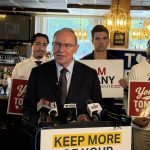
The owners of Tacos Almita hold signs during an April 30 demonstration at Milwaukee City Hall. Photo by Sophie Bolich.
More than a dozen food truck operators and their supporters gathered at Milwaukee City Hall Thursday morning to put the brakes on new late-night restrictions they said would “devastate” business.
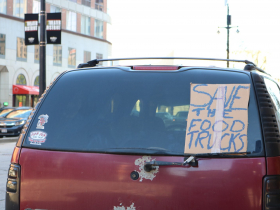
Attendees carried signs with messages such as “food trucks cause no harm” and “save the food trucks,” opposing a new ordinance slashing hours for mobile restaurants in sections of downtown and Burnham Park.
Starting May 9, trucks on Water Street and surrounding blocks will have to close by 10 p.m., down from the previous 1 a.m. cutoff. On a stretch of Burnham Street, operators must close by 11 p.m.
The change, supported by the Milwaukee Police Department, Milwaukee Downtown, Business Improvement District No. 21, and the Milwaukee School of Engineering, is intended to address late-night loitering and violence in the downtown entertainment district, according to city officials. But operators took issue with both the restrictions and how they were introduced.
“They didn’t inform us about this,” said Abdallah Ismail, owner of The Fatty Patty, who, like many fellow operators, was unaware of the ordinance until it had already passed. “This will hurt me a lot. I just want to tell the city that I’m here. They have to give us a chance to speak.”
Ismail said his downtown truck makes the majority of its revenue between 10 p.m. and 1 a.m., a claim echoed by several other operators at Thursday’s demonstration.
“It’s devastating,” said Dave Sluss, who often parks his hot dog cart, Dave’s Dawgs, near Fiserv Forum. “I have lines at 1 a.m. — I mean, we’re turning people away. At 10 p.m., I can only imagine. I get a lot of concertgoers, but at that time, most shows aren’t even over yet.”
Demonstrators also said the measure blames food trucks for issues they didn’t cause. “The bottom line is, it’s not our fault,” Sluss said.
“If you’re saying people are rowdy, are they intoxicated? Because that has nothing to do with the food trucks,” said Kelly Keefe, who attended the event as a supporter. “You’re prohibiting the food trucks, not the people who sell the alcohol.”
While brick-and-mortar businesses, including taverns, can face consequences ranging from warning letters to license revocation for issues on the premises, the approach differs from the new food truck rules, which impose uniform restrictions across designated areas.
“We pay taxes, we pay all the fees, we respect the rules of the health department,” Ismail said. “We’re not against the city. We just want to help stop the violence, but not by closing the business. There’s definitely another solution.”
Though restrictions at Burnham Park are less severe, operators still have concerns. Micaela Antunez, owner of Taqueria La Brazita, said she was informed of the proposed change by email on April 7. She and her team oppose the restrictions but said they attended the demonstration mainly to support downtown operators.
“It does affect us, because our sales increase up to 70% at night,” Antunez said, noting she has not personally observed violence or disorder requiring police involvement from her spot on Burnham Street.
Attendees emphasized that their intention wasn’t to cause disruptions at City Hall, but rather to start a dialogue.
“I just think it’s unfair for small businesses,” Keefe said. “It’s unfair to do to minority businesses and to not at least bring everybody to the table to warn them ahead of time.”
Alderman Robert Bauman sponsored the ordinance responsible for the shift. It passed the Milwaukee Common Council in a unanimous vote April 21 and was signed by Mayor Cavalier Johnson the following day.
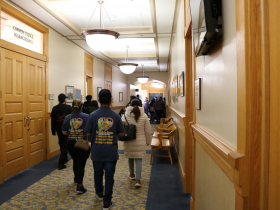
After speaking to the press in the rotunda, attendees moved to a committee room on the building’s third floor, where the Public Safety and Health Committee was scheduled to meet at 9 a.m.
Photos
Existing members must be signed in to see the interactive map. Sign in.
If you think stories like this are important, become a member of Urban Milwaukee and help support real, independent journalism. Plus you get some cool added benefits.
More about the 2026 Food Truck Regulations
- Council Delays Proposal to Fence Off Downtown Bar Districts - Jeramey Jannene - May 12th, 2026
- Not Just Food Trucks, Milwaukee Restricting Late Night Scooter Rides - Jeramey Jannene - May 12th, 2026
- Judge Blocks Milwaukee Ordinance Limiting Food Trucks Hours - Evan Casey - May 9th, 2026
- Lawsuit Seeks to Block Food Truck Curfew - Sophie Bolich - May 7th, 2026
- Food Truck Operators Rally at City Hall - Sophie Bolich - Apr 30th, 2026
- Milwaukee Takes First Step Toward Fencing Off Bar District - Jeramey Jannene - Apr 29th, 2026
- Downtown Food Truck Operators Balk at New Curfew - Sophie Bolich - Apr 27th, 2026
Read more about 2026 Food Truck Regulations here
Political Contributions Tracker
Displaying political contributions between people mentioned in this story. Learn more.
- February 20, 2016 - Cavalier Johnson received $250 from Robert Bauman













Bad move Johnson and Bauman.
Just like the “no” liquor restrictions on gallery night.
I wonder if Bauman and Johnson are getting kickbacks from the Restaurant lobby and the Bar and Tavern league, this stinks of corruptin.
We live in a violent society. Closing food trucks early will not stem the problem of the violence we have in our city. Ald Bauman has made a career out of being short sighted.