

What Does A Rising Assessment Mean For My Taxes?
The average property value increased 6% in Milwaukee. How will that affect you?
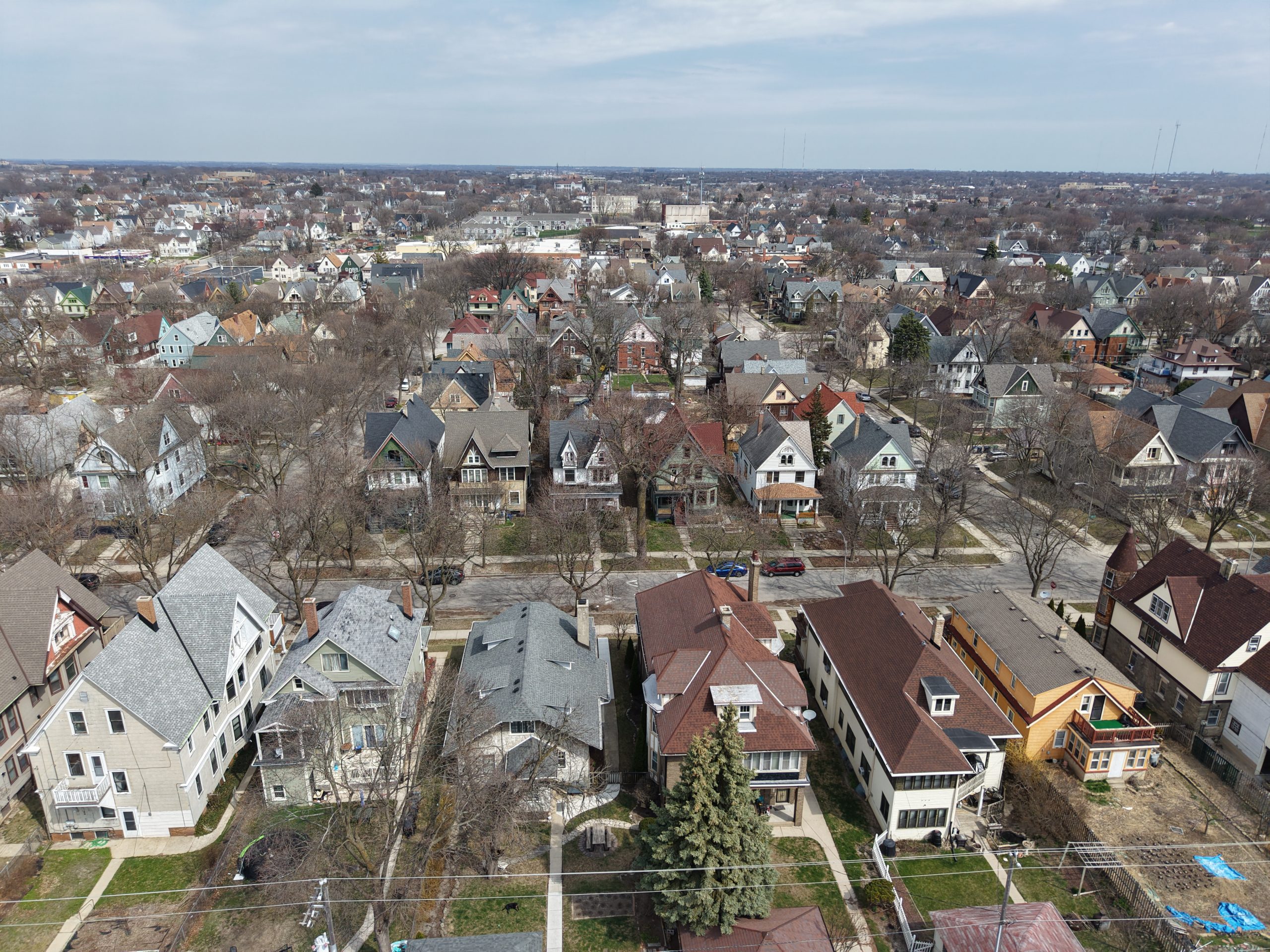
Houses in the Cold Spring Park neighborhood. Photo by Jeramey Jannene.
In addition to orange barrels and green grass, another sign of spring has sprung: the City of Milwaukee has released its annual property assessments.
The process often elicits a mixture of shock and concern, but understanding how it works and what the results mean can drastically change one’s perception.
The most important thing to know is that the process does not directly affect how much money the city or other local governments can collect. The amount of property tax revenue collected, the levy, is set by a separate process and capped by state law based on new construction and a small inflationary increase. If the city conspired to double the value of each property, it would then need to cut the tax rate in half, so there would be no point in doing this.
Why do assessments?
As defined and governed by state statute 70.05, the assessment process is used to determine the fair market value of each of the more than 150,000 properties in Milwaukee.
Generally speaking, fair market value is the amount an owner could expect to receive when selling their property. Even if no changes were made to a property, its value could increase if the real estate market improves.
State law requires a citywide assessment every five years, but the City of Milwaukee elects to calculate each property’s value annually.
The value of each property is calculated using a mixture of property conditions, location and arm’s-length sales of similar properties. The calculation includes the land, any primary structures on it (improvements) and accessory items like swimming pools or sheds (yard items).
How do assessments connect to property taxes?
While increasing or decreasing assessments does not change the amount of money Milwaukee or any other taxing entity can collect, assessments are connected to property taxes.
The linkage can best be compared to dividing a check at a restaurant, a metaphor first offered several years ago by Ald. Scott Spiker. Assessments determine the portion of the property tax levy each property owner will pay by calculating each property’s share of the total. Higher-value homes, like big eaters, are set up to pay a larger share of the bill.
A very rough rule of thumb for understanding the impact on an individual property is that if a property’s value increases by less than the citywide average, the property tax bill will not grow and may even shrink.
According to an Assessor’s Office report, the assessed value of all residential and commercial property in Milwaukee increased 6% year over year. If an individual property increased in value by less than 6%, the owner is likely to see a smaller property tax bill than the year before, once levies are finalized in the fall.
How do I contest my assessment?
A formal process, with a tight timeline, exists to challenge an assessment.
For large apartment buildings or commercial buildings with complex income-based calculations, property owners may use attorneys and ultimately end up fighting in court.
But many homeowners are able to contest their assessment on their own or with the guidance of a real estate agent.
Issues can often be tied to inaccurate data about the property itself, including its size or condition, or may involve disagreements about comparable property sales.
Property owners have until Monday, May 18, at 4:45 p.m. to file an appeal, which can first be reviewed under the Open Book process. If the Assessor’s Office declines to make any change, property owners may then appeal to the city’s Board of Review and ultimately to the state court system.
More information is available on the Assessor’s Office website.
Nicole Larsen has served as the assessment commissioner since 2022. Ryan Ranker is the chief assessor and Larsen’s deputy.
What does the latest assessment show?
After two years of double-digit percentage increases, Milwaukee’s property assessments continued to rise in 2026 but at a notably slower pace.
Citywide assessed values grew by 6%, climbing from $46.7 billion to $49.5 billion, according to the Assessor’s Office. Residential property values increased 6.43% overall, with the median home rising from $192,700 to $207,400 and the average value reaching $224,124. The more modest growth follows a 15.4% increase in 2025 and a 17.4% jump in 2024.
The latest figures also show a more balanced pattern between property types and across the city. Commercial values increased 5.31%, slightly trailing residential growth, a reversal from 2025 when commercial gains outpaced homeowners.
Assessment changes varied widely by neighborhood, with residential increases ranging from a 3.08% gain on the East Side and in Riverwest (3rd District) to more than 13% in parts of the central city (the 7th District centered on W. Fond du Lac Avenue and N. Sherman Boulevard). Despite the small percentage increase, the average residential value in the 3rd District remains the second highest at $395,911 and increased by a dollar amount ($11,839) not as far out of line as the 10-percentage-point spread with the 7th District ($18,191) might suggest.
The most notable shift occurred in Downtown, where the data points to a split within the residential market. In the 4th District, which also includes the Near West Side, overall residential values declined 1.42%, driven by a 2.05% drop in condominium values, even as one- to three-unit homes in the district continued to appreciate. The result is a rare overall decline in the city’s highest-value district, suggesting softening demand or price corrections in the condo-heavy downtown core.
The 12th District, which includes Walker’s Point, also saw its condo values dip 1.27%. The 3rd District, to the north of downtown, saw its condo values increase 1.67%, and the 6th District, northwest of downtown, saw its condo values increase 0.33%.
Apartments are assessed separately from condominiums and saw far more robust and consistent increases. The citywide average was 6.53%, with 5.08% in the 4th District. Apartment assessed value is included with commercial, not residential, property.
UPDATE: The name of the chief assessor was corrected on account of a retirement and a typo in the due date was corrected.
Legislation Link - Urban Milwaukee members see direct links to legislation mentioned in this article. Join today
If you think stories like this are important, become a member of Urban Milwaukee and help support real, independent journalism. Plus you get some cool added benefits.
Political Contributions Tracker
Displaying political contributions between people mentioned in this story. Learn more.





















Deadline is Monday May 18 (not 20).
Thank you Cindy, I had conflated the number of the first day of Open Book (April 20) with the last day (May 18).