DOJ Sues Wisconsin For Voter Data, But Legal Experts See A Different Motive
Civil rights law is at the center of a fight some say is really about stoking doubt in election results ahead of 2026 and 2028 races.
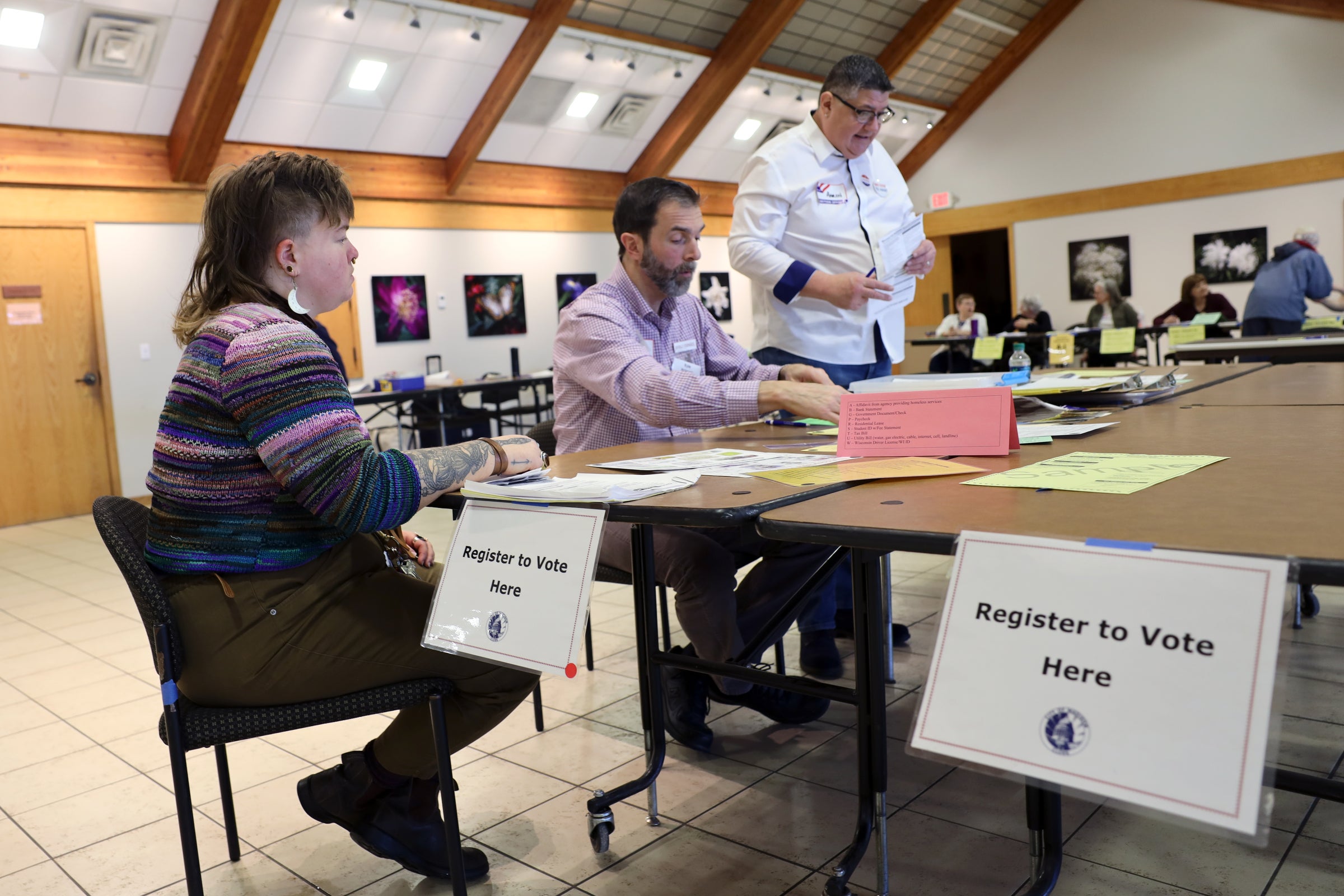
Alix Yarrow, left, registers to vote at the polling place at Olbrich Botanical Gardens in Madison, Wis., on Feb. 18, 2020. (Coburn Dukehart/Wisconsin Watch)
Wisconsin is one of 29 states being sued by the U.S. Department of Justice to turn over sensitive voter data, and state election officials have asked a federal judge to dismiss the case.
Legal experts say the push by the federal government to go after the data is an attempt to scrutinize voter registration lists and part of President Donald Trump’s ongoing efforts to sow distrust in elections.
The U.S. Department of Justice’s Civil Rights Division sued the Wisconsin Elections Commission in December after WEC Administrator Meagan Wolfe refused to hand over unredacted voter registration data containing driver’s license numbers, addresses and the last four digits of voters’ Social Security numbers.
The U.S. DOJ claims a provision in the federal Civil Rights Act of 1960 requires the state to hand over the data upon request by the U.S. attorney general in order to verify Wisconsin is complying with the Help America Vote Act and National Voter Registration Act. The DOJ’s complaint also states courts can’t block the data request under the Civil Rights Act, arguing judges can only rule on whether a request has been made or if state election officials have been given reasonable notice.
The elections commission asked a federal judge to dismiss the lawsuit on Feb. 2, stating it already provided publicly available data on Wisconsin’s 3.6 million registered voters. It also claimed the DOJ changed the legal justification for its request and landed on the Civil Rights Act, which is aimed at preventing discrimination of Black voters and doesn’t entitle the federal government to the state’s unredacted list.
“US DOJ does not allege that its proposed audit would enforce the Civil Rights Act of 1960, other civil rights laws, or any constitutional amendment, ” said the WEC motion. “Nor could it. US DOJ’s concern appears to be that Wisconsin is not removing ineligible voters from its rolls fast enough.”
In response, the DOJ filed a motion on March 2, claiming the elections commission is misreading the Civil Rights Act, which it argues doesn’t only apply to discrimination claims. It cited an identical case in Michigan, stating a federal court rejected the same arguments made by the commission. The DOJ’s lawsuit in Michigan, however, had already been dismissed when it made the reference to the federal judge in Wisconsin.
Two other DOJ voter roll lawsuits have been dismissed in California and Oregon.
The DOJ and elections commission are now awaiting an order on the motion to dismiss the case and the motion to compel the state to hand over the sensitive voter data.
Derek Clinger, a senior attorney with the University of Wisconsin-Madison’s State Democracy Research Initiative, told WPR the federal government’s use of the Civil Rights Act is an interesting approach.
“You’ve got this tricky interpretive question about whether or not this law written in 1960 was meant to apply to the concept of a statewide voter registration list, which did not exist for another four decades,” Clinger said.
Eileen O’Connor, a senior attorney with the Brennan Center for Justice, has been tracking the federal government’s attempts to get state voter registration data. She said the DOJ has demanded records from “at least 47 states plus the District of Columbia” and has sued 29, including Wisconsin. She said the U.S. Constitution is clear that election administration is run by states and court records of agreements between some of them and the DOJ show the department “plans to run some sort of matching.”
“They don’t say how they’re going to do it, what databases they would use, who would do it,” said O’Connor. “They say they’re going to give it to a contractor to do it, and then they’ll send a list of individual names back to the state, and the states are supposed to agree to remove those voters, which turns election administration upside down.”
O’Connor said, more broadly, those leading the litigation “are the same people who spent just endless time after the 2020 election calling into doubt the results of the 2020 election.”
“It is an attempt to sow distrust in the system so that if the results are not what they want, they can say, ‘oh, there’s fraud,’” said O’Connor.
The filings in Wisconsin have been signed by Harmeet Dhillon, the head of the U.S. DOJ’s Civil Rights Division, Eric Neff, the acting chief of the division’s voting section, and trial attorney Brittany Bennett.
Dhillon served as President Donald Trump’s campaign attorney as he unsuccessfully tried to overturn his 2020 loss in court. Neff was previously placed on administrative leave when he worked for the Los Angeles District Attorney’s office over claims of misconduct while prosecuting a Michigan software company used by election officials. Bennett was previously an attorney in Georgia who filed a legal brief supporting a lawsuit from the state’s Republican Party aimed at banning Dominion Voting machines, which was dismissed last year.
Wisconsin election officials pushing back against US DOJ lawsuit seeking voter list was originally published by Wisconsin Public Radio.
If you think stories like this are important, become a member of Urban Milwaukee and help support real, independent journalism. Plus you get some cool added benefits.