
WI Supreme Court Could Order More School Aid
Lawsuit says current system violates state constitution and 2000 court ruling.
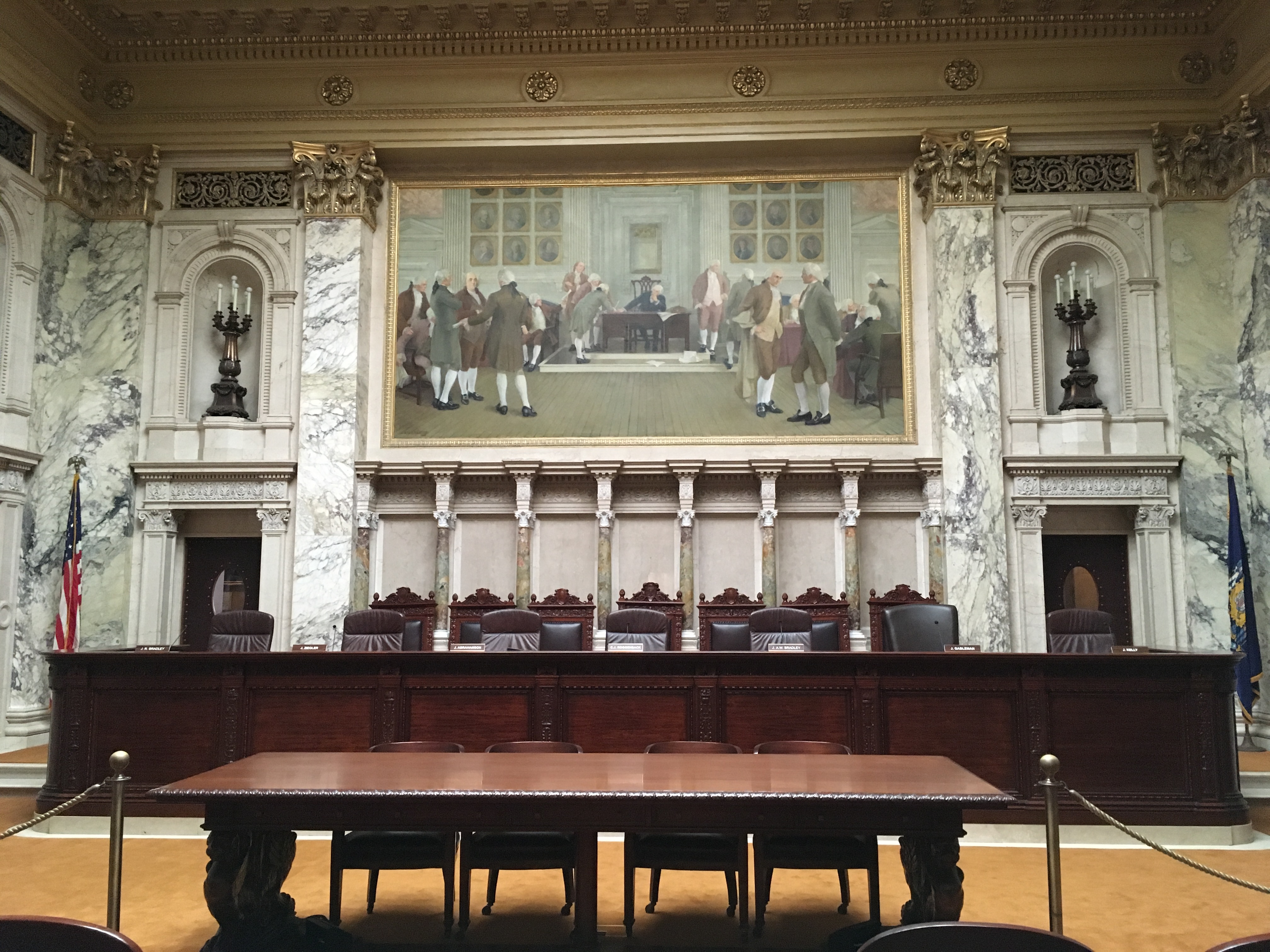
Wisconsin Supreme Court. Photo by Mariiana Tzotcheva.
A lawsuit seeking to overturn how Wisconsin pays for K-12 schools asks the state Supreme Court to develop and implement a new school finance system if the governor and Legislature ignore a ruling that the current system is unconstitutional.
That is a blunt reminder of a previous court order, in 2024, that directed Republicans, who control the Legislature, and Gov. Tony Evers to draw new legislative district lines or have the seven justices draw them.
In the face of that threat, Evers and Republicans agreed on new legislative boundaries before the 2024 elections.
The new warning of the court’s potential ultimate authority over school funding is deliberate, says Jeff Mandell, whose nonprofit firm, Law Forward, filed the new suit on behalf of five school districts, eight parents, local units of the Wisconsin Education Association Council, Wisconsin PTA and the Wisconsin Public Education Network.
“Yes, there’s a parallel to the redistricting remedy,” Mandell said last week.
“The court’s role is to say what the law is, but it’s appropriate in a case like this to then give the political branches an opportunity to fashion a solution, while holding leverage if they fail to do so.”
Named in the suit are legislative leaders of both parties and the Legislature’s Joint Finance Committee, which drafts the state government’s two-year budgets. The constitution “charges the Legislature with the duty to fund public schools,” Mandell explains.
Beloit, Adams-Friendship, Eau Claire, Green Bay and Necedah school districts joined the lawsuit.
The 97-page suit includes details of how each of those districts is crippled by current funding formulas, how they have cut programs and staff, have eliminated other programs to help growing numbers of students with disabilities, and have seen students’ scores on standardized tests fall.
Filed in Eau Claire County Circuit Court, the lawsuit asks that how the state intends to pay $7.8 billion this year as its share of K-12 school costs be found in violation of the state constitution, which says: “The legislature shall provide by law for the establishment of district schools, which shall be as nearly uniform as practicable.”
The lawsuit says a 2000 state Supreme Court ruling, which upheld the way that state government then paid for schools, specified what the constitution requires. In that opinion, the court said, “Wisconsin students have a fundamental right to an equal opportunity for a sound basic education. An equal opportunity for a sound basic education is one that will equip students for their roles as citizens and enable them to succeed economically and personally.”
According to the lawsuit, since that 2000 ruling, state government has “disinvested” in public schools in ways that violate the constitution, including:
– Giving less state aid to districts that have high property values but lower household incomes, forcing them to rely on property taxes. The Adams-Friendship district, for example, must rely on property taxes and fees for 78% of its funding. The result is a wide gap in instructional programs between districts statewide. The lawsuit describes specific negative effects:
– Putting spending limits on school districts to control property taxes forces districts to schedule referendums to continue core programs.
– School districts across Wisconsin are now facing structural budget deficits that leave them little choice but to seek voter approval via referendums to fund school operating expenses through local property tax increases. In a recent year, one-third of referendums failed.
– Giving charter schools more money reduces money available for special education programs in public schools.
– Independent charter schools now receive per-pupil state aid payments in an amount ($12,369 in the 2025-2026 school year) that exceeds the low revenue ceiling threshold for public school districts ($11,000 in the 2025–2026 school year).
– Continuing unequal funding has resulted in falling scores on standardized tests. “Between the 1999-2000 and 2022-2023 school years, statewide fourth grade reading proficiency dropped from 78% to 44.8% (a 43% decline) and statewide eighth grade math proficiency dropped from 42% to 30.5% (a 27% decline).”
If the governor and Legislature don’t respond to a ruling that the current system is unconstitutional, the suit asks that the court “establish a schedule that will enable the court … to adopt and implement a new school finance system that meets all relevant state constitutional guarantees.”
In a statement, Assembly Speaker Robin Vos dismissed the suit as “another meritless attempt by liberal activists to defund the state’s highly successful school-voucher program and interfere with the Legislature’s authority to fund public schools…. The courts will soundly reject it.”
Steven Walters started covering the Capitol in 1988. Contact him at stevenscotwalters@gmail.com.
If you think stories like this are important, become a member of Urban Milwaukee and help support real, independent journalism. Plus you get some cool added benefits.


The State of Politics
-
Lt Governor Race Offers Stark Contrasts
 Oct 19th, 2026 by Steven Walters
-
Will Fox Valley Voters Disappoint Democrats?
 Oct 12th, 2026 by Steven Walters
-
Will Voters Reject Three Constitutional Amendments?
 Oct 5th, 2026 by Steven Walters


















I’m not sure if there is a Constitutional Authority to fund private schools. There does seem to be authority to establish district schools and to fund them. District schools should be tuition-free for all children. A private school has tuition.
“SECTION 3. [As amended April 1972] The legislature shall provide by law for the establishment of district schools, which shall be as nearly uniform as practicable; and such schools shall be free and without charge for tuition to all children between the ages of 4 and 20 years; and no sectarian instruction shall be allowed therein; but the legislature by law may, for the purpose of religious instruction outside the district schools, authorize the release of students during regular school hours. [1969 J.R. 37, 1971 J.R. 28, vote April 1972].”
Instead of holding the leadership of public schools accountable for performance. State – taxpayer money is being given to a for-profit school? What about a law suspending the Wisconsin Department of Public Instruction Superintendent’s or Principals’ License when there is no improvement in student outcomes? No payout or extra money to end a contract. If there is no improvement, the Superintendent or Principal can return to teaching in the classroom.
So, instead of holding those in leadership positions accountable for student performance, the State Government in Wisconsin just gives money to a private school. Where is this authorized in the Wisconsin State Constitution?