

Legal Groups Warn AI Court Interpreters Could Jeopardize Rights
Backers say the bill cuts costs, but critics say errors could send people to jail unfairly.
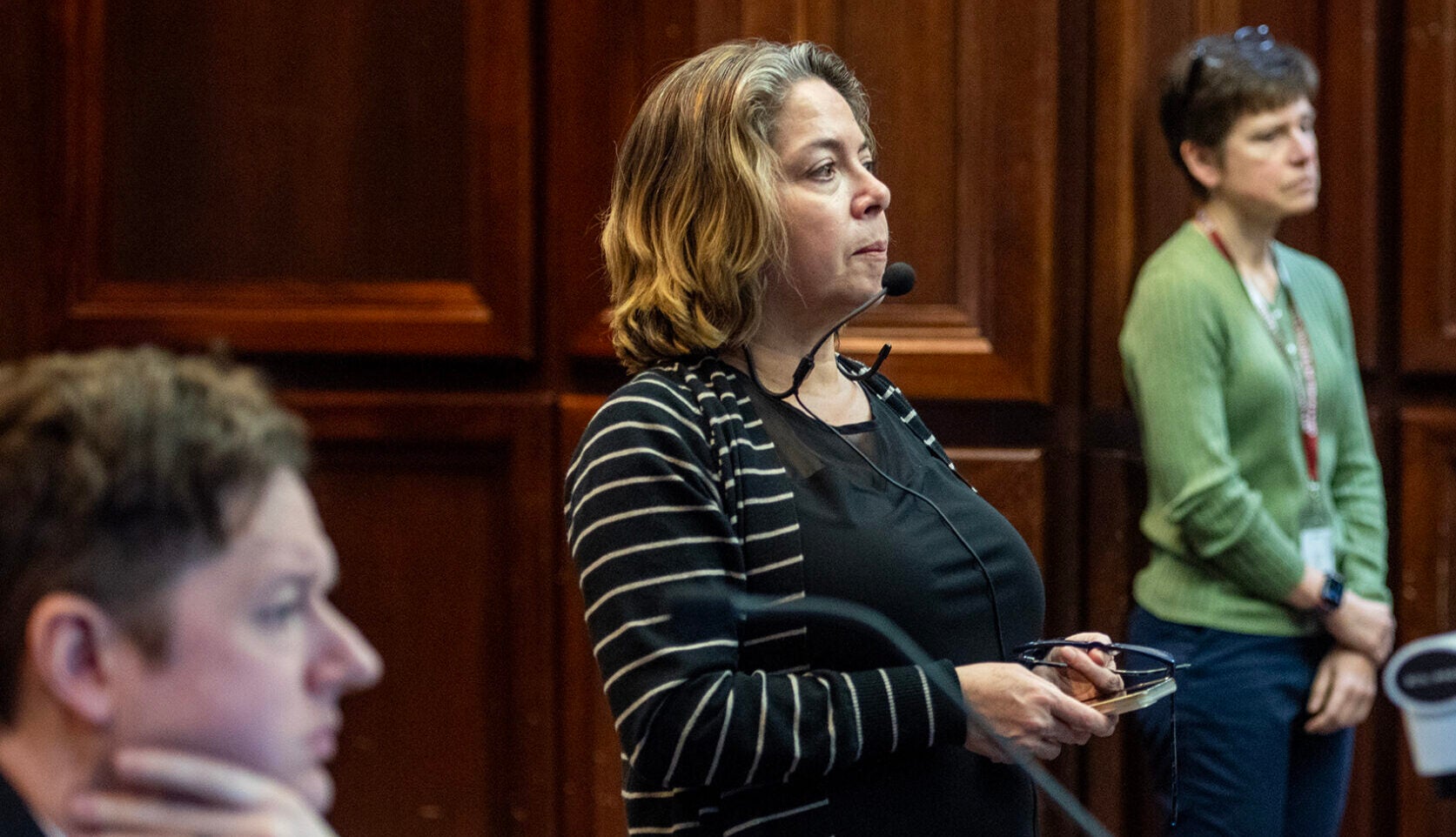
Reme Bashi, left, and Floralba Vivas, right, interpret from Spanish to English and English to Spanish during a sentencing hearing on Friday, March 21, 2025, in Milwaukee, Wis. Angela Major/WPR
Legal advocates are raising alarms about a bill that would allow Wisconsin courts to use interpretation assisted by artificial intelligence.
Republican sponsors say they introduced the bill to cut back on costs and alleviate a statewide shortage of court interpreters.
The proposal would “employ rapidly improving AI and other technology to save local governments from burdensome expenses,” said state Sen. André Jacque, R- New Franken, during a hearing Tuesday.
But critics warned the proposal could lead to costly mistakes and open the door for rulings to be appealed.
Under Wisconsin law, people with limited English proficiency have the right to a qualified interpreter when they appear before a circuit or appellate court.
That applies to witnesses, people charged with crimes, victims and the family members of victims.
Amanda Merkwae with American Civil Liberties of Wisconsin said the proposal risks violating the rights of both victims and defendants.
AI interpretation is known to be “dangerously inaccurate in the legal context,” where mistakes could result in someone going to jail or losing custody of their child, Merkwae said.
She pointed to research from the Stanford Legal Design Lab, in which AI mistranslated “trial” as “test,” and “due date” as “date to give birth.”
Karen Nguyen, an American Sign Language interpreter who teaches at the University of Wisconsin-Milwaukee, told lawmakers that AI often misses nuance and cultural context.
“Everyone in this room probably knows the difference between a booty call and a butt dial,” Nguyen said, prompting chuckles from some lawmakers.
“Misconstruing the two would lead to consequences of embarrassing proportions,” she continued. “But put this in the context of high-risk stakes, and this result doesn’t elicit laughter anymore.”
The State Bar of Wisconsin and Disability Rights Wisconsin are among the groups that have registered against the bill.
Bill amended to exempt ‘violent crime’ proceedings
In response to some of those objections, Republicans have amended the bill to specify that AI interpretation could not be used in situations where someone is accused of a “violent” crime.
But advocates say their concerns remain.
The right to an interpreter applies to people who are deaf and hard of hearing, and members of that community warned lawmakers that AI is not prepared to accurately translate American Sign Language.
“American Sign Language is a whole different modality that uses hand movement, body movement and facial expressions,” Jenny Buechner with the Wisconsin Association of the Deaf said while speaking through an interpreter. “But that is not captured in any written or spoken language.”
Another amendment to the bill would allow Wisconsin courts to use virtual interpreters during trials if the parties involved agree. Those interpreters would be allowed to provide services over video or telephone conference instead of in-person.
The bill would also designate English as Wisconsin’s official language. Last month, it cleared the Assembly, with Republican Jessie Rodriguez of Oak Creek joining Democrats in voting against.
In a statement provided to WPR, Rodriguez said she’s concerned about AI-fueled inaccuracies.
“I understand that there is a shortage of interpreters in the legal field,” the statement said. “I don’t believe this bill would accurately help the parties in such cases and give effective or accurate information given the different terms and idioms in many languages.”
The proposal still needs to clear Wisconsin’s GOP-controlled Assembly. Democratic Gov. Tony Evers’ office did not respond to a question about whether he’d veto it if it got to his desk.
Other interpreter bills have stalled
Last month, Wisconsin’s Assembly wrapped up its regularly scheduled business for the rest of the legislative session. And several bills related to court interpreters appear to have died along with that action.
One bill from Sen. Van Wanggaard, R- Racine, and Rep. Cindi Duchow, R – Town of Delafield, would have allowed Wisconsin courts to use virtual interpreters during civil or criminal trials. Under that proposal, those interpreters would still need to be real, live humans, but they would be allowed to appear via video or telephone conference if the parties involved in the trial agreed.
That bill has never got to an Assembly vote.
Another bill from Rep. Dave Maxey, R-New Berlin, and Sen. Chris Kapenga, R- Delafield, sought to allow AI-assisted interpretation in Wisconsin courts, but it never got a floor vote. That stalled bill also would have allowed virtual interpreters during trials.
Legal advocates object to bill to allow AI interpretation in court was originally published by Wisconsin Public Radio.
If you think stories like this are important, become a member of Urban Milwaukee and help support real, independent journalism. Plus you get some cool added benefits.





















Two very AUTHENTIC things ARTIFICIAL Intelligence provides
are human error and hallucinations.
Forty years ago I was an ASL interpreter in Iowa. Today I could not interpret due to the numerous changes in slang and idioms. Our languge is alive and changes daily. Who is going to update the understanding of our language?