

Assembly Backs Race-Neutral Aid And Campus Speech Suits, Eyes Trans Care
GOP bills target DEI, free speech, trans issues. Democrats object.
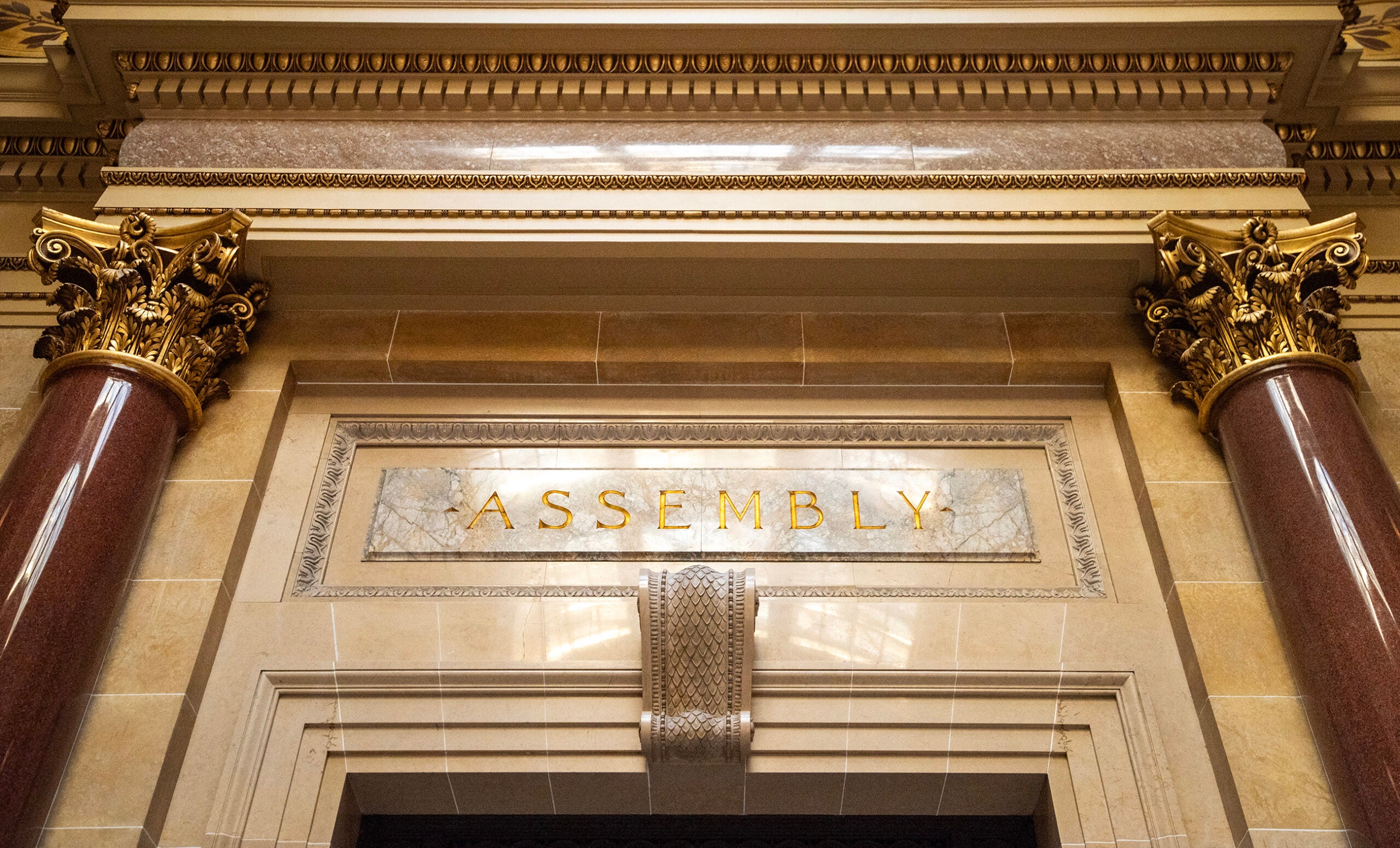
The door to the Wisconsin State Assembly on Monday, July 14, 2025, at the Wisconsin State Capitol in Madison, Wis. Angela Major/WPR
In moves they described as efforts to make the state’s higher education system more meritocratic and safe for conservative students, Assembly Republicans voted Thursday to change eligibility for certain financial aid programs, and make it easier to sue universities for free speech violations.
One proposal that would affect state schools would remove race-based criteria for certain higher education programs, like a teacher loan program and undergraduate grants for students from certain minority racial backgrounds. Instead, it would replace those ethnic criteria with a wider range of “social and economic disadvantage” criteria, “without regard to race or sex.”
The bill passed one day after the Wisconsin Supreme Court heard arguments in a case that could have significant implications for how the state can consider race in academic-adjacent matters. That question comes after a U.S. Supreme Court ruling that significantly curtailed race-based college admissions.
Rep. Supreme Moore Omokunde, D-Milwaukee, called the proposal “racist.”
“You’re trying to change these programs to ‘serve the disadvantaged,’ and in defining ‘disadvantaged,’ you’re either ignorant or mean as hell to suggest that all of these elements, including race and sex, are not interconnected in our society,” he said.
The bill’s author, Rep. Jim Piwowarczyk, R-Hubertus, called it “the exact opposite of racist.”
“This bill updates Wisconsin’s higher education programs by focusing resources on students who face genuine barriers to success,” he said. “This bill preserves these (grant and loan) programs while modernizing their focus so that they reach students who are most at risk of being left behind.”
And Republicans argued that the proposal to penalize state colleges and universities for free speech violations would strengthen First Amendment protections on campuses. The bill would establish clear safeguards for discipline against expressions or speech, and allow the Board of Regents or the Universities of Wisconsin to be subject to court action if a student or employee feels their rights have been violated.

UW-Madison students walk on campus Tuesday, May 6, 2025, in Madison, Wis. Angela Major/WPR
The proposal comes after a 2023 survey indicated that conservative students constitute a minority on UW campuses, and that there was a diversity of opinions over whether speakers with potentially offensive ideas should be disinvited from speaking on campus.
Rep. Angela Stroud, D-Ashland, argued that the bill “misdiagnoses the problem it’s trying to solve.”
“Political division, an unwillingness to speak up, fear of censure or even tolerance of political violence — these are problems in our culture, broadly,” she said. “Passing a bill that offers a punitive solution to a cultural problem will only force campuses to hire more lawyers. It won’t touch the underlying issue.”
Emotional debate over gender-affirming care bill
Assembly Republicans also voted to establish a way for people to sue medical providers who provided them with gender-affirming care, if the person later decides the procedure harmed them.
The state Legislature has weighed in several times over this session on issues related to transgender health care, including in the state Senate Wednesday, especially as it relates to trans children. While Gov. Tony Evers has pledged to veto any bill that he sees as restricting the rights of LGBTQ+ young people, it’s a cultural wedge issue in an election year.
The bill passed on Thursday would create a civil cause of action for a person who underwent gender transition procedures as a minor and then determines that they were injured by the procedure. The bill’s co-author, Rep. Amanda Nedweski, R-Pleasant Prairie, pointed to a recent $2 million settlement in New York state, that could set a precedent for these kinds of malpractice suits.
In that case, a woman who received a double mastectomy at 16, when she was identifying as a boy, sued her psychologist and plastic surgeon, after she detransitioned later and said her medical team didn’t adequately explain the risks of the procedures.
Nedweski said that people who detransition, which may account for between 5 and 10 percent of people who receive gender-affirming care as minors, should have recourse.
“Medical accountability should not be partisan,” she said. “(This bill) simply ensures that a minor harmed by a gender transition procedure in Wisconsin has the same legal rights as the victim of a botched appendectomy.”
Supporters of trans rights say that gender-affirming care is a personal matter best left to families to decide and rarely involves invasive surgery. Rep. Ryan Clancy, D-Milwaukee, who is a member of a lawmakers caucus for parents of trans children, became choked up as he described the mental health effects on some young people who do not receive care for gender dysphoria.
“How many children’s lives are we willing to jeopardize or to lose to give Republicans fodder for their campaigns? How many kids have to die so you can use our children to distract from your failures to pass policy which would improve lives instead of putting them at risk?” he said. “Gender-affirming care for our children saves lives. Taking it away kills them.”
The spectrum of medical care that young people questioning their gender can receive — like puberty blockers or hormone treatments — is subject to heated debate inside Wisconsin and beyond. Gender issues have been a cornerstone of President Donald Trump’s cultural agenda in the White House, and he’s signed executive orders limiting minors’ access to gender-affirming care.
But many medical associations endorse treatment on similar mental health grounds to those that Clancy raised. One exception is the American Society of Plastic Surgeons, which earlier this week issued a new recommendation that its members reserve gender-related chest, genital and facial surgeries until after a person turns 19.
Nedweski said that the bill would subject practitioners offering gender-related care to the same oversight as any other medical professional.
Clancy argued that the bill would just make medical professionals afraid to treat gender issues.
A slate of bills responds to changes to administrative rulemaking
Months after the state Supreme Court issued a consequential decision overturning a longstanding approach to issuing administrative rules, GOP lawmakers approved a slate of bills aimed at giving some power back to the Legislature.
Administrative rules are the details of how a law is applied, written by agency staff, usually hired or appointed by a governor and reflecting a governor’s priorities. Before last summer, the Legislature’s Joint Committee for Review of Administrative Rules would indefinitely block rules it didn’t like. But in July 2025, the high court’s liberal majority found that this essentially gave a very small number of legislators too much power to stop rules from going into effect.
That sparked a long power struggle between Gov. Tony Evers and GOP leadership in the Legislature. Republicans attempted other means of pausing rules they didn’t like, and Evers eventually sued them for those maneuvers.
The Assembly bills approved Thursday would, in combination, hand more oversight of rulemaking back to the Legislature and make rules a little less powerful overall. The legislation would create an expiration date for rules, make it easier for advocates to sue over the validity of a rule, tighten the scope of what rules can touch and add stricter oversight if the rule will likely lead to $10 million or more in compliance or implementation costs.
The Assembly also passed a proposed constitutional amendment that would allow the Legislature to vote to pause or indefinitely suspend a rule. That would give a majority of the Legislature — rather than a small handful of members of a legislative committee — oversight, which addresses a key concern of the Wisconsin Supreme Court’s decision.
While it’s unlikely that Evers will sign off on bills that would restrict his administration’s power, he has no power over constitutional amendments. This proposal would have to pass another session of the Legislature before it could go to voters for final approval or rejection.
Wisconsin Assembly passes bill removing race-based higher ed programs was originally published by Wisconsin Public Radio.
If you think stories like this are important, become a member of Urban Milwaukee and help support real, independent journalism. Plus you get some cool added benefits.





















If the ‘rules’ changes do come to citzenry for a vote, I hope all the media perform due diligence and explain the pros and cons. Repeatedly and in an unbiased manner.
We all know that legislators will present their positions.
The devil is in the language used on the ballots. YES often sounds like a NO, and vice versa. These kinds of things need to very clearly worded and understood well. Otherwise, it’s a game of manipulation by politicians.