

Madison Election Suit Could Affect 1,900 Election Clerks
Are absentee ballots a right? Can voters sue for monetary damages if there's a mistake?
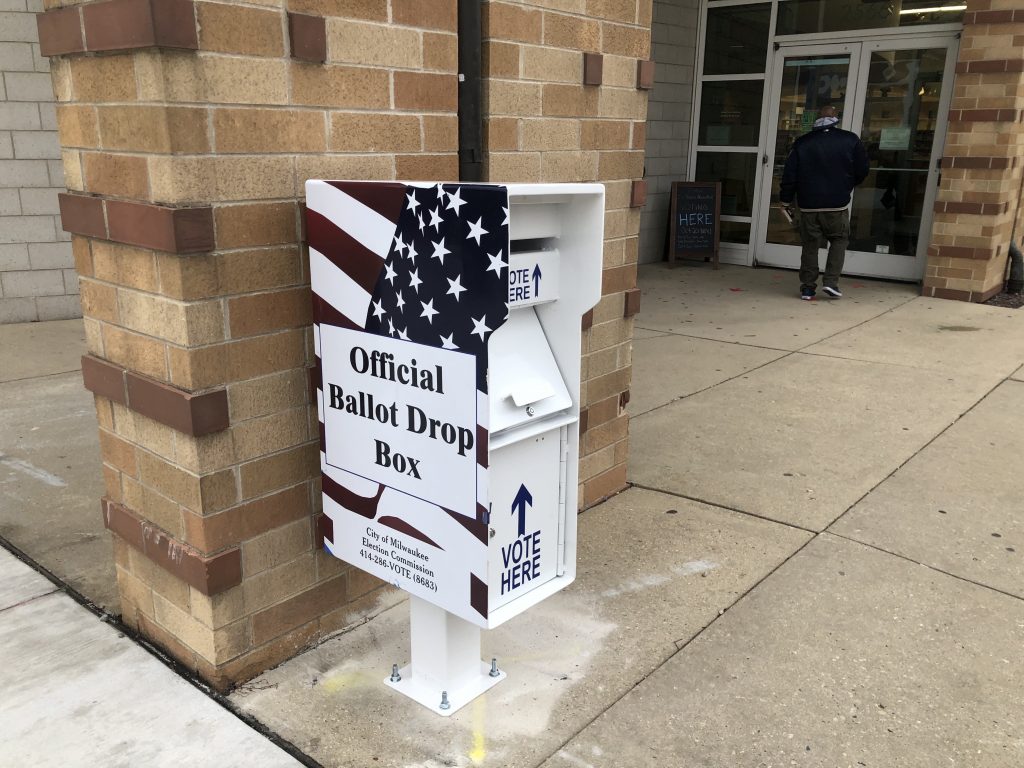
A ballot drop box outside the Bay View Library. Photo by Jeramey Jannene.
The outcome of a lawsuit over Madison’s failure to count 193 absentee ballots in November’s presidential election looms over future elections.
The impact could be significant: More voters are casting absentee ballots and Wisconsin’s statewide elections are often decided by very close margins. President Donald Trump won Wisconsin last November by only 29,397 votes out of 3.3 million votes cast.
A veteran member of the Wisconsin Elections Commission, Don Millis, said Madison’s legal response to the lawsuit filed over the uncounted ballots is similar to the November 2020 attempt by President Trump’s campaign to throw out more than 200,000 absentee ballots cast in Dane and Milwaukee counties.
Wrong, said Madison City Attorney Michael Haas. “The city’s legal position bears no resemblance to the unserious effort to invalidate all absentee ballots that were lawfully cast and counted as part of the attempt to support the fake elector scheme and overturn the results of the valid 2020 election,” Haas said in a statement.
“Madison has a long history of supporting absentee voting and has been a leader in promoting and protecting that option and will continue to do so,” adds Haas, a former staff counsel to the Wisconsin Elections Commission.
Haas said the lawsuit filed by some voters whose absentee ballots were not counted could set a dangerous precedent for all local governments whose clerks conduct elections. There are more than 1,900 such clerks handling elections in Wisconsin.
“The primary issue in the lawsuit is whether the state Constitution or state statutes allow voters to recover money from a municipality when their absentee ballots are inadvertently not timely counted in an election,” Haas says.
Madison “takes this effort to create new law seriously and opposes it because, in addition to affecting [Madison], it will also affect municipalities across the state which could be on the hook to pay damages whenever a human error is made by election staff or poll workers,” Haas added.
Millis objected to the primary argument made by the city’s lawyers in their response to the lawsuit that seeks damages for uncounted votes. In a court filing, the lawyers, representing former Madison Clerk Maribeth Witzel-Behl, who resigned in the wake of the uncounted ballots, and city officials, say that voters lost their constitutional right to vote when they cast absentee ballots.
Voters who sued “describe the right to vote as ‘fundamental’ and ‘sacred,’ and cite a century-old precedent that the right to vote ‘may not under our Constitution be destroyed or even unreasonably restricted,” the filing reads.
“These points are undoubtedly true. However, the manner in which [voters] exercised their right to vote – by absentee ballot – took the process out of its core constitutional protection. When the absentee process unfortunately results in a vote not being counted, it is not a violation of a constitutional right.”
Wrong, Millis says in a statement. A Republican appointee to the Elections Commission, he has been a member of boards and commissions overseeing elections for years.
“While the option to cast an absentee ballot is not guaranteed by the Constitution, as soon as Wisconsin permitted absentee voting, voters casting absentee ballots in accordance with law have the absolute constitutional right to have their votes counted,” Millis said.
Millis said the city’s argument is basically what the Trump’s campaign argued in November 2000, after he lost his campaign for a second term. Then, Trump campaign lawyers said that more than 200,000 “absentee ballots cast in Dane and Milwaukee counties should not be counted” — a request Wisconsin judges rejected.
In a Jan. 23 statement, Madison officials said “all forms of voting — including absentee voting — should be encouraged, promoted and protected.”
“A mistake was made,” city officials added. But, “Our laws do not provide voters with monetary compensation for mishandling an absentee ballot…[A]attaching a dollar value to a vote, when human mistakes occur in elections, would end up regularly costing cities, towns and municipalities hundreds, thousands — or in this case millions — of dollars.”
In a legal brief filed in the case, Gov. Tony Evers also said there is a constitutional right to cast an absentee ballot.
Madison officials didn’t report the 193 uncounted absentee ballots for six weeks, which prompted an Elections Commission investigation that found that laws were broken and recommended changes in city procedures.
Haas says Madison officials have made changes to make sure the November error is not repeated.
Steven Walters started covering the Capitol in 1988. Contact him stevenscotwalters@gmail.com
If you think stories like this are important, become a member of Urban Milwaukee and help support real, independent journalism. Plus you get some cool added benefits.


The State of Politics
-
What Happened to Tax-Cut Negotiations?
 Apr 6th, 2026 by Steven Walters
-
Republicans Badly Divided in Final Senate Session
 Mar 30th, 2026 by Steven Walters
-
Why the Rise in Property Tax Anger?
Mar 16th, 2026 by Steven Walters



















Could “effect”? Maybe it could “affect” them….