

Should All Students Get Free School Lunches?
Gov. Evers supports it. But will it could hurt poorer school districts?
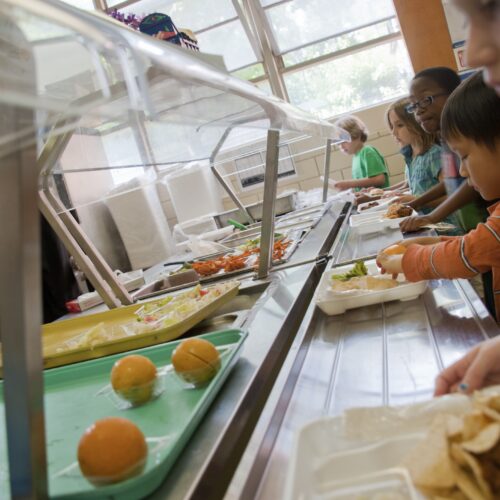
Students get their lunch at a primary school in Atlanta, Georgia. (Amanda Mills | Centers for Disease Control and Prevention)
On Wednesday, Jan. 21, delegates for the Wisconsin Association of School Boards (WASB) passed a resolution that states, “The WASB supports state legislation to establish and fund a universal school meal program to cover the cost of all student meals not covered by federal programs.” The resolution passed with more than two-thirds of the 300-plus delegates voting in favor.
It’s a popular proposal. Renee Slotten-Beauchamp, Milwaukee Public Schools director of nutrition services, has gone to Washington, D.C. to fight for universal meals and is excited the idea is getting more interest.
However, how the program is structured could have a negative economic impact on MPS and other poorer districts. It would require the state to fund student meals in richer districts and could take resources away from students in poorer districts.
MPS already covers all students, as do other Wisconsin schools, through a federal program, Community Eligibility Provision (CEP). Previously, schools had to have at least 40% of students classified as meeting free or reduced-price income levels to be part of CEP. That was reduced to 24%. With the passage of the 2025 federal budget, efforts were made to raise the percentage to 60%. Some larger Wisconsin districts utilize CEP for individual schools, as well as many smaller districts and individual schools. While some schools might have difficulty meeting the 60% should that become law, MPS estimates that more than 65% of its students qualify.
During the COVID-19 pandemic, the federal government provided funding for all schoolchildren regardless of income. That program ended in the 2022-23 school year. Since then, several states saw the benefits of the program and established their own universal meals programs.
Currently, eight states have a universal school meals program. That includes neighboring Minnesota.
A handful of Wisconsin school districts have decided to extend universal meals using their district’s own money. Said one West Allis-West Milwaukee delegate at the WASB meeting, “When COVID ended, our district decided to continue providing lunch and breakfast. We are able to afford that with the existing funds that we have.” The benefits were clear to him and his district. “If a student is hungry, they are not going to achieve.”
Studies point to increased student attendance when high-quality meals are provided. Some researchers even show that breakfast meals in the classroom, rather than in the lunchroom, improve on-time student attendance. MPS has been moving to a “grab-n-go” system, where students pick up the breakfast meals and take them to the classroom.
Student achievement also increases with universal school meals as shown in numerous studies. The quality of school meals has been an issue in MPS. Students are less likely to show up if the meals are not appealing.
In schools not using CEP, individual families must apply for free or reduced-price lunch. But the West Allis-West Milwaukee delegate pointed out the stigma of a student going through a lunch line with a special lunch ID, although federal regulations prohibit overt identification. He added that some parents “will not fill out paperwork or do not have the resources to fill out the paperwork or the understanding,” so it won’t get filled out.
Another delegate at the meeting said, “A lot of families are in economic stress.” Still another said, “We have a lot of families that live on the edges.” Families might be just above the income cutoff for a free lunch, resulting in students coming to school with a substandard lunch from home.
School districts are unlikely to allow a student to go hungry and will provide some kind of meal although not of the quality of the regular school meal. Stated a delegate, “In 2023, Wisconsin had a projected $3 million lunch debt across the state from families who could not pay. So, school districts had to absorb that debt.” The proposal for universal school lunches, the delegate added, “would cost the average taxpayer only $60 per year.”
A year ago, the cost to Minnesota taxpayers for this was estimated at $250 million. But partly because of additional cuts by the federal government in its support for school meal programs and poor projections, the cost is ballooning.
“Free lunches for everybody” in Minnesota is “hundreds of millions of dollars over the projected costs,” said one delegate. “It’s going to compete with all the other priorities to help disadvantaged kids get to where they need to be.” Another delegate put it bluntly, “Feed kids or cut teachers.”
For poorer school districts, a state-sponsored universal school meals program is a two-edged sword. It may mean millions of dollars going to wealthier districts where families can pay for their children’s lunches. And if not properly structured, poorer districts like Milwaukee will have less money to educate their children if the state funding does not increase. The money may come from other educational programs. On the other hand, if the federal government continues to cut school meal programs, any kind of state support for school meals will be a godsend to poorer districts.
There are a number of ways that Wisconsin could provide universal school meals to all students without negatively impacting poorer districts such as Milwaukee. Gov. Tony Evers had touted in his 2026-27 proposed budget the “Healthy Meals, Healthy Kids” program to fully fund school breakfast and lunch for all K-12 kids with no stigma and at no cost to them by providing $147.7 million GPR in fiscal year 2026-27, helping ensure kids can focus on their studies and not whether or when they will eat next. But it was dropped from the budget by Republican legislators. State school superintendent Jill Underly, in her 2025-27 budget, proposed $294 million for this. Given the experience of Minnesota, the amount of funding proposed may not be enough.
Whether the Legislature will eventually consider legislation funding universal school meals remains to be seen. How that might affect poorer school districts like Milwaukee is an even more important question for them.
Correction: The story originally stated the federal government had increased to 60% the required percentage of students eligible for free and reduced-price lunches needed to qualify for federal CEP funding. The measure was discussed but not passed.
If you think stories like this are important, become a member of Urban Milwaukee and help support real, independent journalism. Plus you get some cool added benefits.


K-12 Education
-
Cassellius Betting on Smaller Class Sizes
 Apr 1st, 2026 by Terry Falk
-
Crowd Opposes MPS Staff Cuts
 Mar 11th, 2026 by Terry Falk
-
Cassellius May Use Portable Classrooms for 6th Graders
Feb 23rd, 2026 by Terry Falk




















Id support it IF the kids would eat it. I envision a lot of that “healthy” food being tossed. Pandemic free lunch was a Uncrustable and cheesestick and I found many of them tossed out on my dog walks thru Shorewood HS campus.
It’s always been proven that kids eating leads to better outcomes. Money should not be a barrier to this. Make them free for all.
The quality of the meals is an issue. There is too much reliance on overly processed foods. Serving healthy and nutritious that taste good is possible. Schools in Europe and Asia have managed to do just that.
I think a bigger challenge for Wisconsin school districts is the length of time allotted for lunch. 20 minutes is not sufficient especially if it is the only free time. Students would do better if they had more time to enjoy their food.